


Germany says credibility of Minsk peace deal for eastern Ukraine at stake
WASHINGTON, Feb 29 (Reuters) -- The credibility of the Minsk peace deal for eastern Ukraine will come under threat unless both sides in the conflict make faster progress in implementing the agreement, Germany's foreign minister said on Monday.
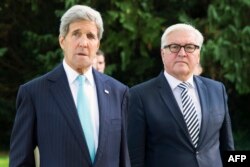
Speaking at a news conference in Washington with U.S. Secretary of State John Kerry, Frank-Walter Steinmeier conceded that the readiness of the government in Kiev and pro-Russian separatists to move forward with Minsk was "very limited".
"Implementation must continue. The credibility of the whole process rests on this," Steinmeier said.
Kerry said "both sides need to perform", and that Russia must ensure that the separatists do their part.
Kiev's struggles to get an election law for eastern Ukraine through parliament and an increase in ceasefire violations in the region have raised fears that the deal, sealed one year ago in the Belarus capital, could collapse, sparking a new wave of fighting.
European countries have tied the removal of sanctions against Russia to the implementation of Minsk. Germany and its allies worry that if Ukraine does not implement its side of the agreement, pressure could rise to ease those sanctions when they expire in July.
Earlier on Monday, Hungarian Prime Minister Viktor Orban warned the European Union against extending the sanctions automatically when they lapse, urging instead a "serious debate" on the matter.
Steinmeier said he hoped that a meeting of the foreign ministers of Germany, France, Russia and Ukraine scheduled to take place on Thursday in Paris would lead to progress on planned elections in eastern Ukraine.
"If elections take place, and everyone says this, then we need two things: first an election law and second security conditions which allow an election to be held," he said. "I hope that we make a small step forward on Thursday."
OSCE Chief Calls For Trust-Building To End Crises In East Ukraine
The Organization for Security and Cooperation in Europe (OSCE) says it remains “deeply concerned” over continuing cease-fire violations in eastern Ukraine.
Addressing the UN Security Council on February 29 as chair of the OSCE, German Foreign Minister Frank-Walter Steinmeier urged Kyiv and Moscow to “live up to their responsibilities” and abide by the terms of the Minsk peace agreement signed a year ago.
Implementing the deal is the only way to a political solution in Ukraine, Steinmeier said.
He said foreign ministers from France, Germany, Russia, and Ukraine would meet in Paris on March 3 to try to achieve progress on the security situation and a new electoral law for eastern Ukraine, where fighting between Russian-Backed separatists and government forces has killed more than 9,000 people since April 2014.
The February 2015 peace agreement has helped reduce fighting in Ukraine's east, but skirmishes have continued.
Based on reporting by AP and dpa
Barring any major developments, that ends the live blogging for today.
A Politico piece arguing Obama's Ukraine policy is "in shambles."
Hungary's Orban says no automatic extension of sanctions against Russia
BUDAPEST, Feb 29 (Reuters) -- The European Union is expected to hold discussions about whether Russia has fulfilled the Minsk agreement on Ukraine and there will not be an automatic extension of sanctions against Moscow, Hungarian Prime Minister Viktor Orban said on Monday.
"At the end of the first half of the year a serious debate can be expected within the EU about the fulfillment of the Minsk agreement," Orban told Hungarian ambassadors.
"In other words, there won't be an automatic extension of sanctions against Russia, and whatever decision we will make, that should be preceded by a calm and objective analysis about the Minsk agreement," he added.
Orban's government has granted a deal to Russia's Rosatom to build new reactors at Hungary's nuclear power plant, and has promoted what it calls a "pragmatic" good relationship with Russia. Orban visited Moscow earlier this month.