


This ends our live blogging for March 19. Be sure to check back tomorrow for our continuing coverage.
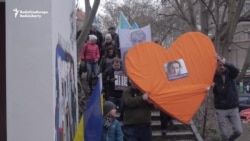
Members of the Crimean Tatar community marched in the Czech capital, Prague, on March 19 to mark the second anniversary of Russia's annexation of the Crimean Peninsula from Ukraine. The Crimean Tatar minority has been strongly critical of the annexation, and their self-governing body, the Mejlis, has refused to recognize the change of government. Marchers including Mejlis head Refat Chubarov walked up Prague's Krymska, or Crimea, Street. They carried signs calling for Russia to release high-profile Ukrainian prisoners: pilot Nadia Savchenko, film director Oleh Sentsov, and activist Oleksandr Kolchenko. (RFE/RL's Current Time TV)

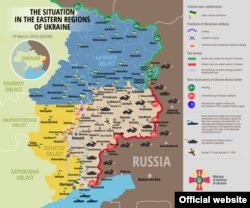
Here is today's map of the security situation in eastern Ukraine, according to the National Security and Defense Council (click to expand):
Two years ago on March 16, Crimeans voted in a sham referendum for Russia to annex Crimea. Has life improved for the approximately two million people who live there?
Not at all. On every measure, from the economy to its treatment of minorities, the beautiful peninsula has become a shell of what it once was.
The economic situation in Crimea is desperate. Tourism, one of the peninsula's main economic engines, took a serious nosedive in 2014, when Crimea received fewer than three million visitors—half the number who vacationed there in 2013. That is because Ukrainians made up the largest portion of tourists in Crimea prior to annexation. But for political and economic reasons, many now choose not to go. The Russian tourists who were supposed to flood into Crimea never came.
Crimeans have experienced a sharp decline in their standard of living. Western sanctions prevent European and American companies from operating on the peninsula, cutting into potential revenue and jobs from foreign investment. The Ukrainian government has imposed restrictions on trade with Crimea as well. Since switching to the Russian ruble, Crimeans have been subject to that currency’s massive depreciation, from an exchange rate of about 35 rubles per dollar in 2014 to 70 rubles per dollar today. While Crimeans’ pensions under Russian occupation may be nominally higher, their rubles have lost more than half of their purchasing power.
The situation for the peninsula’s minorities is even worse. Russian authorities have forced Crimean Tatars to become Russian citizens and curtailed their freedoms of speech, language, education, and residence—as well as their right to a fair trial. The new authorities have shut down Tatar language media, and Tatar leaders face harassment, detention, and threats to their lives. Now, Russia appears ready to outlaw the Crimean Tatar Mejlis, the representative body of the largest indigenous people of the peninsula. “They’re stepping up repressive measures against Crimean Tatars,” Kharkiv Human Rights Protection Group analyst Halya Coynash said in a March 15 interview.
There's "huge pressure on religious communities," Taras Berezovets, founder of Free Crimea, said in a May 2015 interview. After Crimea’s annexation, the FSB raided homes, mosques, schools, and churches, forcing religious leaders to flee. Russia extended its stricter laws regulating religious activity to the peninsula. The new authorities have issued a legal order putting all mosques under the control of the Mufti Office of Crimea, while establishing the Mufti Office of Tavriya, reportedly a political organization with close ties to Russia.