



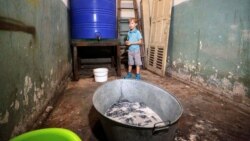
Hmmm, U.S. presidential hopeful Donald Trump is upbeat about Ukraine:
Ukraine's independent MPs boost chances of ending deadlock
KIEV, March 30 (Reuters) -- Several non-aligned Ukrainian lawmakers have agreed to join Ukraine's biggest faction to help end a political crisis that is stalling Western-backed reforms and vital international financial aid, deputies said on Wednesday.
Lawmakers are under pressure to end a deadlock that threatens snap parliamentary elections and has delayed disbursement of $1.7 billion in loans from the International Monetary Fund to help the war-torn economy.
Since mid-February, attempts to form a multi-party coalition with smaller populist or reformist factions have gone nowhere, prompting President Petro Poroshenko's 'BPP' political bloc to appeal to independent MPs.
"Talks are going on at the moment with several non-faction deputies - we've invited them to join our faction," , BPP's Oleksiy Goncharenko told journalists. "There are several applications (to sign up) already."
"There are lots of deputies who don't want snap elections, because they know nothing good would come of it, because it would risk their seat and therefore they're prepared to help," he said.
According to the parliamentary website, the BPP and the People's Front of Prime Minister Arseny Yatseniuk together have 219 lawmakers, only seven fewer than the number needed to form a coalition and appoint a new government.
Parliamentary Speaker Volodymyr Groysman, a 38-year-old former mayor and ally of Poroshenko, has been put forward as a replacement prime minister, but Yatseniuk has refused to step down until a new coalition agreement is signed.
"We need to recruit only a few of the 50 independent deputies. The formal creation of a coalition would allow Groysman to be approved, but after that we would need to focus on building up the coalition further," BPP lawmaker Andriy Vadatursky told Reuters.
Groysman has said as prime minister he would want Ukraine to stick to its reform promises under a $40 billion bailout programme backed by the International Monetary Fund, but his government would need the support of parliament to pass laws.
Lawmaker Irina Suslova said she had agreed to join BPP for the sake of forming a coalition but would not necessarily vote along party lines in parliament.
"My conditions were the following: if I have my own opinion, I will vote as I see fit," she told journalists.
Lukashenka: Crisis In Ukraine's East Cannot Be Solved Without U.S.
Belarusian President Alyaksandr Lukashenka says the ongoing crisis in eastern Ukraine cannot be solved without U.S. involvement.
Lukashenka made the comment during a meeting in Minsk on March 30 with U.S. Deputy Assistant Secretary of Defense Michael Carpenter.
Lukashenka said "if the United States wants to end the war in eastern Ukraine tomorrow and takes a few steps in that direction, the ‘meat grinder’ there will come to a halt."
He called the United States "the world's leading country with which every nation cooperates."
Lukashenka also hailed what he called improved ties between Minsk and the West, saying relations had entered a “new phase.”
In February, the European Union ended five years of sanctions against Belarus and Lukashenka, praising the Belarusian leader for the release of political prisoners in August 2015 and for Minsk's role in hosting international talks on curtailing the fighting in eastern Ukraine.
Based on reporting by BelTA and Interfax
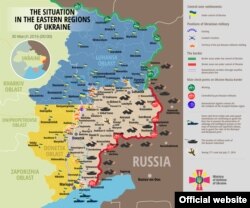
Here is today's map of the security situation in eastern Ukraine, according to the National Security and Defense Council (CLICK TO ENLARGE):
Latvia Blocks Russian Sputnik Site As Kremlin 'Propaganda Tool'
By RFE/RL
Latvian authorities shut down Russia's pro-Kremlin news site Sputnik on March 29, calling it a "propaganda tool" and drawing an immediate rebuke from Moscow.
Latvia's local domain registry suspended Sputnik's right to hold the news site Sputniknews.lv, which was established only a few weeks ago to reach out to Latvia's large Russian-speaking minority with articles in Russian and Latvian.
"We don't regard Sputnik as a credible media source but as something else: a propaganda tool," Latvian Foreign Ministry spokesman Raimonds Jansons told AFP.
Russia's Foreign Ministry called the decision "blatant censorship" and insisted "the Russian mass media adheres to the highest standards of professionalism and ethics."
Riga "once again, with the tacit inaction of leading human rights organizations, is ignoring its convention obligations to ensure media pluralism and freedom of speech as it continues to target Russian mass media in Latvia," the ministry said.
Latvia has banned Russian media before, having shut down Russian state television broadcasts for several months in 2014.
The Russian Embassy in Latvia called the move against Sputnik "groundless" and said that Latvia had started "an information war."
Latvia's domain registry decided to shut the site after receiving a letter of concern from the Latvian Foreign Ministry, which drew attention to Sputnik's coverage of Ukraine and routine denial of the embattled nation's territorial integrity.
The ministry questioned whether the coverage might constitute a breach of European Union sanctions on Russia, which were imposed over Moscow's annexation of Crimea in 2014.
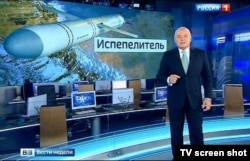
"We wrote pointing out our opinion that the fact that the head of Sputnik, Mr. [Dmitry] Kiselyov is on the sanctions list of the European Union was something that needed to be taken into account" in deciding whether to register the site, Jansons told AFP.