





NATO, Russia Hold Highest Level Talks For Almost Two Years
By RFE/RL
NATO ambassadors resumed talks with their Russian counterpart in Brussels on April 20, ending a nearly two-year hiatus that followed Russia's annexation of Ukraine's Crimean Peninsula.
Practically all civilian and military cooperation between the alliance and Moscow was suspended in April 2014 in response to Russia's role in the Ukraine conflict. That decision still stands, NATO reminded in a statement earlier this month, noting that lines of communication have always remained open.
But while the meeting of the NATO-Russia Council, which serves as a forum for cooperation between the two sides, could be seen as a step toward repairing relations, it also comes amid heightened tensions over Russia's air campaign in Syria and recent incidents involving the U.S. military and Russian planes in the Baltic Sea.
Ahead of the talks, NATO Secretary-General Jens Stoltenberg made a point of noting that "the fact that we are now convening a meeting of the NATO-Russia Council does not mean that we are back to business as normal." Noting that NATO considered dialogue to be "more important when times are difficult and tensions are high," he said the main purpose of the meeting "is to exchange views, is to be transparent, to contribute to predictability, and to discuss Ukraine."
Read more here.
In today's Daily Vertical by RFE/RL's Brian Whitmore, why today's meeting among NATO and Russian envoys will again illustrate that Moscow and the West live in completely different cognitive realities:


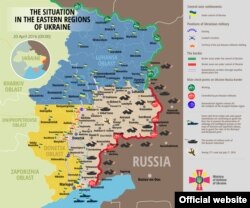
Here is today's map of the security situation in eastern Ukraine, according to the National Security and Defense Council (CLICK TO ENLARGE):
NATO, Russia Hold Highest Level Talks For Almost Two Years
NATO ambassadors resumed talks with their Russian counterpart in Brussels on April 20, ending a nearly two-year hiatus that followed the forcible Russian annexation of Ukraine's Crimean Peninsula.
Ahead of the talks, NATO Secretary-General Jens Stoltenberg said the main purpose of the NATO-Russia Council meeting "is to exchange views, is to be transparent, is to contribute to predictability and to discuss Ukraine."
Two incidents last week in which Russian warplanes buzzed a U.S. warship and performed what Washington called "erratic and aggressive maneuvers" near an American plane during a flight in international airspace underlines "the importance of open military lines of communications, of predictability and risk reduction," Stoltenberg said.
Kremlin spokesman Dmitry Peskov warned the "mistrust" between NATO and Russia will be challenging to overcome.
NATO suspended all practical cooperation with Moscow in April 2014 following Russia's military seizure of Crimea the previous month.
Since then, the NATO-Russia Council has only met once, in June 2014, though Stoltenberg has met with Russian Foreign Minister Sergei Lavrov on several occasions in recent years.