



Kyiv says three soldiers killed:
Ukraine says three of its soldiers have been killed in the country’s east -- the heaviest toll reported in the region in nearly two months.
Military spokesman Andriy Lysenko said on April 20 that the soldiers died in a mortar attack on the government-held village of Mayorsk, located some 35 kilometers north of Donetsk.
He said five soldiers were also wounded over the previous 24 hours in separate incidents along the 500-kilometer front splitting the separatist-held regions of Luhansk and Donetsk from the rest of the country.
The news comes amid rising concerns about cease-fire violations in eastern Ukraine, where fighting between government forces and Russia-backed separatists has killed more than 9,100 since April 2014. (AFP, Interfax)
EU Proposes Visa-Free Travel To Ukrainians
By RFE/RL
BRUSSELS -- The European Union has proposed offering visa-free travel in Europe to Ukrainians.
"Today, we follow up on our commitment to propose short-stay, visa-free travel to the EU for Ukrainian citizens with biometric passports," European Commissioner for Home Affairs Dimitris Avramopoulos said on April 20.
"We need to be united and stand by our neighbor," he also said, expressing hope that visa-free travel for Ukrainians will become a reality "very soon."
The decision will come as a relief to the pro-Western government in Kyiv as many feared that the visa-liberalization process could grind to a halt after the Netherlands earlier this month voted against the Association Agreement between Ukraine and the EU in a consultative referendum.
However, it is still unclear how fast the liberalization process will be dealt with in the European Parliament and European Council, where some EU member states might want to slow down the process.
The EU's neighborhood commissioner, Johannes Hahn, travels to Ukraine on April 20 to officially present the proposal.

NATO, Russia Hold Highest Level Talks For Almost Two Years
By RFE/RL
NATO ambassadors resumed talks with their Russian counterpart in Brussels on April 20, ending a nearly two-year hiatus that followed Russia's annexation of Ukraine's Crimean Peninsula.
Practically all civilian and military cooperation between the alliance and Moscow was suspended in April 2014 in response to Russia's role in the Ukraine conflict. That decision still stands, NATO reminded in a statement earlier this month, noting that lines of communication have always remained open.
But while the meeting of the NATO-Russia Council, which serves as a forum for cooperation between the two sides, could be seen as a step toward repairing relations, it also comes amid heightened tensions over Russia's air campaign in Syria and recent incidents involving the U.S. military and Russian planes in the Baltic Sea.
Ahead of the talks, NATO Secretary-General Jens Stoltenberg made a point of noting that "the fact that we are now convening a meeting of the NATO-Russia Council does not mean that we are back to business as normal." Noting that NATO considered dialogue to be "more important when times are difficult and tensions are high," he said the main purpose of the meeting "is to exchange views, is to be transparent, to contribute to predictability, and to discuss Ukraine."
Read more here.
In today's Daily Vertical by RFE/RL's Brian Whitmore, why today's meeting among NATO and Russian envoys will again illustrate that Moscow and the West live in completely different cognitive realities:


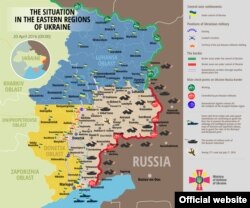
Here is today's map of the security situation in eastern Ukraine, according to the National Security and Defense Council (CLICK TO ENLARGE):