




Former Donetsk resident Nadia Zaslavska spoke to Dmitry Volchek from RFE/RL's Russian Service about why the conflict in eastern Ukraine drove her from the city even though she had spent many happy years living there.
'I Will Never Return To Donetsk' -- Conflict Reduces One Woman's Life To Rubble

I was born in the Dnipropetrovsk region but I spent more than 30 years in Donetsk. I built my house there with my own hands. It was a spacious house, with two stories and big French windows. It was a dream house. The war reduced it to a pile of rubble.
When the Euromaidan [pro-democracy protests] began in late 2013, I traveled to Kyiv to witness it. I was happy this was finally happening in our country. I know who Viktor Yanukovych, our ousted president, is because I'm from the Donetsk region, too. I was against his election, I never voted for him. I always knew it would end badly.
Unfortunately, I was the only person on my street with this opinion. People started walking around the city brandishing Russian flags and shouting "Russia!" Then Ukrainian television was shut off. The only channel we had access to was run by the DNR [Russia-backed separatists in Ukraine's Donetsk region].
There were numerous drug addicts in our city before the war. Many of them joined the DNR army. A friend of mine once bumped into a former schoolmate, a junkie who had enrolled with the separatists. This drug addict told my friend: "Now I feel like someone, because I know that I have power."
All my life I spoke Ukrainian with my parents. I've always loved my native language. But at some point my mother and I became afraid of speaking in Ukrainian, we started whispering to each other. All our neighbors supported the separatists, they believed that Russia would come and rescue them.
We had a wonderful airport, it was close to my house. When the war [between Kyiv's forces and the separatists] began, I initially thought that it was just a bluff, that it wasn't real. At first the city of Slovyansk was captured, and we thought it would end with that. Then Ilovaisk, a town near Donetsk, was taken. Then Peski, which is also close by. Soon enough, we found ourselves at the heart of events – terrible, bloody events.
Read the entire article here
An item from our news desk that's peripheral but still pertinent to Ukraine:
Foreign Investors Reportedly Buy $1.3 Billion Of Russian Eurobond Offering
Foreign investors on May 23 and 24 bought around $1.3 billion of a Eurobond offering by Russia – its first since sanctions were imposed against it for forcibly annexing Crimea and Moscow’s support for separatists in eastern Ukraine.
Reuters quotes financial market sources as saying that Russia sold $1.75 billion of the 10-year Eurobonds at a yield of 4.75 percent.
The sources said $1.3 billion of those sales involved foreign investors from Europe, the United States, and Asia.
Russia launched the Eurobond offering on May 23 and extended the sales by a day in the hope of attracting Asian investors.
Some Western banks said they were not taking part amid concerns about the sanctions risk.
Based on reporting by Reuters, AP, AFP, and TASS
Here's a Ukraine-related item from RFE/RL's Brussels correspondent Rikard Jozwiak:
NATO General Says Eastern Buildup Is Response To Russian 'Aggression'
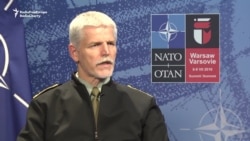

WATCH: Top NATO General Says Russia Sees 'Compromise As Weakness'
The chairman of NATO's Military Committee, General Petr Pavel, told RFE/RL on May 24 that the alliance's planned buildup on its eastern flank is a direct response to Russian military actions in Georgia, Ukraine, and Syria.
Pavel, a Czech general, told RFE/RL that "if there were no increases in Russian assertiveness demonstrated in actions in Georgia, in Ukraine, in Crimea, and in Syria, there would not have to be a reaction from the NATO side."
He said NATO, and especially the alliance's easternmost member states, "feel threatened by Russian assertiveness, Russian aggression, in several areas."
Pavel said countries that directly border Russia "wanted to be more assured about the NATO presence and NATO willingness and preparedness to act."
NATO's Military Committee is the senior military authority in the alliance and the primary source of military advice to NATO's civilian decision-making bodies.