


Here's another item from RFE/RL's news desk:
Former NATO Chief Named Poroshenko Adviser

Former NATO Secretary-General Anders Fogh Rasmussen says he will do his "utmost to promote security, economic reforms, and stronger EU ties" in his new capacity as an adviser to Ukrainian President Petro Poroshenko.
Rasmussen made the comment on Facebook on May 29, one day after Poroshenko announced the appointment. Poroshenko's announcement did not specify on what issues Rasmussen would be advising.
Rasmussen described the "security situation" in eastern Ukraine as "alarming." He also said Ukraine must fight corruption and implement reforms.
Russian Duma member Leonid Kalashnikov, deputy chairman of the Foreign Affairs Committee, told Interfax that Rasmussen's appointment was "a hostile gesture" toward Russia.
"It shows that Ukraine has chosen the West and NATO as the vector of its drifting movement," he said, describing Ukraine as "a beachhead against Russia" that "will be used sooner or later."
Konstantin Kosachyov, chairman of the Federation Council's Foreign Affairs Committee, said on Facebook that Rasmussen's appointment, like many other Ukrainian moves, is "for show" because "Ukraine badly needs…attention from the outside."
With reporting by Interfax
In case you missed it earlier in the week. One of the good reads recommended recently by Brian Whitmore in his Morning Vertical:
Good morning. We'll get the live blog rolling today with an update on sanctions from our news desk:
German Foreign Minister Suggests Gradual Reduction In Russia Sanctions
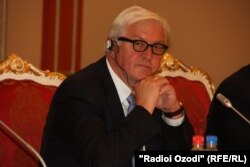
German Foreign Minister Frank-Walter Steinmeier has suggested that the European Union might gradually reduce sanctions if Moscow takes steps to fulfill its obligations under a peace accord with Ukraine.
"I hope that by the end of June there will be progress and then we can see if we can reduce the sanctions step by step, or if we stay with the measures we have right now," Steinmeier told reporters on a visit to Tallinn on May 27.
"If there is no progress, an evaluation will also be necessary," he said. "It is not our aim to maintain the sanctions but to resolve the conflict."
Steinmeier has previously said that resistance to the sanctions is growing within the EU, so finding unanimous agreement among all 28 EU members before the sanctions expire next month will be difficult without compromise.
His willingness to consider providing some sanctions relief to Moscow contrasts with statements this week by British Prime Minister David Cameron and EU President Donald Tusk that they expect the sanctions to be extended without change.
The Group of Seven economic powers, which includes Germany, also called for extending the sanctions on May 27.
Based on reporting by AFP and Interfax
This ends our live blogging for May 27. Be sure to check back tomorrow for our continuing coverage.