

Here's an item from our news desk. It seems like Petro Poroshenko is weighing in on the issue of violent Russian fans at Euro 2016:
Ukrainian President Says Violent Russian Soccer Fans Were 'Trained Killers'
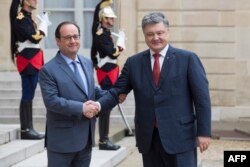
Ukrainian President Petro Poroshenko has said during a visit to France that Russian soccer fans behind violence in Marseille during the European Championships were "trained fighters who kill."
Poroshenko made the remark on French television ahead of a June 21 meeting in Paris with French President Francois Hollande.
Two Britons remained in a coma on June 21 after being seriously injured ahead of a June 11 Euro match in Marseille.
They were among 35 mostly British fans hurt in the three days of violence.
French prosecutors said the Russian fans in Marseille targeted England supporters in an orchestrated "hunt."
Three Russian fans were jailed for up to two years and six England fans were sentenced for up to six months.
Twenty Russians were expelled from France for violence -- including far-right fan leader Aleksandr Shprygin, who was expected to be expelled a second time on June 21 after sneaking back into the country.
Based on reporting by AFP and Reuters
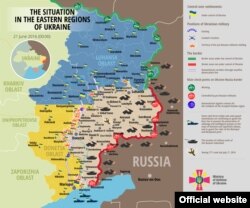
Here is today's map of the latest situation in the Donbas conflict zone, according to the Ukrainian Defense Ministry (CLIK IMAGE TO ENLARGE):
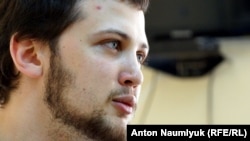
Following his recent release in a prisoner swap, Hennadiy Afanasyev, a photographer from Crimea convicted in Russia of plotting terrorist attacks on the Moscow-occupied peninsula, tells why he decided to recant his testimony implicating fellow Ukrainians.
This just in from our News Desk, via RFE/RL's Brussels correspondent Rikard Jozwiak:
EU Diplomats Agree To Extend Sanctions Against Russia
By RFE/RL
BRUSSELS -- European Union ambassadors have agreed to a six-month extension of sanctions against Russia in response to its occupation and illegal annexation of Ukraine's Crimean Peninsula and Moscow's support for pro-Russia separatist fighters in eastern Ukraine.
The decision by diplomats at a meeting in Luxembourg on June 21 still requires approval by EU leaders at a summit in Brussels next week.
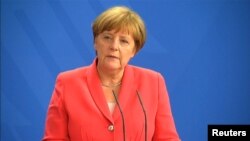
German Chancellor Angela Merkel has pushed for prolonging the current sanctions, which are due to expire at the end of July, despite growing calls for a more conciliatory approach from some EU members.
Reports suggest Merkel convinced countries like Slovakia, Hungary, and Italy to set aside their objections and keep sanctions in place until the end of January.
The sanctions, which have targeted Russia's finance and energy sectors, were first imposed in June and July 2014 and have been extended every six months since then.
Based on reporting by Reuters, AP, AFP, dpa, and TASS
EU Prepares To Extend Russian Sanctions, Amid Signs Unity Is Fraying
By RFE/RL
The European Union is preparing to extend sanctions against Russia for another six months this week, but what happens after that is uncertain as cracks in the bloc's unity have begun to show.
The EU's top diplomats are expected to agree to prolong the sanctions, which expire at the end of July, at a meeting in Luxembourg on June 21, though EU leaders will not give them a formal blessing until their summit in Brussels next week.
To this point, German Chancellor Angela Merkel has firmly guided the bloc toward maintaining sanctions, keeping Russia-friendly members of her own government on the sidelines while convincing skeptical states like Slovakia, Hungary, and Italy to set aside their objections and go along.
But Merkel can no longer hide growing evidence that the mood in Berlin is shifting in favor of Russia in what may be the first sign of a serious break in the European consensus.
German Foreign Minister Frank-Walter Steinmeier's push for a more conciliatory approach toward Russia was laid bare over the weekend when he told the German tabloid Bild that NATO "is inflaming the situation by warmongering and stomping boots."
Likewise, in France, lawmakers sent a clear warning that they are getting impatient with sanctions by approving a resolution earlier this month urging the government to gradually lift them.
France's Foreign Minister Jean-Marc Ayrault on June 20 repeated his government's assurances that the sanctions will stay in place for now because Russia and Ukraine still are not complying with the Minsk agreement to settle the conflict in east Ukraine.
But he said EU leaders need to start showing "real, concrete, significant progress" in carrying out that agreement.
"Today, as I speak to you...the requirements are not met to lift sanctions...These sanctions will be renewed for six
months," Ayrault told journalists in Luxembourg after meeting with his EU counterparts. "Whatever sympathy we can have for the Russian people and Russia, we have to be clear: The Minsk agreements have to be implemented and respected."
But with the EU facing major threats posed by a massive influx of refugees, a possible British exit from the union, and attacks by the Islamic State extremist group, high-ranking officials from Germany, France, Italy, Greece and other EU members have openly wondered whether the EU can afford to let ties with Moscow keep suffering, possibly beyond repair.
Berlin, in particular, has become openly frustrated with the Ukraine government's failure to implement its side of the Minsk deal by pushing through a law that would allow elections to take place in the disputed east.
Kyiv has deflected several deadlines Germany laid down this year for carrying out the election provisions.
Steinmeier's desire to engage Russia may have its roots in his mentor: former German Chancellor Gerhard Schroeder, a friend of Russian President Vladimir Putin, who cautioned in a weekend newspaper interview that "we can't allow the successes of Willy Brandt's Ostpolitik (engagement policy) to be squandered."
But the German foreign minister is far from alone in demanding less militaristic posturing and more of a dialogue with Moscow.
Italian Prime Minister Matteo Renzi and European Commission President Jean-Claude Juncker both attended a major Russian investor conference that was held in St. Petersburg last week -- visits that would have been unthinkable a year ago.
Juncker, while saying beforehand that he advocated extending the sanctions, stressed that he attended the event to keep the lines of communication open with Moscow.
Meanwhile, Slovakia, one of the biggest skeptics on Russia sanctions, takes over the EU Presidency in July and will be in that role when the sanctions must be revisited again in January.
"People are tired of confrontation with Russia. They don't like the tensions and they see that Ukraine is not delivering enough on the reform front," said Ulrich Speck, a senior fellow at the Transatlantic Academy in Washington.