




Here's an item from our news desk on a reported military build-up in Crimea:
Activists: Russian Military Hardware Sighted Along Northern Crimea Border
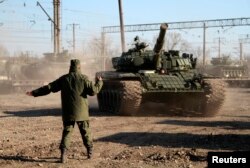
Crimean Tatar activists have reported armed checkpoints being erected at scattered sites around the Russian-occupied peninsula, and unusually large concentrations of Russian hardware in northern regions.
Ukraine-s border guard service, meanwhile, reported that Russian authorities had blocked all road entry to the Black Sea peninsula for several hours on August 7.
Nariman Celal a top official with the executive body of the peninsula’s Crimean Tatar minority, reported tanks and other heavy weaponry concentrated around two key northern settlements, near the administrative border with the Ukrainian mainland.
The Crimean Human Rights Group, a local nongovernmental organization, said it had also received reports, photographs, and videos from witnesses showing Russian military trucks being transported on trains on August 6 near Kerch, an eastern port town that is opposite Russia's Stavropol territory.
Rafat Chubarov, a member of Ukraine’s parliament and one of the Crimean Tatar community's most prominent figures, told the news portal 112.ua that the Russian maneuvers appeared to be a training exercise.
Russia seized Crimea in the aftermath of the so-called Euromaidan protests in Kyiv that forced President Viktor Yanukovych to flee.
Moscow later declared it had annexed the peninsula, a move that has been rejected across the globe. Its naval base at Sevastopol is the home for the Russian Black Sea fleet.
With reporting by RFE/RL’s Krym.Realii project, 112.ua and Interfax
More speculation on what seems like some sort of Russian military build-up in Crimea...
Here's a taster of The Washington Post's editorial, which is getting a lot of traction on Twitter (e.g. see tweet above):
DONALD TRUMP’S assertion that Russia “is not going to go into Ukraine” reminded us that very little reporting has been done in recent months about the state of the conflict in the eastern provinces of Donetskand Luhansk, which were first invaded by Russian forces in early 2014. That’s unfortunate, because while the West’s attention has been otherwise occupied this summer, Russia and its proxies have steadily escalated the fighting.
According to the United Nations, 20 civilians were killed and 122 injured in June and July, more than double the average monthly toll of the previous nine months. The Ukrainian army, for its part, reported at least 13 soldiers killed in July. Most of the deaths came in shelling attacks by heavy weapons, including artillery and Grad rockets, that were expressly prohibited by the two peace agreements Russia and Ukraine made. Apart from brief periods, the Russian side has never fully observed the cease-fire, according to reports by international monitors.
Meanwhile, military supplies continue to pour across Ukraine’s eastern border, parts of which Russia exclusively controls. According to statements by Ukrainian officials, at least 19 trains carrying military hardware crossed the border in July. On Aug. 2, authorities reported that 30 tanks, 11 armored vehicles and six Grad rocket systems had been shipped in during the previous week. This despite repeated Russian commitments to pull all such weapons back from the front lines and place them under monitoring.