




Brother Of Ukrainian Held By Russia Appeals To Kyiv For Help
The brother of Yevhen Panov, who was detained and charged by Russian authorities with preparing terror attacks in Crimea, has asked Ukrainian officials for help in securing his release. Panov, a Ukrainian citizen, is being held on the peninsula, which Russia annexed in 2014. His brother Igor Kotelyanets spoke to RFE/RL's Current Time TV.


By RFE/RL
Tensions between Russia and Ukraine have escalated one day after Moscow claimed it thwarted an incursion into Russia-held Crimea by Ukrainian saboteurs, with Kyiv putting troops near the peninsula on highest alert and Russia announcing increased security measures and new naval exercises in the Black Sea.
Meanwhile, the U.S. ambassador to Ukraine said Washington has seen no evidence supporting the claim by Russia', which accused Kyiv of plotting “terror” in Crimea and reporting that two members of its security forces were killed in clashes last weekend with the alleged assailants.
The “U.S. government has seen nothing so far that corroborates Russian allegations of a 'Crimea incursion' & Ukraine has strongly refuted them,” U.S. Ambassador Geoffrey Pyatt said on Twitter on August 11.
“Russia has a record of frequently levying false accusations at Ukraine to deflect attention from its own illegal actions,” Pyatt said. He added that the U.S. view is that “Crimea is, and will always remain, part of Ukraine.”
Russia’s Federal Security Service (FSB) said on August 10 that an FSB employee and a soldier were killed while repelling what it described as attempts to get Ukrainian “saboteurs” into the peninsula, which Russia seized from Ukraine in 2014 after deploying troops and staging a referendum denounced as illegitimate by Kyiv, the West, and a total of 100 countries.
The FSB also said it had detained several men -- both Ukrainian and Russian citizens -- and confiscated weapons.
Expanding on the FSB allegation, Russian President Vladimir Putin accused the pro-Western government in Kyiv of using “terror” tactics to seek to ignite a new conflict and destabilize Crimea. Ukrainian President Petro Poroshenko called the Russian allegations preposterous fantasies and a pretext for Moscow to make more military threats against Ukraine.
After taking over Crimea in March 2014, Russia threw its support behind separatists who seized territory in the Donetsk and Luhansk regions of eastern Ukraine, leading to a war that has killed more than 9,500 combatants and civilians since that April. The current tension in Crimea follows weeks of increased fighting in eastern Ukraine.
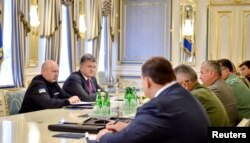
On August 11, Poroshenko said he had instructed all military units near Crimea and in eastern regions near tseparatist-held territory to be at their highest level of combat readiness.
In Moscow, Putin held a meeting of his Security Council and discussed “additional measures to provide for the security of the citizens and vital infrastructure facilities of Crimea in connection with the prevention by the [Russian] special services of a terrorist act on the peninsula,” the Kremlin said on its website.
Putin and the senior security officials discussed potential “counterterrorist” security measures on land, sea, and air in and around Crimea, it said.
The Russian claims came amid reports of an unusual increase in Russian military activity in the northern part of Crimea, near the administrative border with mainland Ukraine, over the past several days.

That activity, as well as the Russian allegations and the upsurge in fighting in eastern Ukraine, has stoked concerns in Ukraine that the Kremlin may seek to take control of more of its territory.
A senior Ukrainian security official told AFP on August 11 that the claims from Moscow were a "crude Russian provocation" and that Kyiv was "getting ready for anything," including an invasion.
The spokesman for the Ukrainian armed forces General Staff, Vladislav Seleznyov, told Reuters that Ukraine has the military resources to defend itself and is monitoring the situation around Crimea.
Meanwhile, Russian media delved into details of the Russian claims.
The daily Kommersant cited sources it did not name as saying that two of seven suspects in one group had been killed and the other five captured. Most of them were Crimea residents and some had Russian passports, the report said.
Kommersant cited the sources as saying the detainees had confessed to planning a series of bombings at Crimean tourist resorts and said their objective had been to spread panic to destroy the tourist industry, but not to kill anyone.
Ukranian military spokesman Oleksandr Motuzyanyk said Moscow's claims "do not correspond to reality. Ukraine did not commit any armed provocations in [Crimea] or any other area. None of [Ukraine's] Defense Ministry intelligence staff was detained in occupied Crimea."
There is no way to check the veracity of the reports. Russian authorities frequently report that suspects have confessed, and human rights activists say confessions are often extracted through pressure or torture.
The FSB claimed the attempted attack took place between August 6 and August 8, when a group of “saboteurs” from Ukraine was discovered in the Armyansk district of northern Crimea. It said this led to at least two armed clashes on the border between Crimea and mainland Ukraine, including “massive firing” from the Ukrainian-held side.
The FSB said one of its officers was killed in armed clashes while arresting “terrorists” on the night of August 6-7, while a Russian soldier died in a firefight with “sabotage-terrorist” groups sent by the Ukrainian military on August 8.
Pyatt and others have said there is little physical evidence to support Russia’s claims.
“There has been no independent confirmation of the claims made by the Russian authorities," a European Union foreign policy spokeswoman said in a statement.
The Digital Forensic Research Lab at the Atlantic Council, a U.S.-based think tank, said in a report on August 10 that there was “not a single photograph or video of these incidents of gunfire and shelling.”

Among those Russia says it has detained is Yevhen Panov, a Ukrainian truck driver who previously volunteered in the conflict zone in eastern Ukraine.
Moscow claims Panov worked as a Ukrainian military intelligence officer, and Russian state TV published a photograph of a man who appears to be a handcuffed Panov.
Panov’s stepbrother, Ihor Kotelyanets, told RFE/RL’s Current Time television that Panov was not a member of Ukraine’s armed services and that he had been abducted. He said his stepbrother had left his hometown of Energodar on August 6 to visit friends over the weekend and had been due back on August 8.
“They called me a few hours ago, and told me, yeah, he’s there [in Crimea]. But I still didn’t want to believe it,” Kotelyanets said. “But Russian channels showed my brother in Crimea, being led in handcuffs, beaten, and they’re saying that he’s a terrorist.”
Other media outlets tried to puzzle out Putin’s motives for the Russian claims, if they are false.
The independent Russian daily Vedomosti said that Russia may be intentionally increasing tensions and putting pressure on Kyiv and the West ahead of a possible new round of talks on the conflict in eastern Ukraine.
Putin said on August 10 that a tentative meeting with Poroshenko and German Chancellor Angela Merkel and French President Francois Hollande on the sidelines of next month's G20 summit in China was now "senseless."
In an op-ed article titled A New Old Enemy, Vedomosti wrote that Moscow had a habit of ramping up tensions ahead of negotiations with Ukraine.
"The main political question now is what is the future of the Minsk process," the paper wrote, referring to a cease-fire and peace plan that was hammered out in the Belarusian capital in February 2015 but has not been implemented. "Will Russia bring an end to it or demand new concessions?"
Motuzyanyk, the Ukranian military spokesman, said Russia's actions and statements were intended "to discredit Ukraine, to stall the Minsk agreements, and to escalate conflict in eastern Ukraine which was caused by the Russian aggression."