



Many Puzzled By Obama's Reference To Ukraine As Russian 'Client State'
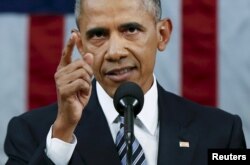
KYIV -- U.S. President Barack Obama raised eyebrows around the world with a difficult-to-interpret reference to Ukraine in his final annual State of the Union address that lumped the post-Soviet state and its West-leaning government together with Syria as Russian "client states."
"Even as their economy contracts, Russia is pouring resources in to prop up Ukraine and Syria -- client states they saw slipping away from their orbit," Obama said on January 12. "And the international system we built after World War II is now struggling to keep pace with this new reality."
In the transcript of the speech posted by the White House, the confusing reference remains, although the word "client" does not appear and the transcript uses the present tense ("states they see slipping away from their orbit").
The annual address to a joint session of the U.S. Congress is one of the U.S. president's most comprehensively prepared and vetted speeches. Obama's chief speechwriter, Jon Favreau, told National Public Radio earlier in the day his office had been working on the speech since "around Thanksgiving."
"Once the new year came and went, there would be a frenzied couple of weeks writing and editing and rewriting, right up until the final speech and then practicing the speech on the last day," Favreau said.
So the president's infelicitous comment about Ukraine is all the more difficult to understand. Was Obama referring to Russia's support for former Ukrainian President Viktor Yanukovych, the pro-Russian leader who was driven from office by pro-democracy demonstrations in February 2014? Or did he have in mind Moscow's economic, political, and military support for separatists in eastern Ukraine and Crimea, the Ukrainian Black Sea peninsula that Moscow annexed in March 2014?
Read more of the story by RFE/RL's Robert Coalson and Tetiana Iakubovych here.
White House: Obama’s Puzzling Ukraine Comment Referred To Kremlin Ally Yanukovych
By Carl Schreck
The White House has clarified U.S. President Barack Obama’s puzzling reference to Ukraine in his final State of the Union address, in which he said Russia is “pouring resources in to prop up” its ex-Soviet neighbor.
Obama raised eyebrows with the phrase in the January 12 speech to a joint session of the U.S. Congress because it appeared to contradict his administration’s position that Russia is stoking unrest in Ukraine by supporting armed separatists.
But a senior U.S. administration official told RFE/RL on January 13 that Obama was referring in part to Moscow’s support for former Ukrainian President Viktor Yanukovych, who fled to Russia in February 2014 amid mass street protests that helped usher in a pro-Western government.
ALSO READ: Many Puzzled By Reference To Ukraine As Russian 'Client State'
“The president was referring in his remarks to Russia’s previous long-term efforts to bolster the regime of former President Yanukovych as a way to prevent Ukraine from pursuing further integration with Europe,” said the official, who could not be identified under White House protocol.
Yanukovych’s ouster triggered events that led to Russia’s seizure and annexation of Ukraine’s Crimean Peninsula, which a majority of UN member states deem illegitimate. It also led to war between Russia-backed separatists and Kyiv’s forces in the east of the country that has killed more than 9,000 since April 2014.
Before Yanukovych’s ouster, Russia had offered billions in financial incentives, in what was widely seen as an effort to dissuade him from signing an agreement for closer relations with the European Union. Moscow feared the deal would have tugged Ukraine out of its orbit, economically and politically.
The U.S. official also told RFE/RL that Obama’s remarks about Ukraine referred to Russia’s “current occupation of Crimea, extensive efforts to support armed groups operating in eastern Ukraine, and other efforts to destabilize the country.”
Obama veered only slightly from his prepared remarks on Ukraine in the annual address, which is thoroughly vetted by the U.S. president’s staff and speechwriters.
"Even as their economy contracts, Russia is pouring resources in to prop up Ukraine and Syria -- client states they saw slipping away from their orbit," he said in the speech. "And the international system we built after World War II is now struggling to keep pace with this new reality."
The phrase “prop up Ukraine” was also included in the prepared version of the speech distributed to the media by the White House.
The administration official reiterated Washington’s support for Ukraine’s government and citizens.
“Over the past two years, the United States has led an international coalition to help Ukraine defend its democracy and territorial integrity, and the United States remains firmly committed to helping the Ukrainian people build a country that is peaceful, prosperous, and free to chart its own destiny,” the official said.
Overall, Ukraine and Russia got scant mention during the hourlong speech, which instead focused on other pressing foreign policy issues such as terrorism, the Islamic State in Syria, the Iran nuclear deal, and warming relations with Cuba.
Relatives Of MH17 Crash Victims Demand Release Of Key Data
By RFE/RL
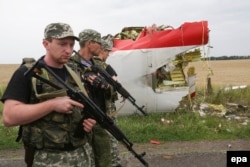
Relatives of those killed in the MH17 air disaster are demanding the release of what they say is key evidence that could shed light on the tragedy over eastern Ukraine in July 2014.
Malaysia Airlines flight MH17 was shot down over the eastern Ukrainian region of Donetsk with the loss of all 298 lives on board, most of them Dutch.
The Dutch Safety Board said in its final report released on October 13 that the jet was destroyed by a Russian-made surface-to-air missile, fired from an area at the time under the control of pro-Russia separatists.
A separate criminal probe is also being conducted in the Netherlands to determine who was responsible and bring them to justice.
Now, Dutch relatives of the MH17 tragedy have written to Dutch Prime Minister Mark Rutte to protest that primary radar data was not made available to the investigators by either the Russian or Ukrainian authorities.
"We can't accept that people have refused to provide crucial information," the families said in the letter, published on January 13.
They are urging Rutte to push either the United Nations or the International Civil Aviation Organization to demand that the data is handed over.
The families hope that may help pinpoint who fired the missile at the plane.
The EU, the United States, and Ukraine believe the plane was downed by Russia-backed separatists using a Buk missile system provided by the Russian military.
Moscow denies providing such equipment and has suggested that the aircraft was shot down by a Ukrainian fighter jet or with a Buk fired by the Ukrainian military -- claims roundly dismissed by Kyiv and Western governments.
With reporting by AFP
Obama, Putin Discuss Crisis In Ukraine
U.S. President Barack Obama and Russian President Vladimir Putin spoke by telephone on January 13, discussing the crises in Ukraine and Syria, the White House said.
"They spent a significant portion of their time discussing the need for the Russians to live up to the commitments that they made in Minsk -- to end their support for separatists that are destabilizing Ukraine right now," said White House spokesman Josh Earnest.
Kyiv and Western government accuse Moscow of fueling the conflict, providing weapons and other aid to the separatists, charges the Kremlin denies.
According to the Kremlin, Putin and Obama also called for an easing of tensions between and Iran and Saudi Arabia.
The two leaders also discussed a resolution to Syria's crisis and the situation on the Korean peninsula, a Kremlin statement said.
Based on reporting by AP and Reuters
Sides In Ukraine Conflict Vow To Abide By Truce
Negotiators at the Ukraine peace talks have vowed to make fresh efforts to enforce a shaky cease-fire in eastern Ukraine.
Martin Sajdik, the envoy for the Organization for Security and Cooperation in Europe (OSCE), made the comment on January 13.
He spoke in Minsk after a meeting of the Trilateral Contact Group, which is negotiating a settlement to the conflict that has killed more than 9,000 people since April 2014.
Sajdik said the parties agreed to try again to fully halt fighting between Ukrainian forces and pro-Russia separatists and discussed new efforts to exchange war prisoners.
Taking part in the Minsk talks was Boris Gryzlov, a former speaker of the Russian parliament who has been named a Russian envoy.
Gryzlov, a member of Russia's presidential Security Council, is seen as more influential than his predecessor, Mikhail Zurabov.
His appointment has been interpreted by some analysts as a sign the Kremlin wants to intensify the talks.
Based on reporting by AFP, AP and Interfax
That concludes our live-blogging of the Ukraine crisis for Wednesday, January 13. Check back here tomorrow for more of our continuing coverage.
Dozens Killed By Deadly Swine Flu Virus In Ukraine
An outbreak of the H1N1 swine flu virus has killed more than 50 people in Ukraine this winter -- an increase of 10 percent over last year, Ukrainian authorities said.
Ukrainian Health Minister Aleksandr Kvitashvili urged people not to panic, saying, “We haven’t exceeded the epidemic threshold, and every year January is the peak of the flu season.”
Nevertheless, the outbreak is serious as many people died unnecessarily by not seeking treatment in time to be saved, he said at a cabinet meeting on January 13.
People with high temperatures should immediately consult doctors and not attempt to self-medicate, as some treatments are not effective after 48 hours, he said.
The areas worst hit include Kyiv, Kharkiv, Vinnytsia, and Odesa, lawmaker Irina Sysoyenko wrote on her Facebook page. She said 28 people have died from flu in Odesa and 25 in Vinnytsya.
“As of today, 5.7 percent of the population is ill with the flu,” Sysoyenko wrote. “Of these, 70 percent are children and pregnant women."
According to the Health Ministry, only 0.3 percent of Ukraine's population received flu vaccines.