




Moldova Indicts, Sentences Individuals Who Fought As Mercenaries In Ukraine
By Eugen Tomiuc
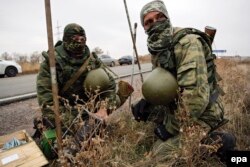
Moldovan prosecutors say Russian-backed separatists in southeastern Ukraine have been hiring Moldovan mercenaries to fight on their side, sometimes promising as much as $3,000 monthly.
Dozens of Moldovans are known to have fought along the separatists for money, officials under the Prosecutor-General's Office said at a news conference on February 11.
Ten suspected mercenaries have been arrested and place under investigation since the beginning of the year, and two of them have already been sentenced to three years in prison each, said Igor Popa, the acting prosecutor-general for Moldova's capital, Chisinau.
Under Moldova's current legislation, serving as a mercenary abroad is punishable by up to 10 years in jail.
Popa said criminal cases are continuing against the remaining eight, aged 26 to 32, most of whom are Russian speakers from southern Moldova.
At the time of their arrest, all were carrying documents showing they belonged to separatist units from southeastern Ukraine.
"I regret to say it, but tens of Moldovans have been fighting in the Donetsk and Luhansk regions of Ukraine," Popa said. "We have documented cases where Moldovan citizens have been injured and we don't rule out possible deaths of our citizens during this military conflict."
The precise number of Moldovans fighting in Ukraine is not known, but Moldovan security services say they are making every effort to identify suspected mercenaries.
Since they are usually ex-members of special military or police units, according to Popa, they pose a threat to Moldova's national security.
"Ukraine's security service promised during a joint meeting with its Moldovan counterpart that Kyiv would give them a list of all Moldovans known to be involved in the conflict," Popa said.
While empathy with the separatists' cause may have played a role in the recruitment of ethnic Russians from Moldova, the main incentive remains money.
"For example, one individual who was sent to court in January has admitted that he was promised from the outset that he would be paid some $3,000 monthly," said Nicu Sendrea, the deputy prosecutor for Chisinau.
Two other suspects were apprehended upon reentering Moldova with large sums of Russian rubles after fighting alongside separatists in Ukraine.
"Both individuals admitted to being paid sums of money in Russian rubles -- one 15,000 rubles ($180), and the other one 40,000 rubles ($500) monthly," said Denis Rotaru, the head of Moldova's antiorganized crime unit.
More than 9,000 civilians and combatants have been killed since the war erupted in southeastern Ukraine between government forces and Russia-backed separatists in April 2014. Fighting has diminished markedly after a second cease-fire was signed in Minsk in February 2015, but violations are frequent and a deal aimed to resolve the conflict has gone largely unimplemented.
RFE/RL Moldovan Service correspondent Nicu Gusan contributed to this report from Chisinau
Biden, Poroshenko Again Discuss Corruption, Reforms
By RFE/RL
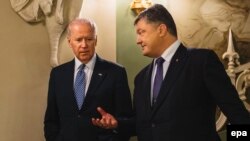
With concern growing about Ukraine’s government and its commitment to cleaning up corruption and cronyism, U.S. Vice President Joe Biden has spoken to Ukrainian President Petro Poroshenko for the second time in as many days.
The February 12 phone call from Biden -- the White House’s point man on Ukraine -- came just days after the resignation of reformist Economy Minister Aivaras Abromavicius, who angrily accused top officials in the Poroshenko administration of hindering badly needed reforms.
Western ambassadors have been vocal in urging Poroshenko to do more, and the International Monetary Fund has signaled that $1.75 billion in bailout funds could be in doubt.
The White House said Biden told the Ukrainian leader that reforms need to be passed quickly to ensure the IMF funds.
"The two leaders agreed on the importance of unity among Ukrainian political forces to quickly pass reforms in line with the commitments in its IMF program, including measures focused on rooting out corruption," it said in a statement.
Poroshenko had been seen as committed to cleaning up Ukraine’s notorious corrupt and untransparent government, and Abromavicius had been one of several foreign-born officials brought in as part of that effort.
But the push to eliminate problems like bribery, kickbacks, and preferential hiring for wealthy insiders has proceeded at a slow pace, resulting in growing frustration both inside Ukraine and among Western officials and lenders.
The resignation of Abromavicius sparked fears that the government of Prime Minister Arseniy Yatsenyuk might collapse. That would undermine efforts to cement the Minsk accords that brought a shaky cease-fire to the fighting in eastern Ukraine between Russia-backed rebels and government troops.