





More potential ramifications from the deportation of a Russian journalist yesterday...
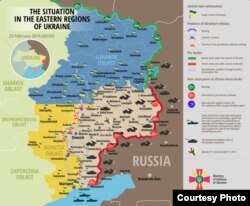
Here is a map of the latest situation in the Donbas conflict zone, courtesy of the Ukrainian Defense Ministry (CLICK IMAGE TO ENLARGE):
Needless to say, Ukraine features pretty prominently in this story from RFE/RL's news desk:
NATO Commander: Russia Poses 'Existential Threat' To US, West
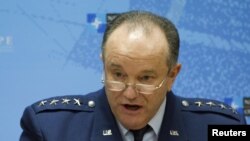
WASHINGTON – NATO Supreme Commander Philip Breedlove said Russia has decided to become an adversary of the West and presents an "existential threat" to the United States and its allies.
U.S. Defense Secretary Ash Carter, meanwhile, accused Russia of intimidating its immediate neighbors, and said he doubted whether Moscow was still committed to strategic stability on nuclear weapons.
The comments by Carter and Breedlove, in testimony before two congressional committees on February 25, reflected the deepening concern and ongoing shift in thinking in Washington about how to respond to Russian moves in Europe and the Middle East.
Breedlove has been one the most vocal critics of Russia among top U.S. military brass since Moscow annexed Ukraine's Crimea Peninsula in March 2014 and subsequently backed separatists fighting Kyiv's forces in eastern Ukraine.
Russia has repeatedly dismissed assertions by U.S. and European officials that it presents a threat to the West, portraying the accusations as dangerous saber-rattling.
Breedlove told the U.S. House Armed Services Committee that Russia was seeking to "rewrite the agreed rules of the international order," and undermine unity in Europe.
"Russia has chosen to be an adversary and poses a long-term existential threat to the United States and to our European allies and partners," he told the committee.
Carter, speaking before the House Appropriations Committee, asserted that Russia seemed intent "to erode the principled international order that has served us, our friends and allies, the international community, and also Russia itself so well for so long."
"Moscow’s nuclear saber-rattling," Carter said, raised questions about Russian leaders’ "commitment to strategic stability" and "whether they respect the profound caution that nuclear-age leaders showed with regard to brandishing nuclear weapons."
Russia's military doctrine updated in recent years laid out new guidelines for the use of nuclear weapons, and Russia's ongoing deployment to Syria has been widely seen as a showcase for new weaponry and a training ground for new military tactics.
"To be clear, the United States does not seek a cold, let alone hot war with Russia. We do not seek to make Russia an enemy, even as it may view us that way," he said. "But make no mistake -- we will defend our interests, our allies, the principled international order, and the positive future it affords us all."
The United States and NATO has moved slowly to adjust to Russian actions, which have included increased bomber and fighter-jet flights near NATO members' borders, as well as the military deployment to Syria, Russia's largest in decades.
The Pentagon's budget request for the coming fiscal year includes a $3.4 billion quadrupling of spending to bolster European defense. And NATO recently announced plans to begin rotating up to a brigade-sized, multinational force into some Eastern European and Baltic States, in an effort to reassure alliance members.