




That concludes our live-blogging of the Ukraine crisis for Thursday, March 3. Check back here tomorrow for more of our continuing coverage.
Good morning. We'll start the live blog today with this update on diplomatic efforts to push the Minsk agreement forward (from RFE/RL's news desk):
Paris Talks On Ukraine Peace Fall Flat
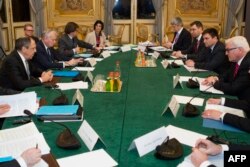
Progress was seen but no breakthrough made during talks aimed at jumpstarting a fragile peace deal in Ukraine, ending with Moscow and Kyiv failing to agree on a proposal to hold elections in eastern Ukraine this year.
Following the multiparty talks in Paris on March 3, Russia said it was prepared to support the election proposal presented by Germany and France. But Ukraine quashed early optimism by saying polls would not possible until security was established.
French Foreign Minister Jean-Marc Ayrault, who described the four-hour meeting as "frank, direct, and without holding back," announced that the talks had underlined the importance of adopting an electoral law to hold elections in Ukraine's eastern Donbas region in June.
But when asked by journalists if there had been a breakthrough, Ukrainian Foreign Minister Pavlo Kimkin responded by saying: No, I don't have that impression."
Klimkin said Ukraine continues to insist that all commitments for a cease-fire and withdrawal of weapons be carried out before such elections are held.
"We must be able to ensure these elections are organized safely; we need our territory to be secure. Without security we can't deliver on anything further," Kimkin added.
Kyiv has long insisted there must be a total cessation of hostilities in the country's east, where Ukraine has battled Russia-backed separatists since early 2014, before it will pass the laws needed to authorize elections there.
Although violence in the east has diminished, the Organization for Security and Cooperation in Europe (OSCE) has reported sporadic violations by both sides of the cease-fire established by the Minsk II agreement, which was signed in the Belarusian capital in February 2015 by Ukraine, Russia, the separatists, and the OSCE.
Russian Foreign Minister Sergei Lavrov said Moscow was prepared to push separatists in the east to abide by the cease-fire and participate in the polls. But he said Ukraine's refusal to go along with any hard deadline thwarted a consensus on the matter.
Lavrov said the group agreed on beginning mine clearance in 12 areas in the conflict zone, and banning all firing drills and military exercises near the contact line.
"This will reduce the risk of provocations, the risk of unexpected or unintentional incidents. These are good agreements that need to be implemented," he said.
German Foreign Minister Frank-Walter Steinmeier expressed frustration after the negotiations in Paris, saying he was "not satisfied with the way Kyiv and Moscow are operating the negotiations here... I'm afraid the situation in eastern Ukraine really isn't being viewed seriously enough... It can escalate again at any time."
A Western diplomat said France and Germany would continue to push Ukraine to adopt elections laws and hold polls in the first half of the year.
"Failure to reach a consensus on elections does not mean that there is no progress at all," the unnamed diplomat said.
During a visit to Ukraine last month, Ayrault and Steinmeier called on the government to pursue the legal and constitutional reforms needed to allow local elections to take place in the east.
However, a political crisis has been consuming Kyiv's attention, and aides say the French and German ministers have begun to worry that political dysfunction is preventing Kyiv from delivering on its commitment to hold elections in the east.
Beyond the contentious issue of holding elections in the east, the four top diplomats agreed to "the release and exchange of all prisoners and people held in illegal detention between now and April 30," Ayrault said after the Paris talks.
They also agreed to establish by April 30 a mechanism to "prevent and settle incidents connected with cease-fire violations," as well as ensure access to the conflict zone by truce monitors."
The Paris meeting was called to carry out the Minsk II accord, which established a cease-fire and called for elections and other measures to end the conflict in eastern Ukraine that has claimed more than 9,100 lives.
With reporting by AP, AFP, Reuters, dpa, TASS, and Interfax
Here's another item from our news desk:
Juncker Says Ukraine Not Likely To Join EU, NATO For 20-25 Years
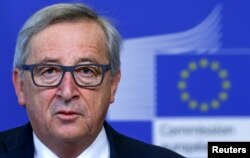
It will take Ukraine at least 20 to 25 years to join the European Union and NATO, European Commission President Jean-Claude Juncker said March 3.
"Ukraine will definitely not be able to become a member of the EU in the next 20 to 25 years, and not of NATO either," he said in a speech at The Hague.
While Juncker did not explain why Ukraine would have to wait so long, his speech was aimed at reassuring Dutch voters that this year's free-trade agreement between Ukraine and the EU was not a first step toward quickly joining the European Union.
Despite his prediction, the EU has been paving the way for visa-free travel to the bloc for Ukrainian citizens while providing Kyiv with a generous $40 billion bailout along with the United States and the International Monetary Fund to help it maintain economic stability amid a war with Russia-backed separatists.
NATO also sent a reassuring message to Ukraine last year by holding military exercises there in a show of force against Russia, which has repeatedly denounced the alliance's eastern expansion as a threat to its national security.
But Juncker's comments suggest that Ukraine's ambition to join Europe, frequently expressed by leaders in Kyiv, will not be fulfilled anytime soon.