



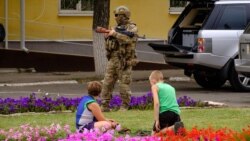
Here's is a report from RFE/RL's news desk on Nadia Savchenko's meeting with separatists in Minsk:
Savchenko Meets Russia-Backed Separatist Leaders, Stirring Outrage
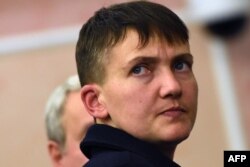
KYIV -- Ukrainian lawmaker Nadia Savchenko has confirmed that she met with the leadership of Russia-backed separatists for consultations on prisoner swaps. The move triggered rebukes from her party for what it called "negotiating with terrorists."
Savchenko, a military aviator who was jailed in Russia in 2014 and became a national symbol of resilience before her release in May, told the TV channel 112 Ukraina on December 12 that she met recently in Minsk with separatist leaders Aleksandr Zakharchenko and Igor Plotnitsky.
She spoke hours after Ukrainian media reported that the secret meeting had taken place last week in the Belarusian capital.
Savchenko's Batkivshchyna (Fatherland) party, headed by former Prime Minister Yulia Tymoshenko, called the meeting "unacceptable."
Savchenko has previously infuriated some lawmakers and officials by urging reconciliation to end the conflict in eastern Ukraine between the separatists and Kyiv's forces that has killed more than 9,750 people since April 2014.
Kyiv considers the separatists to be "terrorists" who are backed by Russia's government with money, personnel, and heavy weaponry.
'Chosen By The People'
Savchenko told 112 Ukraina that she did not inform her party about the meeting because "every lawmaker, regardless of party… is chosen by the people."
Oleksandr Tkachuk, chief of staff of Ukraine's SBU security service, told RFE/RL on December 12 that Savchenko had confirmed her meeting with the separatist leaders during a visit to its office earlier in the day.
He said Savchenko had not broken any laws by taking part in the meeting but "may have violated parliament security procedures."
ALSO READ: The Many Faces Of Nadia Savchenko
Ukrainian members of parliament are provided access to state secrets, he explained, and thus must disclose with the office of the Verkhovna Rada all trips abroad in advance.
Savchenko "should have informed the parliament of her intentions to go abroad," Tkachuk added.
Plotnitksy confirmed the meeting to Russia's state-run RIA Novosti news agency on December 12.
"The main topic of conversation was the exchange of prisoners in an 'all-for-all' format," Plotnitsky was quoted as saying.
With reporting by RFE/RL's Christopher Miller in Kyiv, 112.ua, Liga.net, and RIA Novosti
Here's a new feature from the Ukrainian capital by RFE/RL's Christopher Miller:
Ukraine Searches For Culprit After Cyberattacks On Finance Ministry, Treasury
KYIV -- Ukrainian authorities are still looking for the culprits nearly a week after troublesome cyberattacks against official financial institutions that appeared to be designed to inflict maximum chaos on end-of-the-year payments.
But the head of staff of the Ukrainian Security Service (SBU) identified the so-called malware used in the December 6 attack as the same disruptive software employed in an unprecedented incident a year earlier, blamed on Russia, that cut off power to hundreds of thousands of homes in Ukraine.
Hundreds of thousands of hryvnyas' worth of remittances were delayed or stopped completely over the course of two days after hackers knocked the websites and payment systems of the Ministry of Finance, State Treasury, and pension fund offline, according to statements posted to those sites and local reports.
The National Police are leading the investigation and have discussed the case with the SBU, Oleksandr Tkachuk, chief of staff of the SBU, told RFE/RL on December 12.
The Finance Ministry, which described the incident as a "coordinated professional hacking attack," also claimed the attack had damaged its network equipment.
Tkachuk confirmed that "some data was destroyed and access to networks was blocked."
He said authorities were not prepared to discuss many details publicly because it would take time to fully assess them, adding that attribution in the cybersecurity sphere is a tricky business.
Tkachuk said the attack appeared to bear some similarity to a December 2015 attack against the Prykarpattyaoblenergo power company in Ukraine's western Ivano-Frankivsk region that cut power to hundreds of thousands of homes.
Critical Infrastructure
Ukrainian officials blamed that cyberattack on Russia and speculated that it might have been retaliation for Kyiv cutting off electricity one month earlier to Crimea, which Russia seized from Ukraine in early 2014.
But experts at the time warned that the greater message might be that hackers had the power to shut down critical infrastructure -- something that cybersecurity experts had long feared but never seen in practice.
Elizabeth Sherwood-Randall, a deputy secretary at the U.S. Department of Energy, also blamed Russia for the December 2015 cyberattack.
In that case, the hackers used malicious software called KillDisk, which deletes or overwrites data in system files, causing computers to crash.
KillDisk was also used in the December 6 attacks, the SBU's Tkachuk told RFE/RL.
Relations between Kyiv and Moscow soured after Russia forcibly annexed Crimea in March 2014, and Russia has been accused by Kyiv and Western powers of backing a separatist conflict in eastern in Ukraine that has killed more than 9,750 people.
Kyiv has on several occasions blamed Russia for cyberattacks -- including one on Ukraine's election system ahead of the presidential vote in May 2014 -- that it claims are part of Moscow’s greater "hybrid war," a military strategy that combines conventional warfare, irregular warfare, and cyberwarfare.