

Here's another item from our news desk on Canada's new foreign minister:
Russia Signals Sanctions On Canada's Freeland Can Only Be Lifted Reciprocally
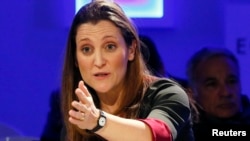
Russia has signaled that it will only remove newly appointed Canadian Foreign Minister Chrystia Freeland from its sanctions list on a reciprocal basis.
Russian news agencies cited an unidentified Russian Foreign Ministry official as saying on January 11 that Freeland has been on a list of Canadians subject to sanctions, which includes a travel ban, since 2014.
Moscow introduced the sanctions list after many Western countries, including Canada, imposed targeted sanctions against Russian officials over Moscow’s 2014 annexation of Ukraine’s Crimean Peninsula.
"The issue of removing her from the response sanctions is an issue of reciprocity and the mirror principle," the Foreign Ministry official said. "The fact that she is blacklisted will not impede contacts with Russian officials at international forums."
Freeland, a former journalist who is of Ukrainian descent, has been a harsh critic of Russian President Vladimir Putin.
After Moscow imposed sanctions on her, Freeland posted on Twitter that she considered it "an honor to be on Putin’s sanction list."
Canadian Prime Minister Justin Trudeau appointed Freeland as foreign minister on January 10.
In 2015, she wrote an article for Quartz magazine titled My Ukraine, And Putin's Big Lie.
Trudeau, in announcing Freeland's appointment as foreign affairs minister, sidestepped a question from reporters over whether her rocky relationship with Russia would have an impact.
Freeland, who once lived in Moscow during her career as a financial correspondent, said that whether she will be able to travel to Russia as foreign minister was not up to her.
"That's a question for Moscow," she said. "I am a very strong supporter of our government's view that it is important to engage with all countries around the world, very much including Russia."
Based on reporting by RIA Novosti, Interfax, Reuters, TASS, and AFP
Ukrainian journalist Alisa Sophova has had a nice piece published in The Guardian. Here's a taster:
When I started working as a journalist in my native city of Donetsk I never imagined that war would come to town, until the day it did.
In the spring of 2014 tanks and pro-Russia separatists showed up on the streets of the city, which was quickly turned into the capital of the self-proclaimed Donetsk People’s Republic (DPR).
I was a news editor at Donbass, the largest newspaper and website in the city and responsible for a dozen reporters covering local news. We reported on the governor’s weekly press conferences, the construction of a new hockey arena, several scandalous crimes a year – that was our journalistic routine. It felt like nothing unexpected could happen.
Then it did. Within days my neighbourhood had become a battlefield between the separatists and the national army and my newspaper was forced to suspend its activities, but this was an international news story so I was offered work as a fixer, then as a reporter for the New York Times.
My office dresses were replaced by a flak jacket and helmet. I saw people fighting, surviving – and dying. My colleagues and I often found ourselves under fire.
Should you write about corruption in the national army, knowing that your story will be distorted by the Russian propaganda machine and used against your country? How do you balance opinions about the conflict while your brother, a Ukrainian soldier, is imprisoned and tortured by the insurgents (a situation my colleague faced)?
These are the complicated but real choices that Ukrainian journalists still face. It’s easy to be a person of principle in a peaceful and democratic environment, but as soon as the situation gets personal journalists are told that “truth above neutrality” must prevail. However, that “truth” is never simple.
Read the entire article here.