




Russian-Imposed Authorities Target Alleged Islamic Group Members In Crimea
The Russian-imposed authorities in Crimea said that security forces were conducting an operation targeting alleged members of Hizb ut-Tahrir, an Islamic group that is banned in Russia.
Zaur Smirnov, the chairman of Crimea's State Committee for Interethnic Issues, said on January 26 that a "special operation" was being conducted in the city of Bakhchisaray.
He did not provide any details.
At least five Crimean Tatars were arrested in October on suspicion of being Hizb ut-Tahrir members.
In September, a court in southern Russia sentenced four Crimean Tatars to lengthy prison terms after finding them guilty of being members of Hizb ut-Tahrir.
Russia has been heavily criticized by international rights groups and Western governments for its treatment of Crimea's indigenous Turkic-speaking, mainly Muslim people since Russia seized control of the Ukrainian region in March 2014.
Arrests, disappearances, and killings of Crimean Tatars have been reported.
With reporting by RIA and TASS
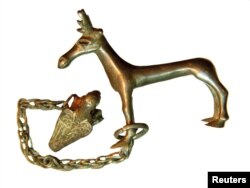
Crimean Museums Appeal Court Ruling Returning Scythian Gold To Kyiv
Museums in Crimea have appealed a Dutch court ruling that said artifacts from their collections should be returned to Ukraine rather than to the Russian-controlled peninsula, a Russian lawmaker said on January 25.
"We have filed an appeal. We hope that a right political decision will be taken," said Natalya Poklonskaya, a Russian parliament deputy and former prosecutor in the Russian-imposed government in Crimea.
"What happened in the court is against all museum ethics. ... These valuables can only be kept in the region where they were found," she said. "They are Crimea's heritage that should be returned home."
The items, known as the Scythian gold, are in the Netherlands because they were borrowed from four museums in Crimea and one in Kyiv for an exhibition in early 2014 at Amsterdam's Allard Pierson Museum.
They were sent before Russia seized Crimea from Ukraine in March 2014 in a move condemned as illegal in the West.
Late last year, an Amsterdam court ruled that the collection was part of Ukraine's cultural heritage and should be returned to Kyiv.
Based on reporting by TASS and Interfax
We are now closing the live blog for today, but we'll be back again tomorrow morning to follow all the latest developments. Until then, you can keep up with all our other Ukraine coverage here.