

Russia urged to drop charges against Crimean journalist:
By RFE/RL
Human rights advocates and European lawmakers are calling on Russia to drop criminal charges against Mykola Semena, an RFE/RL contributor who is accused of separatism in a case supporters say is aimed at silencing criticism of Moscow's seizure of Crimea from Ukraine.
Semena was given a final version of the charges in December and was served on January 20 with the closing indictment in his case, a detailed document that includes descriptions of evidence, the names of prosecution witnesses, and other information.
The development means that Semena, who was initially detained in April over an article expressing the view that Crimea should be returned to Ukraine and then released but ordered not to leave the peninsula, could be tried soon.
He could be sentenced to five years in prison if convicted.
In a resolution adopted on January 24, the Parliamentary Assembly of the Council of Europe (PACE) urged Russia to drop its charges against Semena and two other journalists it said were being prosecuted "for their reports about the illegal occupation and annexation of the Crimean Peninsula by the Russian Federation."
Also on January 24, the Organization for Security and Cooperation in Europe's (OSCE) media-freedom representative, Dunja Mijatovic, expressed concern about what her office called the "persecution" of Semena, a contributor to RFE/RL's Crimea Realities website.
"The case of Semena reminds us all of the arbitrary practice of silencing critical voices in Crimea," Mijatovic said. "It is totally unacceptable to persecute the journalist for expressing his views. I call for all charges against Semena to be dropped."
On January 25, RFE/RL President Thomas Kent said that the charges against Semena were "part of a concerted effort by Russian and Russian-backed authorities to obstruct RFE/RL's journalistic mission to provide an independent press to residents of Crimea."
Russia seized control of Crimea from Ukraine in March 2014, after sending in troops to secure key facilities and staging a referendum dismissed as illegitimate by Ukraine, the United States, and a total of 100 countries in the UN General Assembly.
Human rights advocates say Russian and the authorities it imposed in Crimea have conducted a persistent campaign of oppression targeting opponents of the annexation as well as independent media outlets and journalists.
Russian-Imposed Authorities Target Alleged Islamic Group Members In Crimea
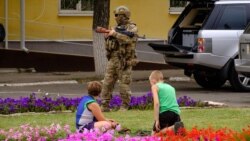
The Russian-imposed authorities in Crimea said that security forces were conducting an operation targeting alleged members of Hizb ut-Tahrir, an Islamic group that is banned in Russia.
Zaur Smirnov, the chairman of Crimea's State Committee for Interethnic Issues, said on January 26 that a "special operation" was being conducted in the city of Bakhchisaray.
He did not provide any details.
At least five Crimean Tatars were arrested in October on suspicion of being Hizb ut-Tahrir members.
In September, a court in southern Russia sentenced four Crimean Tatars to lengthy prison terms after finding them guilty of being members of Hizb ut-Tahrir.
Russia has been heavily criticized by international rights groups and Western governments for its treatment of Crimea's indigenous Turkic-speaking, mainly Muslim people since Russia seized control of the Ukrainian region in March 2014.
Arrests, disappearances, and killings of Crimean Tatars have been reported.