



EU's Tusk Says Fighting Must Stop In Ukraine, Points To 'Russia's Aggression'
By RFE/RL
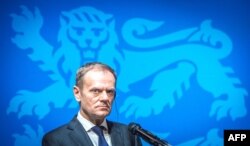
European Council President Donald Tusk is calling on Russia to use its influence with separatists in eastern Ukraine to end an upsurge of fighting that has caused many casualties and aggravated the humanitarian situation.
"We are reminded again of the continued challenge posed by Russia's aggression in eastern Ukraine," Tusk said on February 2. "The fighting must stop immediately. The cease-fire must be honored."
Ukraine says two of its servicemen were killed and 10 others wounded in the country's east in the previous 24 hours as heavy fighting between government forces and Russia-backed separatists entered its fifth day.
Ukrainian officials had earlier reported the deaths of eight soldiers in the past few days, the highest toll in weeks, and casualties among civilians and separatist fighters were also reported.
Two Ukrainian Soldiers Reported Killed In Eastern Fighting
Ukraine says two of its soldiers have been killed in the country's east as heavy fighting between government forces and Russia-backed separatists entered its fifth day.
The military said on February 2 that 10 other servicemen were wounded in the previous 24 hours.
Ukrainian officials had reported the deaths of eight soldiers in the past few days, the highest casualty toll in weeks.
In the separatist-held provincial capital of Donetsk, separatists said two civilians were injured by shelling late on February 1.
The sides traded blame for the surge in hostilities that are concentrated around the government-controlled city of Avdiyivka, where shelling left many residents without electricity, water supplies, and heating in temperatures well below freezing.
By February 2, the water supply and heating in the town north of Donetsk has been partially restored, the Associated Press reported.
More than 9,750 people have been killed in the conflict in eastern Ukraine since April 2014.
Based on reporting by AP and UNIAN

Putin Heads To Budapest Amid Concerns Over EU Unity
Russian President Vladimir Putin is heading to Hungary for his second visit in two years, a development that has many in the European Union looking on with concern.
Hungarian Prime Minister Viktor Orban’s February 2 meeting with Putin comes at a time of heightened worries within the bloc about the views of new U.S. President Donald Trump, who has expressed disdain for the European Union and a desire for closer relations with Moscow.
"We are concerned [about the trip], there is no doubt about it," an EU official requesting anonymity told RFE/RL on February 1. "It is Putin’s year. He's looking at a divided Europe, which the Visegrad Four (the Czech Republic, Hungary, Poland, and Slovakia), especially Hungary, are making more divided due to actions like [inviting Putin to Budapest], and a United States that for the first time is providing no counterbalance to [Putin].”
Putin's visit -- his second to Budapest in two years and his third official meeting with Orban in that time -- is primarily to discuss economic issues, including the controversial Paks nuclear-power plant that Russia is contracted to build and further agreements on natural-gas purchases.
Putin has received few invitations to EU countries since Moscow’s illegal 2014 takeover of Ukraine's Crimea region and the introduction of EU sanctions against Moscow over its interference in Ukraine.