

U.S. senators submit bill seeking veto power on Russia sanctions:
By Carl Schreck
WASHINGTON -- A group of U.S. senators has introduced legislation that would hamstring any effort by President Donald Trump's administration to lift sanctions imposed on Russia for its actions in Ukraine.
The bill, called the Russia Sanctions Review Act, has both Republican and Democratic backers and comes amid mounting concerns in Congress about the Trump administration's policy intentions toward Russia.
Trump has repeatedly signaled he wants more cooperation with Russia in areas like the fight against international terrorism, particularly in Syria. But his administration has made statements about Ukraine and other issues that echo Russia's perspective, in contrast to the previous U.S. administration.
Senators Lindsey Graham (Republican-South Carolina) and Ben Cardin (Democrat-Maryland) are among the group backing the legislation that would impose strict congressional oversight and veto power over the Trump administration if it sought to lift sanctions on Russia.
"The reason for the Russia Review Act is that we've heard the president speak several times about potentially reducing or eliminating sanctions," Cardin told reporters on February 8.
"So it's aimed at getting consultation from Congress and, if necessary, action from Congress, if the president were to change our policy on the current sanctions without the broad support and understanding of Congress."
The bill is co-sponsored by Senators John McCain (Republican-Arizona), Marco Rubio (Republican-Florida), Claire McCaskill (Democrat-Missouri), and Sherrod Brown (Democrat-Ohio).
Trump's predecessor, Barack Obama, froze assets and banned visas on a range of top Russia officials after Moscow annexed Ukraine's Crimean Peninsula in 2014.
Ukraine, the United States, and the EU also say that Russia has supported separatist forces in eastern Ukraine who are fighting Ukrainian troops. Russia denies those charges.
More than 9,750 people have been killed in the fighting in Ukraine's Donbas region.
McCain said in a statement after the legislation was introduced that easing sanctions against Russia "would send the wrong message as [Russian President] Vladimir Putin continues to oppress his citizens, murder his political opponents, invade his neighbors, threaten America's allies, and attempt to undermine our elections."
"Congress must have oversight of any decision that would impact our ability to hold Russia accountable for its flagrant violation of international law and attack our institutions," added McCain, who has repeatedly been accused by officials in Moscow of baselessly stirring up anti-Russian sentiment in Washington.
Speaking to reporters earlier in the day, Cardin said the legislation was modeled after the Iran Nuclear Agreement Review Act, a 2015 law giving Congress a say in the landmark deal between Tehran and world powers to restrict Iran's nuclear activities in exchange for easing sanctions.
He expressed optimism that the legislation will receive broad bipartisan backing in Congress and said he believed it could be passed with sufficient support to prevent Trump from vetoing it. (w/Mike Eckel)
Officials: Sheremet's death a contract killing:
Ukrainian officials say Belarusian journalist Pavel Sheremet was killed because of his professional activities in a contract killing.
Ukrainian Interior Minister Arsen Avakov said in Kyiv on February 8 the results of a pretrial investigation into Sheremet's death "lead to the conclusion that this crime was carefully prepared by a group of people."
"Investigators do not rule out that the order for the killing came from the Russian Federation," Avakov added.
Oleksandr Vakulenko, the deputy chief of Ukraine's National Police and head of its main investigative unit, said Sheremet's journalistic activities in Ukraine, where he lived, and Belarus and Russia "is considered in the first place" as a motive for his killing.
Sheremet, 44, was killed when the car he was driving to work was blown up in central Kyiv on July 20.
Jailed in Belarus in 1997 while recording a story on the Russian-Belarusian border, Sheremet was often critical of top political leaders and other government officials in his reporting.
He had also warned in the last blog post before his death that Ukrainian politicians who were former members of volunteer battalions that had fought separatists in eastern Ukraine could carry out a coup in Kyiv.
Vakulenko said an antipersonnel mine was used in the blast that killed Sheremet. He added that no one had yet been arrested for the killing.
Ukrainian Prosecutor-General Yuriy Lutsenko agreed with Avakov in saying that Sheremet's "killer was not alone. This is a group [of assassins] and we can see part of this group in the video [taken where Sheremet's car was parked before he drove it]." (Interfax, Kyiv Post)
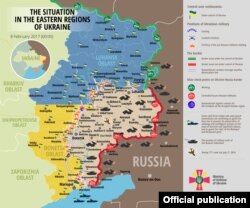
Here is today's map of the security situation in eastern Ukraine, according to the National Security and Defense Council:
Date set for Crimean journalist's trial:
By the Crimean Desk of RFE/RL's Ukrainian Service
A date has been set for the high-profile trial of journalist Mykola Semena in the Russian-controlled Ukrainian region of Crimea.
Semena's lawyer, Emil Kurbedinov, told RFE/RL on February 8 that preliminary hearings into the case will be held by the Zaliznychnyy district court in Simferopol on February 17.
Kurbedinov said the actual trial for Semena, an RFE/RL contributor, will start on February 28.
Semena has been charged with separatism and may be sentenced to five years in prison if convicted for an article he wrote on his blog that was critical of Moscow’s seizure of Crimea from Ukraine in 2014.
Semena denies the charges.
He is currently under a court order from occupying Russian officials that bars him from leaving Crimea and forces him to seek permission before traveling outside the region's capital, Simferopol.
The United States, the European Union, the Organization for Security and Cooperation in Europe (OSCE), and international media watchdogs have expressed concern over Semena's case, which activists say is part of a Russian clampdown on independent media and dissent in Crimea.
Russia-backed separatists say one of their commanders in the Donetsk region of eastern Ukraine has been assassinated. Mikhail Tolstykh was better known by his nom de guerre, Givi. In Current Time TV's documentary about the brutal battle for Donetsk airport, he explained how he came to join the separatist forces. In 2016, Givi was charged in Ukraine with crimes including the creation of a terrorist organization, abduction, and abuse of prisoners of war.

