


Good morning. To get the live blog rolling today, here are a few of the things that caught our eye overnight:
A Time magazine reporter speculates on how Russia might react to the resignation of U.S. national security adviser Michel Flynn:
And here's some background:
Meanwhile, in eastern Ukraine...
And then there's this tweet from RFE/RL's correspondent in Kyiv pointing you in the direction of a report by RFE/RL's Ukrainian Service
We are now closing the live blog for today, but we'll be back again tomorrow morning to follow all the latest developments. Until then, you can keep up with all our other Ukraine coverage here.
Here's an item from RFE/RL's Rikard Jozwiak in Brussels that is good news for those in Ukraine who want the country to move closer to the EU:
European Parliament Paves Way For Visa-Free Travel For Georgians, Ukrainians
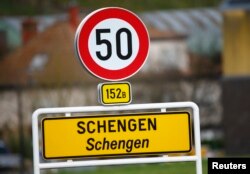
BRUSSELS -- The European Parliament is set to endorse new rules governing the suspension of visa-free regimes with countries outside the European Union, a key step toward visa-free travel for Georgians and Ukrainians to the Schengen zone.
EU lawmakers approved the visa-suspension mechanism in December, and an announcement of its final version was made on February 13 after the text was translated into all EU languages and vetted by legal experts.
Under the new set of rules, visa-waiver agreements with third countries may be suspended faster in certain cases, such as an upsurge in baseless asylum applications or imminent security threats posed by third-country nationals.
The measure paves the way for Georgia and Ukraine to be allowed visa-free travel to the Schengen Area within months.
The European Parliament overwhelmingly approved visa liberalization for Georgia in a February 3 vote, and this will be implemented now that the new visa-suspension mechanism has been endorsed. Diplomats say visa liberalization for Georgia is expect to enter into force in late March.
The approval of the suspension mechanism also clears the way for further steps on visa liberalization for Ukraine, which diplomats say is expected to enter into force in June.
Georgia and Ukraine have long sought greater integration with Europe, largely as a bulwark against Russian influence, but have been frustrated in the past with the pace of EU moves to bring it closer.
Russian forces drove deep into Georgia in a five-day war in 2008, and Moscow supports the breakaway Georgian regions of Abkhazia and South Ossetia. Russia seized control of Ukraine's Crimean Peninsula in March 2014 and backs separatists in a war that has killed more than 9,750 people in eastern Ukraine since April 2014.
The 26 Schengen Area countries are Austria, Belgium, the Czech Republic, Denmark, Estonia, Finland, France, Germany, Greece, Hungary, Iceland, Italy, Latvia, Liechtenstein, Lithuania, Luxembourg, Malta, the Netherlands, Norway, Poland, Portugal, Slovakia, Slovenia, Spain, Sweden, and Switzerland.
Reporting by RFE/RL Brussels Correspondent Rikard Jozwiak
For those in need of a quick re-cap:
From a tweeter who's known for her strongly pro-Kyiv views:
ICYMI
Here's a new item from RFE/RL Christopher Miller in Kyiv and Carl Schreck in Washington:
Rights Groups Press Ukraine Separatists Over Missing Russian LGBT Activist, Musician
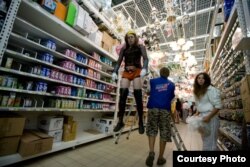
KYIV -- International rights groups have urged separatist leaders in eastern Ukraine to disclose the location and ensure the safety of a Russian LGBT activist and a fellow performance artist who went missing there two weeks ago.
Friends of transgender activist Seroye Fioletovoye (Gray Purple) and musician Viktoria Miroshnichenko say they have not heard from the two since they entered separatist-controlled territory on January 31.
The Kremlin-loyal tabloid news outlet Life News on February 13 cited an unidentified source with the separatists as saying that the two were detained because Fioletovoye had planned to stage a protest in support of sexual minorities in a separatist-held area of Donetsk.
There has been no formal confirmation of that claim, and Amnesty International said in a February 13 statement that it has "serious concerns" about the safety of the two Russians.
The international rights group published a petition calling on separatist leaders to reveal the location of the two Russians and protect them from "physical and psychological" abuse.
Russia-backed separatists control areas of the Donetsk and Luhansk regions in Ukraine's east nearly three years after the start of their war against Kyiv's forces that has killed more than 9,750 people.
International rights watchdogs and Western governments have repeatedly accused the separatists of illegal detentions and abuses, including torture.
Fioletovoye, who was born Oleg Vasliyev and also goes by the name Maria Shtern, is a former member of the Russian art group Voina, which drew international attention with its daring antigovernment stunts and spawned the dissident art collective Pussy Riot.
The activist typically uses "it" in self-reference, and rights advocates became increasingly concerned after a February 9 update appeared on Fioletovoye's Twitter feed referring to the activist as male.
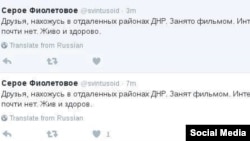
The tweet was subsequently deleted and replaced with a new post consistent with the activist's typical gender identification.
"Friends, I am in the far-flung regions of the DNR," the tweet reads, using an acronym used by the separatists that stands for Donetsk People's Republic.
"I am busy with a film. There is almost no Internet. I'm alive and well," it continued.
The Twitter feed had been dormant since August, and the sudden tweet has raised suspicions that the activist was not the person who posted it.
"It was very, very creepy, and very concerning, too," Tanya Cooper, a Ukraine researcher for the New York-based Human Rights Watch, told RFE/RL.
Miroshnichenko is a musician who previously collaborated with Fioletovoye. She staged a performance-art piece at a 2013 event related to LGBT issues that Fioletovoye moderated.
In her most recent Facebook post -- on January 31 -- Miroshnichenko wrote that she would be online infrequently until February 15. She added in a comment to the post that she was traveling to the southern Russian region of Rostov, which borders the Donetsk region.
Human Rights Watch said in a February 10 statement that it feared the two had become the victims of a "violent disappearance."
"Their disappearance demands an immediate and effective investigation," Cooper said in the statement.
Based on reporting by Christopher Miller in Kyiv and Carl Schreck in Washington
Peripheral but pertinent to Ukraine: