



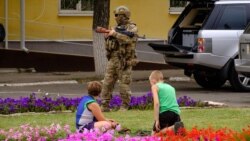
U.S. President Donald Trump has been tweeting about Crimea and our news desk has this report:
Trump Blasts Media Over 'Russian Connection,' Suggests Obama Was Soft On Moscow
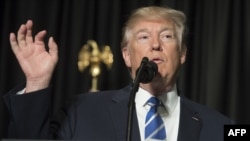
U.S. President Donald Trump said on Twitter on February 15 that "Crimea was taken by Russia" during the administration of his predecessor, Barack Obama, and added: "Was Obama too soft on Russia?"
In a series of tweets two days after he called for and accepted the resignation of national security adviser Michael Flynn amid questions over Flynn's contacts with the Russian ambassador to Washington in December, Trump also lashed out at the media.
"The fake news media is going crazy with their conspiracy theories and blind hatred," Trump said on Twitter. "This Russian connection non-sense is merely an attempt to cover-up the many mistakes made in Hillary Clinton's losing campaign."
The tweets followed a February 14 report in The New York Times that cited current and former U.S. officials as saying members of Trump's campaign and other associates had contacts with Russian intelligence officials in the months before the November 2016 presidential election.
Russia seized control of Crimea from Ukraine in March 2014, after sending in troops and staging a referendum denounced as illegal by the United States and a total of 100 countries in the UN General Assembly.
White House spokesman Sean Spicer said on February 14 that Trump has "made it very clear" that he expects Russia to "return Crimea" and reduce violence in eastern Ukraine, where a war between government forces and Russia-backed separatists has killed more than 9,750 people since April 2014.
In today's Daily Vertical, titled Why Minsk Failed, RFE/RL's Brian Whitmore looks at what went wrong with the 2015 cease-fire in Ukraine:


Here's some Russian reaction to Sean Spicer's comments that the White House expects Russia to return Crimea to Ukraine:
Russia Won't Discuss Crimea, Dismisses Report Of Contacts With Trump Team
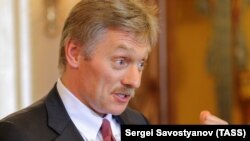
Russian President Vladimir Putin's spokesman says Moscow will not discuss the return of Crimea to Ukraine with the United States or any other country.
Dmitry Peskov spoke on February 15, a day after White House spokesman Sean Spicer said that U.S. President Donald Trump has "made it very clear" that he expects Russia to "return Crimea" and reduce violence in eastern Ukraine.
The Kremlin spokesman referred to Crimea as Russian territory, saying that "Russia never discusses issues related to its territories with foreign partners, including the United States."
Russia seized control of Crimea in March 2014 after sending in troops and staging a referendum denounced as illegal by the United States and a total of 100 countries in the UN General Assembly.
Peskov said that Trump did not raise the issue of Crimea in his January 28 telephone conversation with Putin.
He also dismissed a February 14 report in the New York Times that cited current and former U.S. officials as saying members of Trump's campaign and other associates had contacts with Russian intelligence officials in the months before the November 2016 presidential election, claiming it was "not based on any facts."
"Let's not believe anonymous information," Peskov said in a conference call with reporters.
The Kremlin spokesman also responded to U.S. media reports that cited U.S. officials as saying that Russia has deployed cruise missiles in violation of the Intermediate-Range Nuclear Forces (INF) Treaty, a 1987 pact between Moscow and Washington.
"Russia has been and remains committed to its international commitments, including to the treaty in question," Peskov said.
"Nobody has formally accused Russia of violating the treaty," he said.
More broadly, Peskov said that it is too early to talk about the "normalization" of ties between Russia and the United States as Trump's administration is still being built.
Trump has repeatedly said he hopes relations between the United States and Russia will improve during his administration.
Ties have been badly strained by rancor over issues including Russia's interference in Ukraine, its role in the war in Syria, and what U.S. intelligence agencies say was a hacking and propaganda campaign to meddle in the U.S. presidential election with the aim of undermining the United States, discrediting Democratic Party candidate Hillary Clinton, and helping Trump.
With reporting by Interfax, TASS, and Reuters
An interesting comparison:
The Kremlin's response to news that the White House expects Russia to return Crimea to Ukraine:
Here's an item from our news desk about today's NATO meeting in Brussels:
NATO Meeting Attended By By Mattis To Tackle Defense Spending, Terrorism
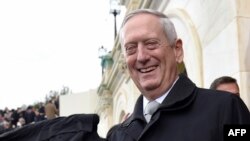
NATO defense ministers are expected to discuss defense spending and the fight against terrorism at a Brussels meeting attended for the first time by the new U.S. Defense Secretary James Mattis.
Before the the two-day meeting starting on February 15, NATO Secretary General Jens Stoltenberg said he was "confident" that the gathering would "reconfirm the enduring importance of the transatlantic bond" and called on countries to reassure the United States of their efforts to increase defense spending.
NATO allies are also seeking assurances on the U.S. commitment to the 28-nation pact after U.S. President Donald Trump called it "obsolete" and threatened to withhold U.S. support unless members ramp up their defense spending.
Trump has repeatedly criticized NATO member states that fail to meet the defense spending target of 2 percent of their gross domestic product (GDP) and has called for fair burden sharing.
Stoltenberg said "defense spending has been the main topic" in his two telephone conversations with U.S. President Donald Trump.
In 2014, the year Russia seized Crimea and backed separatists in a war in eastern Ukraine, NATO leaders committed to halt defense spending cuts and move toward raising their military budgets to 2 percent of GDP within a decade.
Twenty-four of the 28 members have stopped cutting defense spending.
Stoltenberg said the United States, Britain, Poland, Greece, and Estonia are "already meeting the 2 percent target, " while Latvia, Lithuania, and Romania are getting close.
The Brussels meeting is also expected to boost NATO's involvement in the fight against terrorism, in particular against the Islamic State extremist group.
With reporting by Reuters, dpa, and AP
An ex-U.S. ambassador to Russia has this question to ask: