



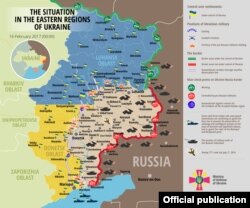
Here is today's map of the security situation in eastern Ukraine, according to the National Security and Defense Council:
Crimean journalist's separatism trial to start in Simferopol:
By RFE/RL
Ukrainian journalist Mykola Semena, an RFE/RL contributor accused of separatism in the Russian-controlled Ukrainian region of Crimea, is preparing to face trial.
Semena's lawyer, Andrei Sabinin, said on February 14 that preliminary hearings into the case will be held by the Zaliznychnyy district court in Crimea's capital, Simferopol, on February 17.
The journalist's other lawyer, Emil Kurbedinov, told RFE/RL on February 8 that the actual trial for Semena will start on February 28.
Semena was detained in April and then released but ordered not to leave the peninsula. He was charged with separatism and may be sentenced to five years in prison if convicted of separatism based on an article he wrote on his blog that was critical of Moscow's seizure of Crimea from Ukraine in 2014.
Semena was given a final version of the charges in December and was served on January 20 with the closing indictment in his case, a detailed document that includes descriptions of evidence, the names of prosecution witnesses, and other information.
Semena denies the charges.
The United States, the European Union, the Organization for Security and Cooperation in Europe (OSCE), and international media watchdogs have expressed concern over Semena's case, which activists say is part of a Russian clampdown on independent media and dissent in Crimea.
Human rights advocates say Russia and the authorities Moscow has imposed in Crimea have conducted a persistent campaign of oppression targeting opponents of the annexation, including many among the region's indigenous Crimean Tatars, as well as independent media outlets and journalists.
RFE/RL President Thomas Kent said in January that the charges against Semena were "part of a concerted effort by Russian and Russian-backed authorities to obstruct RFE/RL's journalistic mission to provide an independent press to residents of Crimea."
Russia seized control of Crimea from Ukraine in March 2014, after sending in troops to secure key facilities and staging a referendum dismissed as illegitimate by Ukraine, the United States, and more than 100 countries in the UN General Assembly. (w/UNIAN, TASS)
Mediator says warring sides agree to pull back heavy weapons:
An international mediator says Ukraine's warring sides have agreed to withdraw heavy weapons from the front line by February 20 in line with the Minsk peace plan.
Martin Sajdik, the lead negotiator on the Ukraine crisis for the Organization for Security and Cooperation in Europe, said on February 15 that Ukraine, Russia, and the Russia-backed separatists all agreed to the move after a fresh round of talks in the Belarusian capital, Minsk.
The agreement comes after a surge in violence earlier this month left several dozen people dead around the town of Avdiyivka.
Under the 2015 Minsk peace plan, the warring parties are supposed to withdraw their big guns to create a buffer zone along the front line.
The Minsk agreement has been repeatedly violated by both sides and no progress has been made toward a political resolution of the conflict in the two years since it was signed.
The conflict has cost more than 9,750 lives since 2014. (AFP, TASS, Interfax)
SBU says Russian hackers targeting power grid, financial system:
Ukraine has accused Russian hackers of targeting its power grid, financial system, and other infrastructure with thousands of attacks and a new type of virus that attacks industrial processes.
Oleksandr Tkachuk, Ukraine's Security Service (SBU) chief, said on February 15 that the attacks were orchestrated by the Russian security service with help from criminal hackers, and looked like they were designed by the same people who created malware known as "BlackEnergy."
Ukraine blamed hackers using BlackEnergy for knocking out part of Kyiv's power grid in December 2015, and for attacks last year on the Defense and Finance ministries and the State Treasury.
"Russian hackers and infobots become an important tool of the aggression against our country," Tkachuk said.
The latest attacks employed a mechanism dubbed "Telebots" to infect computers that control infrastructure, he said.
Moscow has repeatedly denied it is waging a "cyberwar" on Ukraine.
Slovakian cybersecurity firm ESET said it believes the Telebots evolved from the BlackEnergy hacking effort.
Separately on February 15, cybersecurity firm CyberX said that it had uncovered an espionage operation in Ukraine that had compromised more than 60 victims, including the Energy Ministry and a scientific research institute. (AFP, Reuters)
This ends our live blogging for February 15. Be sure to check back tomorrow for our continuing coverage.