


This ends our live blogging for February 18. Be sure to check back tomorrow for our continuing coverage.
Powers agree cease-fire in eastern Ukraine:
Ukraine, Russia, Germany, and France have agreed a cease-fire between Russia-backed separatists and Kyiv in eastern Ukraine.
The cease-fire, brokered after talks at the Munich Security Conference, will go into effect on February 20.
Russian Foreign Minister Sergei Lavrov said the agreement included the withdrawal of heavy weapons from eastern Ukraine, where fighting has recently escalated.
"We have actively supported this decision and obviously expressed a conviction that this time, failure should not be allowed to take place," Lavrov said on February 18 after talks with his Ukrainian, German, and French counterparts in Munich.
Lavrov, speaking to reporters, called the agreement "positive" but cited the absence of "major progress" at the meeting.
"The aim is to have a cease-fire starting from February 20 and to do what has long been agreed but never implemented: To withdraw the heavy weapons from the region, to secure them and enable the Organization for Security and Cooperation in Europe (OSCE) monitors to control where they are kept," German Foreign Minister Sigmar Gabriel told reporters. (AFP, Reuters)
Poroshenko received "very strong message" of U.S. support:
By RFE/RL
MUNICH, Germany -- Ukrainian President Petro Poroshenko says he received a "very strong message supporting Ukraine" in a meeting with U.S. Vice President Mike Pence and recent talks with other top U.S. officials.
Poroshenko spoke to reporters after talks with Pence on the sidelines of the Munich Security Conference on February 18.
Asked whether he was concerned that U.S. President Donald Trump and members of his administration were sending mixed signals on Ukraine, Poroshenko dismissed that notion.
"There is no difference" of opinion, he said, citing the meeting with Pence and recent phone conversations with Trump and U.S. Secretary of State Rex Tillerson.
Trump suggested during the election campaign that he would consider lifting sanctions imposed on Russia by the Obama administration in response to its seizure of Crimea from Ukraine and support for separatists in the country's east.
But senior U.S. officials have taken a tougher stance in recent weeks, saying that Russia must return Crimea and de-escalate violence in eastern Ukraine.
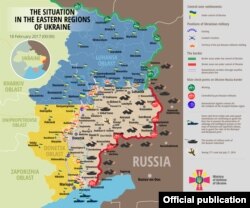
Here is today's map of the security situation in eastern Ukraine, according to the National Security and Defense Council:
It's been three years since Ukraine's Euromaidan protesters took the streets of Kyiv to demand the resignation of pro-Russian President Viktor Yanukovych. RFE/RL's Ukrainian Service has returned to locations in the Ukrainian capital that saw some of the fiercest clashes. Between February 18 and 21, 2014, protests descended into deadly violence as government forces fought brutal street battles with antigovernment demonstrators. (RFE/RL's Ukrainian Service)