



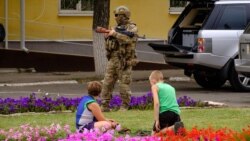
Here's a news item from RFE/RL's Ukrainian Service on the nationalist protest in Kyiv.
Thousands March In Kyiv To Honor 2014 Maidan And Challenge Government
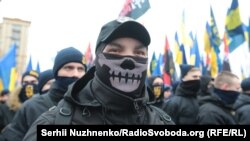
KYIV -- Thousands of activists are marching in Kyiv to honor protesters who were killed during the pro-European Maidan demonstrations in 2013-14 and to challenge the government.
The so-called March of National Dignity was organized by three nationalist parties -- Svoboda (Freedom), the National Corps, and Right Sector.
Activists gathered on Kyiv's central Maidan Nezalezhnosti (Independence Square) early on February 22 and began marching toward parliament, where they planned to announce their demands to lawmakers, the cabinet, and President Petro Poroshenko.
Organizers have said their demands include calls for full investigations of the deadly dispersal of demonstrators in Kyiv in February 2014 and the immediate cancellation of all trade with Russia, which demonstrators called "the aggressor country."
Hundreds of police officers were on the scene.
They also plan to demand a halt to all economic ties with the portions of eastern Ukraine that are currently controlled by Russia-backed separatists.
Here's a rough translation of the interview with Viktor Yanukovych that was originally published in German (from the Kyiv Post's editor):
A tweet linking to a report on a list published by the (aptly named) Facebook group Cargo 200:
Nationalist groups, including the Freedom (Svoboda) and Right Sector parties, are marching in Kyiv today. Three years after the Euromaidan protests, they say the ideals of that popular movement have not been fulfilled and they are going to submit a list of demands to that effect at the parliament building in the capital. RFE/RL's Ukrainian Service has a live feed of proceedings:
And here's another Ukraine-related news item that was issued overnight:
Kyiv Urges Reforms To Stop Russia From Vetoing UN Action On Ukraine Conflict
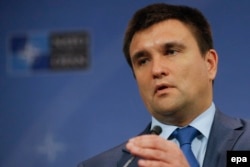
Ukraine has called for reform of the United Nations Security Council's structure to prevent Russia from using its veto power on the council to obstruct actions involving the conflict in eastern Ukraine.
"We need urgently to reform the Security Council in order to remove the veto power abuses," said Ukrainian Foreign Minister Pavlo Klimkin, who chaired a meeting of the council on unresolved conflicts in Europe on February 21.
A provision of the council's charter requires that "a party to a dispute shall abstain from voting" when the council acts, but it has been "blatantly ignored," he said.
Russia used its power, for example, to block an initiative to set up an international tribunal to prosecute those responsible for downing Malaysian Airlines flight MH17 in 2015 over the war zone in eastern Ukraine, killing hundreds of people.
The council should be able to address "bloody conflicts" regardless of whether one of the parties involved is a permanent council member with veto power, Klimkin said.
"It is imperative that clear proceedings are introduced for the proper implementation" of the council's abstention requirement, he said.
Russia, which maintains that it has no troops in Ukraine despite evidence to the contrary, has previously rejected as unacceptable any curbs on its veto power.
Based on reporting by Union Information Agency and TASS
Good morning. We'll get the live blog rolling today with this item from RFE/RL's Patrice Hill in Washington:
Monitor Says Ukraine Cease-Fire, Weapons Withdrawal Not Being Honored
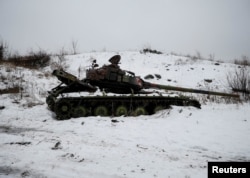
The head of the Organization for Security and Cooperation in Europe (OSCE) has said there are still "significant" violations of the cease-fire in Ukraine and "no evidence" that either side is withdrawing heavy weapons from the front line as agreed last week.
"There are still a significant number of violations of the cease-fire, so it's not really quiet...And they have no evidence of the withdrawal of weapons," Lamberto Zannier, the organization's secretary-general, said at a press conference in New York on February 21 after he briefed the United Nations Security Council on the conflict.
"We will have to keep pushing both sides" to secure compliance, he said.
Ukrainian government troops and Russia-backed separatists had appeared to be respecting the new cease-fire attempt earlier in the week, with each side acknowledging that the other was complying.
However, Zannier told the Reuters news agency that the situation remains "confused" and he sees the potential for a restart of another intense phase of combat.
Last week's cease-fire agreement was the latest effort to carry out the 2015 Minsk peace protocol, which has failed repeatedly to bring about peace since it was signed two years ago.
Zannier said that, beyond the problems with getting a cease-fire to hold in Ukraine, "the larger picture remains problematic" in Europe, with a new "Cold War mentality" setting in, but without the mechanisms for dealing with potential crises that existed during the Cold War.
"There's no real reconciliation, no trust. Relationships between Russia and the West remain strongly visceral," he said. "There was dialogue during the Cold War which resulted in a number of things...Now this dialogue doesn't really exist" and has been replaced by accusations being hurled from one side to the other.
"The tools we have are not really working as well as they should to intervene in a crisis situation, to ensure potential crises didn't turn into conflicts," he said.