



That concludes our live-blogging of the Ukraine crisis for Thursday, February 23, 2017. Check back here tomorrow for more of our continuing coverage. Thanks for reading and take care.
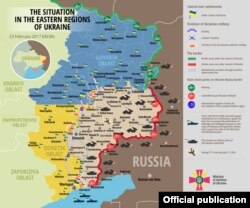
Here is today's map of the security situation in eastern Ukraine, according to the National Security and Defense Council:
From RFE/RL's Rikard Jozwiak in Brussels...
Dutch Lawmakers Vote In Favor Of EU-Ukraine Deal
BRUSSELS -- The Netherlands' lower house of parliament has voted for the ratification of the EU-Ukraine Association Agreement, leaving a vote in the upper house -- the Dutch Senate -- as a final hurdle before the deal, which was signed in March 2014, finally can enter into force.
It has been expected that the House of Representatives would vote in favor of the deal, as the governing coalition enjoys a majority there.
The Senate vote is expected to take place only after the next month's parliamentary elections in the Netherlands on March 15, despite the fact that the composition of the Senate isn't affected by the general election.
The Netherlands is the only EU country that still hasn't ratified the Association Agreement with Ukraine after 61 percent voted against it in a citizen-driven referendum in the country in April 2016.
Although the result was consultative, the Dutch government decided to negotiate a legally binding supplement to the Association Agreement with the other 27 EU member states.
The supplement, which does not change the text of the actual agreement, was adopted at an EU summit in Brussels in December 2016 and outlined, among other things, that the EU-Ukraine deal doesn't give Kyiv the right to EU membership or guarantees of military support from the EU.

Everyone Seems To Have A Peace Plan For Ukraine
By Christopher Miller
KYIV -- It seems that peace plans for Ukraine are everywhere these days.
Amid a recent surge in violence in eastern Ukraine and yet another failed cease-fire in the nearly 3-year-old conflict are a wave of new proposals to bring peace to the crisis-stricken nation -- and from some unexpected places.
The Ukrainian Army has battled against Russia-backed separatists in the eastern Donbas region since 2014, with more than 9,750 people killed and more than 1.8 million displaced in that time, according to the United Nations.
More than 40 Ukrainian soldiers, separatists, and civilians have been killed in an uptick in fighting just since January.
The hostilities have continued despite an official peace deal known collectively as the Minsk agreements, the first of which was agreed in September 2014, followed by the second -- a reaffirmation -- in February 2015 by Ukraine, Russia, as well as the Moscow-backed separatists.
But the Minsk agreements have become unpopular and seem impervious to being implemented, leading to frustration and perhaps the flurry of new peace proposals.
Each new plan -- made by a mix of known politicians and shadowy operatives -- has sparked fierce debate in Kyiv political circles and among the Ukrainian public.
And the suspected motivations behind the peace offerings run the gamut, from personal ambition to a Kremlin plot to destroy Ukraine.
Balazs Jarabik, a nonresident scholar at the Carnegie Endowment for International Peace, told RFE/RL that he thinks the main reason for the peace plans seems to be to weaken Ukrainian President Petro Poroshenko, who remains in limbo between the increasingly disparaged Minsk agreements and "victory."
"Minsk is unpopular, peace is not. People are fed up with the war and the corruption [among government officials]," Jarabik said.
Some of the peace plans share similarities, while ideas in others seem to come from left field. Many of the news ones are far-fetched or wholly unacceptable to either Kyiv or Moscow.
In brief and collectively, they include:
-- Ukraine leasing the Russian-annexed Crimea to Moscow long-term, followed by a referendum to decide the Black Sea peninsula’s fate once and for all;
-- Temporarily setting aside the dispute over Crimea and Kyiv’s continued integration with the European Union and flirtation with NATO membership to focus on stopping the conflict in the east;
-- Reinstating elected officials from 2010 -- the last time nationwide elections included areas under the control of separatists -- and bringing in UN peacekeepers;
-- Allowing separatist leaders from the Donetsk and Luhansk regions to be included in Minsk negotiations with Ukrainian officials and reserving the option to hold a referendum on the status of the Donbas if Kyiv doesn’t fulfill its part of the Minsk deal;
-- Bringing back Viktor Yanukovych, Ukraine’s ousted ex-president living in self-imposed exile in Russia since 2014, to head a pro-Russian eastern region with more autonomy.
For a closer look at each of the plans, CLICK HERE.