



That concludes our live-blogging of the Ukraine crisis for Thursday, March 2, 2017. Check back here tomorrow for more of our continuing coverage. Thanks for reading and take care.
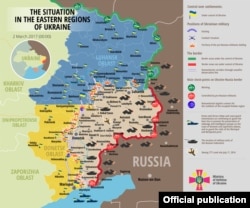
Here is today's map of the security situation in eastern Ukraine, according to the National Security and Defense Council:
From RFE/RL's correspondent in Brussels, Rikard Jozwiak:
EU Ambassadors Agree To Prolong Sanctions On Yanukovych, Associates
BRUSSELS -- European Union ambassadors have decided to prolong asset freezes imposed by Brussels against Ukraine's former President Viktor Yanukovych and 14 of his associates.
The decision on March 2 by the ambassadors sets up a vote by EU ministers who are expected to confirm the one-year extension when they meet in Brussels on March 3.
One politician who previously had been sanctioned by the EU, Yuriy Ivanyushchenko from Yanukovych's former party, the Party of the Regions, has been removed from the sanctions list that was approved by the EU ambassadors on March 2.
Ivanyushchenko recently was cleared of any wrongdoing by Ukraine's high court.
The EU sanctions were imposed shortly after the collapse of Yanukovych's government in February 2014 against people who, according to the EU, "were responsible for the misappropriation of Ukrainian state funds or for abuse of office causing a loss to Ukrainian public funds."
Apart from Yanukovych, the list includes his son Oleksandr Yanukovych, former Prime Ministers Mykola Azarov and Serhiy Arbuzov, and the head of Yanukovych's administration, Andriy Kliuiev.
Ukraine's former Prosecutor-General Viktor Pshonka, former Justice Minister Olena Lukash, and former Interior Minister Vitaliy Zakharchenko remain on the EU sanctions list.
The European Court of Justice in 2016 rejected challenges filed against the sanctions by Yanukovych and others on the list.
The court ruled that the reason for imposing sanctions against them was lawful.
Coal-Mine Blast, Collapse In Western Ukraine Kills Eight
By RFE/RL
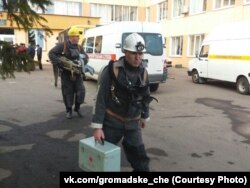
Authorities in Kyiv say a methane gas explosion and tunnel collapse at a underground coal mine in western Ukraine has killed eight workers.
Ukraine's State Emergency Service said on March 2 that 20 other miners who were trapped beneath the surface have been rescued.
"All the miners have been brought to the surface," the authorities said.
Six other injured miners were able to escape on their own from the mine shortly after the explosion.
There was no immediate word about the condition of the injured miners.
The mine is located in Ukraine's western region of Lviv near the border with Poland.
Authorities said 34 miners were working at a depth of about 550 meters when a buildup of methane gas exploded.
The coal mine is operated by a state company called Lvivvuhillya.
About 172 total workers were at the facility at the time of the disaster, authorities said.
Regional Governor Oleh Synyutka said the mine has been preparing to increase its coal output in an attempt to make up for the loss of coal supplies from parts of eastern Ukraine that are under the control of Russia-backed separatists.
The separatists in eastern Ukraine continued to supply coal to the government in Kyiv after their conflict against Ukrainian government forces began in April 2014.
But Ukrainian activists, including some members of the parliament in Kyiv and many former government soldiers who are veterans of the conflict, started in January to blockade train routes into eastern Ukraine to protest the coal deals.
The blockade has cut off supplies of coal from eastern Ukraine that are desperately needed in western Ukraine for power plants, causing power shortages and other harm to Ukraine's economy.
The disruptions prompted Ukrainian President Petro Poroshenko recently to declare an emergency in late February and to urge all Ukrainians to try to conserve energy.
Meanwhile, the Russia-backed separatists have threatened to stop supplying coal to the government in Kyiv or companies that are not in separatist-controlled areas.