


EU Slams Russia Over Crimea Annexation On Third Anniversary
By RFE/RL
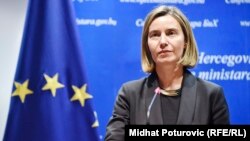
The European Union on March 17 condemned Russia’s seizure of Ukraine’s Crimea territory, calling Moscow’s annexation of the Black Sea peninsula a “direct challenge to international security.”
The statement by EU foreign affairs chief Federica Mogherini came one day ahead of the third anniversary of Russia’s formal incorporation of Crimea that was dismissed as illegitimate by Ukraine, the United States, and more than 100 countries in the United Nations General Assembly.
“Three years on from the illegal annexation of the Autonomous Republic of Crimea and the city of Sevastopol by the Russian Federation, the European Union remains firmly committed to Ukraine's sovereignty and territorial integrity,” Mogherini said.
Both the EU and the United States hit Russia with several rounds of sanctions in response to the land grab and Moscow’s backing of separatists whose war against government forces has killed at least 9,940 people in eastern Ukraine.
That conflict continues to grind on despite a 2015 peace deal reached in Minsk, Belarus. The Ukrainian military said on March 17 that two of its soldiers were killed and eight others wounded a day earlier in attacks by the separatists in the swathe of eastern Ukraine known as the Donbas.
Separatist leader Igor Plotnitsky vowed on March 17 that a referendum would be staged on the incorporation of separatist-controlled areas into Russia.
Prior to annexing Crimea, Russia staged a referendum on the peninsula following the seizing of key government buildings there by unmarked Russian special forces after former Ukrainian President Viktor Yanukovych fled to Russia amid mass street protests across the country.
Moscow used the poll, rejected by Kyiv and the West as illegal, as justification for taking control of Crimea, claiming it represented the will of the people there.
Russian President Vladimir Putin's drew international condemnation last month by signing a decree ordering Russian authorities to recognize identity documents issued by the separatists who hold parts of Ukraine's Donetsk and Luhansk regions.
The Kremlin however, is not considering integrating the separatist-controlled areas into Russia, spokesman Dmitry Peskov said on March 17.
"We do not see any eventual deliberations as possible in this context," he said.
He accused Ukraine of "deliberately rejecting" the region, criticism that came days after Ukrainian authorities announced the suspension of all cargo traffic with areas held by the separatists.
Addressing the anniversary of the Crimea annexation, Peskov told reporters that Russia hopes that "sooner or later Kyiv will start to treat the will expressed by the several million Crimean residents with respect and will accept the results" of the 2014 referendum staged by Moscow there.
Russia has portrayed its military operation in Crimea following Yanukovych’s ouster as necessary to protect ethnic Russians and other residents of the peninsula from oppression by pro-Western officials that eventually took power in Kyiv.
That narrative is rejected by Ukraine and Western governments, which accuse Russian-backed authorities in Crimea of rights abuses against Crimean Tatars and others opposed to Moscow’s rule there.
Referring to the annexation, Mogherini said in her March 17 statement that the EU “reiterates that it does not recognize and continues to condemn this violation of international law.”
“It remains a direct challenge to international security, with grave implications for the international legal order that protects the unity and sovereignty of all states,” she said.
While U.S. President Donald Trump has said he wants to improve ties with Russia and previously indicated he could consider lifting sanctions against Moscow related to Crimea, his young administration has repeatedly denounced Russia’s takeover of the peninsula.
State Department spokesman Mark Toner said in a March 16 statement that Washington “again condemns the Russian occupation of Crimea and calls for its immediate end.”
With reporting by RFE/RL's Brussels correspondent Rikard Jozwiak, RIA-Novosti, TASS, Interfax, and Reuters
Barring any major developments, that ends the live blogging for tonight.
From Trump's presser with Merkel:
U.S. President Donald Trump says a “peaceful solution” is needed to resolve the conflict in Ukraine, where at least 9,940 people have been killed in the war between Kyiv’s forces and Russia-backed separatists.
Trump made the statement at March 17 news conference with German Chancellor Angela Merkel following their meeting at the White House.
He thanked Merkel and French President Francois Hollande for their work in brokering a 2015 peace deal aimed at ending the conflict, though violence between the two sides continues to grind on.
“We ideally seek a peaceful solution" in Ukraine, Trump said.
Trump has said he wants to improve ties with Moscow, though his administration has harshly criticized Russia’s 2014 annexation of Ukraine’s Crimea territory and its support for the separatists.
Merkel told the news conference that relations with Russia need to be improved but that the crisis in Ukraine must first be resolved.
In case you missed it, today's Daily Vertical:
This might get awkward...
The Ukraine language bill has passed:
Ukrainian lawmakers have approved a bill that requires national television and radio stations to have at least 75 percent of their programming in the Ukrainian language.
The issue is controversial among Ukraine’s Russian-speaking population, and pro-Russia separatists fighting in eastern Ukraine claim Kyiv is deliberately reducing the use of the Russian language. Kyiv denies the allegation.
The legislation is still going through parliament and requires presidential approval. The first reading of the bill was approved on March 16.
The bill also requires local TV and radio stations to have 50 percent of their content in Ukrainian.
The language quotas would be in place between 0700 and 2200.
The bill also requires that foreign films aired on Ukrainian television channels, including Russian movies, must carry Ukrainian subtitles.
Viktoria Syumar, chairwoman of the parliamentary committee for freedom of speech and information policies, told a session that some Ukrainian broadcasters have up to 90 percent of their programming in Russian.
She added that the Crimean Tatar language was included in the Ukrainian language quota.
Based on reporting by Interfax and UNIAN
Latest from our news desk on Nasirov:
KYIV -- Ukraine's suspended tax and customs service chief, Roman Nasirov, was summoned to the National Anti-Corruption Bureau (NABU) for questioning on March 17.
In a rare attempt to prosecute a high-level official in Ukraine over alleged corruption, Nasirov is being investigated on suspicion of defrauding the state of 2 billion hryvnyas ($74 million).
The summons came a day after he was released from pretrial detention when his family paid his 100-million-hryvnya ($3.7 million) bail -- a record high in Ukraine.
NABU said on March 17 that it has lodged an official request with the State Service for Fiscal Monitoring to find out where his relatives came up with the money.
Upon his release on March 16, Nasirov told journalists that the case against him is "politically motivated" and said he would fight to prove his innocence. http://www.radiosvoboda.org/a/28374256.html
"I am thankful to my family that they somehow managed to find this crazy amount of money," he said. "Now I have a better opportunity to quickly and fully prove my absolute innocence and the absolute groundlessness of the allegations."
Nasirov was suspended from his post on March 3, and a district court in Kyiv on March 7 ordered him placed in pretrial detention for two months.
NABU says that Nasirov signed off on grace periods for a number of taxpayers, including companies linked to a former lawmaker who fled the country in 2016 while facing a corruption investigation.
During earlier court hearings related to Nasirov's pretrial arrest, dozens of activists rallied in Kyiv to ensure Nasirov does not escape trial. That was not the case when Nasirov's was released long after dark on March 16.
Officials had said that Nasirov would be placed under house arrest if he made bail, but the Specialized Anti-Corruption Prosecutor's office (SAP) said on March 16 that he would not be confined to his home.
It said that he had been fitted with an electronic monitoring device. and he will be allowed to move around the city of is residence -- Kyiv.
https://www.facebook.com/sap.gov.ua/photos/a.836519139784604.1073741828.836354983134353/877575582345626/?type=3&theater
He is barred from leaving the city without investigators' permission, hand in travel documents so that he cannot leave Ukraine, and contact or communication with people involved in the probe.
President Petro Poroshenko’s government is under pressure from Ukrainians, Western governments, and groups such as the International Monetary Fund (IMF) to fight corruption.
Observers say corruption harms the economy and hurts Ukraine's chances of throwing off the influence of Russia, which seized Crimea in 2014 and backs separatists whose war against government forces has killed more than 9,900 people in eastern Ukraine.
Lithuania Wants NATO Command To Move Closer To Eastern Borders
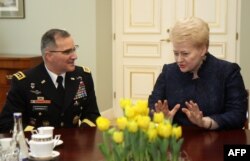
Lithuania’s president says NATO should move its command centers closer to the alliance’s eastern borders to deter the "growing threat from Russia."
President Dalia Grybauskaite on March 16 said NATO’s current location in Western Europe is a relic of the Cold War and that more forces should be redeployed.
"The current NATO command structures and military forces were positioned according to the Cold War logic -- in Europe's west and south," Grybauskaite said after talks with U.S. General Curtis Scaparrotti, NATO's supreme allied commander.
With the "growing threat from Russia, it is necessary to redeploy allied forces to the eastern flank," she said.
She said NATO has been "too slow" to redeploy its command structure from Western Europe.
Scaparrotti told reporters that advanced technologies enable the Western military alliance "to command and control from different locations."
Since World War II, U.S. and NATO forces have been stationed in Western Europe, mainly in Germany, Britain, and Italy.
But NATO is beefing up its presence in Eastern Europe, deploying four multinational battalions to the Baltic states and Poland on a rotational basis in an effort to reassure Eastern members in the face of Russia's military support for separatists in eastern Ukraine and its illegal annexation of Ukraine's Crimean Peninsula.
Hundreds of NATO troops and heavy equipment have been moved to Lithuania as part of that process.