
Here's more on the latest Eurovision kerfuffle, from RFE/RL's news desk:
Ukraine Bars Russia's Eurovision Contestant Over Crimea Visit

Ukraine's main state security agency has announced it has barred Russia's contestant in the Eurovision Song Contest from entering the country, drawing a swift and angry reaction from Moscow.
"The Security Service of Ukraine has prohibited Russian Federation citizen Yulia Samoilova from entering Ukrainian territory for a period of three years," agency spokeswoman Olena Hitlyanska said on Facebook on March 22.
She said the decision was based on information indicating that Samoilova had violated Ukrainian law, an apparent reference to a visit by the singer to Crimea in 2015 -- the year after Russia seized control of the Black Sea peninsula from Ukraine.
Ukrainian law enables the government to ban people who have traveled to Crimea without obtaining prior permission from Kyiv. Ukraine last year blacklisted 140 Russian performing artists on those grounds.
Ukraine won the right to host this year's edition of Eurovision, a colorful annual song contest watched live on television by nearly 200 million people last year, when its contestant won in 2016. The final will be held on May 13 in Kyiv.
Russian Deputy Foreign Minister Grigory Karasin called the ban "the latest baldly cynical and inhuman act by the Kyiv authorities."
Samoilova, 27, was chosen as Russia's contestant on March 12. The singer, who suffers from a rare muscular disorder that leaves her bound to a wheelchair, performed in the Crimean city of Kerch in mid-2015.
Russia took control of Crimea in March 2014, after sending in troops and staging a referendum considered by most countries worldwide as illegitimate.
The takeover was decried in the West as an aggressive attempt to redraw European borders and upset the postwar security order, and led to the imposition of sanctions on Russia by the United States, the European Union, and other countries.
Moscow moved to seize the peninsula after Russian-friendly Ukrainian President Viktor Yanukovych was pushed from power in Kyiv by protesters incensed over his decision to scrap plans for a pact tightening ties with the European Union.
The seiziure of Crimea, which Russian President Vladimir Putin has called sacred Russian land, was followed by an upsurge in separatism in eastern Ukraine, which Kyiv says was fomented by Moscow.
It led to a war between Russia-backed separatists and Ukrainian forces that has killed more than 9,900 people in eastern Ukraine since April 2014.
With reporting by Unian, Interfax, and TASS
NEWS FLASH:
Ukraine's main state security agency says Russian's Eurovision Song Contest contestant, Yulia Samoilova, is barred from entering the country.
(Unian, Interfax)
More to follow...
Fears Of Mass Property Confiscation In Donbas
A new regulation approved by Russia-backed separatists in eastern Ukraine has sparked fears that apartments abandoned by people who fled the fighting in the region could be seized on a mass scale. (RFE/RL's Ukrainian Service)

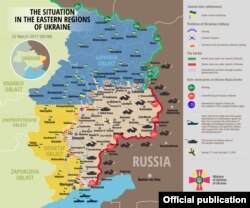
Here is today's map of the security situation in eastern Ukraine, according to the National Security and Defense Council:
Crimean Tatar Leader Likely To Face Trial Soon On Separatism Charge
By RFE/RL
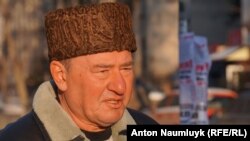
A Crimean Tatar leader who has criticized Russia's seizure of the Black Sea peninsula appears likely to face trial soon on what he says are spurious charges of separatism.
Ilmi Umerov, deputy chairman of the Crimean Tatars' self-governing body, the Mejlis, said he and his lawyer were informed on March 21 that the case against him had been sent to a court in Russia-controlled Crimea.
He also said he has received the final written charges, a step that is often followed within days or weeks by a trial.
Umerov, 59, was charged with separatism in May 2016 after he made public statements opposing Russia's seizure of Crimea from Ukraine in March 2014.
He denies the charges, saying he has the right to express his opinions freely.
Russia took control of Crimea after sending in troops and staging a referendum considered by most countries worldwide as illegitimate.
After the takeover, Russia adopted a law making it a criminal offense to question Russia's territorial integrity within what the government considers its borders.
RFE/RL contributor Mykola Semena went on trial in Crimea on March 20 on separatism charges he says are unfounded.
Trump To Reaffirm 'Strong Commitment' At NATO Summit In May
U.S. President Donald Trump plans to attend a NATO summit on May 25 in Brussels.
In a statement on March 21, the White House said that Trump "looks forward to meeting with his NATO counterparts to reaffirm our strong commitment to NATO."
It said he also plans to "discuss issues critical to the alliance, especially allied responsibility-sharing and NATO’s role in the fight against terrorism."
Trump caused concern during the presidential campaign by calling NATO obsolete.
He has since stressed that the United States is committed to NATO but has pushed hard to get other members of the 28-nation military alliance to increase defense spending, saying that many are not paying their fair share.
The statement also said that Trump will meet with NATO Secretary-General Jens Stoltenberg at the White House on April 12.
With reporting by Reuters
RFE/RL's Brian Whitmore takes a look at Putin's Plan B in Ukraine in today's Daily Vertical commentary: