

From a former NATO chief:
Another item from our news desk:
Ukraine President Orders Cease-Fire In Eastern Conflict Zone
Ukrainian President Petro Poroshenko has ordered the military to implement a cease-fire and weapons pullback in the conflict region in eastern Ukraine beginning on April 1.
Poroshenko made the announcement on March 30 in Malta, where he was meeting with European Commission head Jean-Claude Juncker.
Porosehnko said that he is "not very optimistic" that the Russia-supported rebels controlling parts of two eastern Ukrainian regions will abide by the agreement, which was reached in Minsk on March 29.
According to the Russian state news agency TASS, a spokesman for the militants in Luhansk said on March 30 that his forces are "always ready to ensure the cease-fire."
During a meeting of the Russia-NATO Council in Brussel, NATO Secretary-General Jens Stoltenberg pressed Russia to compel the militants to implement the cease-fire and withdraw their heavy weaponry.
He also asked Moscow to ensure that international observers from the Organization for Security and Cooperation in Europe have complete access to the conflict area.
Based on reporting by dpa, Reuters, and TASS
Here's an item on NATO-Russia talks from our news desk:
Ukraine Conflict Dominates NATO-Russia Council Session
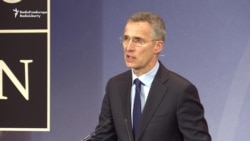

NATO representatives have told Russia that the situation in Ukraine is of "deep concern" at the first session of the Russia-NATO Council to be held this year.
NATO Secretary-General Jens Stoltenberg told journalists after the Brussels meeting on March 30 that the meeting was "frank" and "constructive" although the two sides "continue to have clear disagreement" on the crisis in Ukraine.
Stoltenberg said the alliance urged Moscow to use its influence with militants in eastern Ukraine to compel them to meet their obligations under the so-called Minsk process to resolve the crisis.
He added that NATO was firm in its support for Ukraine's sovereignty and territorial integrity.
"The allies do not and will not recognize Russia's illegal annexation of [the Ukrainian region of] Crimea," Stoltenberg said.
Russia's ambassador to NATO, Aleksandr Grushko, in turn criticized NATO for "continuing to provide political and practical support to Kyiv," a policy that he said is "at odds with genuine interests of conflict settlement."
He urged NATO to pressure Kyiv to resume trade and transit with the rebel-held areas.
On March 15, Kyiv announced the suspension of all cargo traffic with separatist-held areas of eastern Ukraine, essentially putting a blockade launched by activists in January under state control.
The NATO-Russia Council also discussed various military activities and ways of improving "risk reduction" following numerous incidents of close encounters between Russian and NATO military assets.
"It is not an easy dialogue," Stoltenberg said. "But it is a dialogue we are committed to. And when tensions run high, it is even more important to keep talking with each other to increase predictability and reduce risks."
Ambassador Grushko told told Russian media that "it is not possible to build confidence until NATO abandons its military-domination policy."
He criticized NATO for purportedly adopting a "policy aimed at restraining Russia and demonstrating their military capabilities near our borders."
He added that such meetings of the Russia-NATO Council are important "but they are not enough to improve the security situation." He warned against pursuing "dialogue for the sake of dialogue."