

History repeating itself?
Good morning.
We'll get the live blog rolling again today with some reaction to Emmanuel Macron's victory in the French presidential election and what it might mean for Ukraine:
Here's an excerpt:
The French elections were especially important for Ukraine, since France is a member of the Normandy format established to resolve the conflict in eastern Ukraine, and Front Nationale leader Marine Le Pen’s victory would have meant an irremediable turn for the Donbas peace talks.
As in most European capitals, Le Pen’s defeat seen as a victory for Kyiv. However, the victory of centrist Emmanuel Macron leaves Ukrainians with only a cautious optimism, mostly because of his largely unknown stance on Ukraine.
Throughout the entire campaign, Macron scarcely commented on Ukraine and the way he sees relations with this huge eastern neighbour of the EU. Nevertheless, Macron briefly touched upon the conflict in eastern Ukraine and made it perfectly clear that de-escalation is a must. Also, earlier in his campaign he mentioned that fulfilment of the provisions of the Minsk agreement, signed to end the war in the Donbas region, is the only way for Russia to get rid of the economic sanctions imposed by the EU. His words didn’t sound new as they repeated the position of other members of the Normandy peace talks.
In this case, no news is good news since Macron’s victory means the continuation of France’s previous stance in talks, while Le Pen would have meant a turn towards Russia. The Normandy talks may not have resulted in any breakthrough so far, but it is very important for Ukraine that this diplomatic platform isn’t turned into Russian President Vladimir Putin’s puppet theatre.
Apart from Donbas, we don’t know much what the future of Ukrainian-French relations will be. All the signs show Ukraine will maintain decent working relations with France with good chances to evolve. However, France’s position towards Eastern Europe will be largely determined by the temperature of relations between the Elysee Palace and the Kremlin.
We are now closing the live blog for today, but we'll be back again tomorrow morning to follow all the latest developments. Until then, you can keep up with all our other Ukraine coverage here.
Ukrainian President Petro Poroshenko tweets his congratulations to Emmanuel Macron on his "spectacular victory" in the French presidential election and says he's counting on "ambitious cooperation" with Paris and intensifying the Normandy format.
Here's another Eurovision-related item, this time from RFE/RL's news desk:
Ukraine Blocks Entry Of Two Russian Journalists Heading To Eurovision
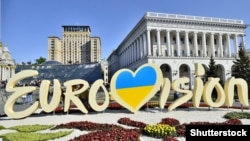
Ukraine has blocked entry to the country of two Russian journalists who were going to Kyiv to cover the Eurovision Song Contest.
Two reporters from the newspaper Komsomolskaya Pravda, both accredited to work at the contest, were detained at the border and eventually turned away and barred from entering Ukraine for three years, according to border service spokesman Oleh Slobodyan.
"The state border service notes that having accreditation for Eurovision does not give you the right to cross the border," Slobodyan wrote on Facebook on May 7.
The newspaper confirmed to the TASS news agency that the reporters were denied entry to Ukraine.
Though Eurovision is supposed be about bringing people together through music, the contest has often struck political notes over the past six decades and this year's edition is no exception.
In April, Ukraine banned Russia’s entrant to the contest, singer Yulia Samoilova, because she violated Ukrainian law by performing in Crimea in 2015. Russia illegally annexed the Ukrainian peninsula in 2014.
Russia slammed Kyiv's ban and rejected a compromise under which Samoilova would be allowed to compete via satellite link. The country later pulled out of the contest altogether.
Russia occupation and subsequent annexation of the Crimean Peninsula, allegedly thrust eastern Ukraine into war in 2014. The resulting conflict has cost at least 9,940 lives and displaced roughly 2 million people.
Ukraine fears Russian-orchestrated provocations during Eurovision, Mariana Betsa, head of communications for the Ukrainian Foreign Ministry, said.
Ukraine won the right to host the Eurovision contest by winning last year.
The semifinals are set for May 9 and May 11, while the final will be held May 13.
With reporting by TASS and AFP
Here's what one of the experts we talked to in our news story said Emmanuel Macron's victory in the French presidential election could mean for Ukraine:
Macron's foreign policy is expected to largely be a continuation of the course set by current President Francois Hollande, a Socialist in whose government Macron served as economy minister from 2014 to 2016.
"Macron is a politician who has never in his career dealt with [foreign policy] issues...so you can expect lots of predictability on the Macron team," Martin Michelot, deputy director of the EUROPEUM Institute for European Policy, told RFE/RL, ticking off a list of EU points of emphasis vis-à-vis security and Russia, whose invasion of Ukraine and continuing support of separatists there prompted Western sanctions: "the same strong position on Russia, the importance of respecting the Minsk agreements, on not recognizing the illegal annexation of Crimea," and a strong commitment to NATO.