



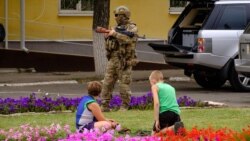
Meanwhile in Russia...
In other news, Eurovision kicks off today in Kyiv. It's the first semifinal. BBC has a primer on who to watch our for.
We are now closing the live blog for today, but we'll be back again tomorrow morning to follow all the latest developments. Until then, you can catch up with all our other Ukraine coverage here.
Before we go tonight, we'll point you in the direction of this intriguing feature written by Aleksandr Litoi for RFE/RL's Russian Service:
Head Of Donbas 'People's Army' A Wanted Man In Russia
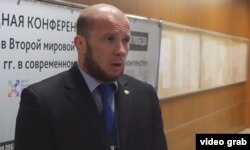
Georgy Makaryev doesn't act like a wanted man.
He leads a high-profile life among the Russia-backed separatists in Ukraine's Luhansk region as the head of a "patriotic" youth organization called NADO, or the People's Army of Donbas.
He regularly organizes athletic and cultural events and frequently appears at gatherings organized by the separatist leadership -- often at the side of Ihor Plotnitskiy, the head of the Russia-backed separatist group that calls itself the Luhansk People's Republic. His NADO has opened three free athletic centers in the separatist-controlled area, where youths can study boxing and martial arts while getting steady doses of "patriotic education."
But the 39-year-old former police investigator from the Russian region of Kabardino-Balkaria is wanted in Russia for organizing and participating in a brutal May 2016 fight between hundreds of young toughs and a group of mostly Tajik migrant workers at Moscow's Khovanskoye Cemetery. That incident left three of the Tajik migrants dead and about 30 people injured.
The case against the first 16 Khovanskoye defendants is expected to go to trial soon, but Makaryev will be tried in absentia. The photograph of him on the wanted list of Russia's Center Against Extremism shows him wearing the black uniform and insignia of NADO.
Apparently, the separatist authorities in Luhansk -- who are entirely dependent on Moscow for military, political, and economic support -- feel no pressure to hand over the fugitive in their midst. Novaya Gazeta reported last month that Russian investigators had traveled to Luhansk to seek Makaryev's extradition but "were unable" to secure it.
Read the entire article here.
A lot of Ukraine-watchers will no doubt be interested in this:
The Odesa Blogger's thoughts on Victory Day:
Here's another item from our news desk:
Ukraine Says Poroshenko And Merkel Discuss Russia, Conflict In East
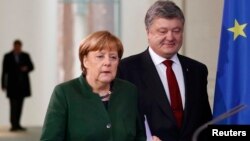
Ukrainian President Petro Poroshenko's office says he and German Chancellor Angela Merkel have discussed her meeting last week with Russian President Vladimir Putin.
Poroshenko's office said in a May 8 statement that a telephone call between the two leaders earlier in the day also addressed Kyiv's conflict with Russia-backed separatists and the death last month in eastern Ukraine of a monitor with the Organization for Security and Cooperation (OSCE).
The call follows Merkel's May 2 meeting with Putin in Russia's Black Sea port of Sochi for talks that focused on the conflicts in Ukraine and Syria.
Germany has been a key broker between Kyiv and Moscow over the conflict in eastern Ukraine, which has killed at least 9,940 since April 2014, according to the UN.
Merkel has been a staunch supporter of the EU's sanctions targeting Russia over its backing of the separatists and seizure of Ukraine's Crimean Peninsula in March 2014.
Merkel "informed the Ukrainian president about the results of her negotiations in Russia on May 2," Poroshenko’s office said in its statement.
It added that the two leaders stressed the importance of fulfilling the Minsk accords aimed at ending the violence in the region, as well as the April 23 death of an OSCE monitor in a land-mine explosion in eastern Ukraine.
There was no immediate statement from Merkel's office about the call.
The Ukrainian statement said Poroshenko warned that any displays of weaponry in "occupied territories" -- a reference to Crimea and separatist-held areas of eastern Ukraine -- as part of May 9 Victory Day celebrations would be "unacceptable."
Russia is gearing up for its nationwide celebration of Victory Day, its most revered holiday, commemorating the defeat of Nazi Germany in World War II.
Russia seized control of Crimea in March 2014 after sending in troops without insignia, engineering a takeover of the regional legislature, and staging a referendum that was swiftly dismissed as illegitimate by Ukraine, the United States, and a total of 100 countries at the UN General Assembly.
Moscow has portrayed its takeover of Crimea as necessary to protect ethnic Russians and other residents of the peninsula from oppression by pro-Western officials that took power in Kyiv following the 2014 ouster of former Ukrainian President Viktor Yanukovych.
That narrative has been rejected by Ukraine and Western governments, which accuse Russian-backed authorities in Crimea of rights abuses against Crimean Tatars and others opposed to Moscow's rule there.