

EU Extends Sanctions Against Russia
By RFE/RL
BRUSSELS -- European Union leaders have agreed to extend the bloc's economic sanctions against Russia by six months until January 31.
The 28 EU heads of state and government made the decision on June 22 during a two-day summit in Brussels after German Chancellor Angela Merkel and French President Emmanuel Macron gave a briefing on how the Russia-backed insurgents and Ukrainian forces fighting in eastern Ukraine are adhering to the conditions in the Minsk agreements.
The Minsk agreements were forged by the leaders of France, Germany, Russia, and Ukraine in Minsk in 2015 in an effort to end the fighting.
The sanctions, which mainly target Russia's banking and financial sectors, were first imposed by Brussels in June and July 2014 as a response to Russian aggression in the eastern part of Ukraine and the invasion and later illegal annexation of Crimea.
The sanctions package has been renewed every six months since then.
The EU member states' ambassadors will officially prolong the sanctions either at the end of June or beginning of July.
Earlier this week, the EU rolled over its investment ban on Crimea by another year.
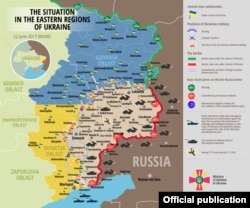
Here is today's map of the security situation in eastern Ukraine, according to the National Security and Defense Council:
Poroshenko Hails EU 'Solidarity' With Ukraine
By RFE/RL
Ukrainian President Petro Poroshenko says he and European Council President Donald Tusk have discussed relations with the EU, as well as U.S. sanctions related to the conflict in eastern Ukraine and to Russia's illegal annexation of Ukraine's Crimean Peninsula.
"I am happy to hear today from Donald [Tusk] and from our consultations with other leaders of the European Union that the position of the EU is unity and solidarity with regard to Ukraine, which is vitally important for us," Poroshenko said at a news conference with the European Council president in Brussels on June 22.
The EU on June 19 extended the bloc's investment ban against Crimea for another year, while the United States on June 20 announced new financial measures against Russia-backed separatists involved in the conflict in eastern Ukraine.
The EU sanctions were introduced in 2014 in response to Russia's illegal annexation of the Ukrainian region and have since been extended on a yearly basis.
"The message about the rolling over of the sanctions is exactly what we are happy to hear these days," Poroshenko said.
Poroshenko, who returned from a trip to the United States, also said that he and U.S. President Donald Trump had "a very promising negotiation and coordination first of all about the sanctions."
The new sanctions announced by the U.S. Treasury Department on June 20 targeted more than three dozen fighters and separatist leaders in the Donetsk and Luhansk regions of eastern Ukraine.
"You know that the United States introduced the new sanctions and confirmed that all sanctions remain in place until the full implementation of [the] Minsk [agreement]," Poroshenko said.
The Minsk peace agreement, brokered by France and Germany and signed by Russia and Ukraine in February 2015, calls for a cease-fire, the withdrawal of heavy weapons from the front lines, and constitutional reforms to give eastern Ukraine more autonomy.
However, the fighting has recently intensified in eastern Ukraine.
A United Nations report on June 13 said at least 10,090 people, including 2,777 civilians, have been killed during the conflict since it began in April 2014.