




New Envoy Volker Says U.S. Considering Sending Arms To Ukraine
By Current Time TV
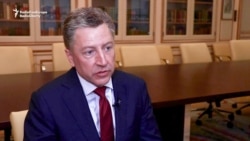
PARIS -- The new U.S. special envoy for efforts to end the conflict in eastern Ukraine, Kurt Volker, says Washington is considering sending Kyiv weapons to help government forces defend themselves against Russia-backed separatists.
Providing lethal defensive weapons would allow Kyiv to "defend itself if Russia were to take further steps against Ukrainian territory," Volker told Current Time TV in an interview in Paris on July 25.
"Russia says it won't do that and isn't doing that, so then there should be no risk to anybody, if that's the case," said Volker, who was appointed on July 7 and visited towns near the front lines in eastern Ukraine on July 23.
President Donald Trump's administration "is now reviewing where the Obama administration left it, considering whether we should provide defensive arms to Ukraine or not," he said. "So that's the state of play."
Volker said he did not think arming Ukraine with lethal defensive weapons would "provoke Russia to do more than they are already doing, and it also isn't going to change any kind of balance that way."
"I hear these arguments that it's somehow provocative to Russia or that it's going to embolden Ukraine to attack. These are just flat out wrong," Volker told Current Time, the Russian-language network run by RFE/RL in cooperation with Voice of America.
"First off, Russia is already in Ukraine, they are already heavily armed," he said. "There are more Russian tanks in there than [tanks] in Western Europe combined. It is a large, large military presence."
After a Moscow-friendly president was pushed from power in February 2014 by massive pro-European protests, Russia seized control of Ukraine's Crimea region and fomented separatism in eastern Ukraine.
The ensuing war between Russia-backed forces and the government has killed more than 10,000 people since Aril 2014 and persisted despite a pact known as Minsk II, a February 2015 agreement on a cease-fire and steps to resolve the conflict.
Volker said that ending the fighting will require agreement by all sides on two major principles -- the "territorial integrity of Ukraine, security of all the people" -- and a change in Russia's approach. He suggested the United States is stepping up its efforts.
"What we need to do is bring this to a higher strategic level -- getting more U.S. involvement and engagement, which is partly why I was named; getting Germany and France, the partners in the Normandy process...and, frankly, getting Russia to make a different strategic choice -- that it wants to solve this conflict too."
"If the issue here is the safety and security of all of the people -- Russian speakers, Ukrainian speakers -- this conflict is not providing that; this conflict is killing that," he said. "And so we've got to do a better job of stopping the conflict, getting the forces out, and then providing a basis of governance going forward."
Progress toward implementation of Minsk II has been slow, and fighting has flared up in recent weeks. Ukraine's Defense Ministry said on July 20 that eight Ukrainian soldiers were killed and 10 were wounded amid intense shelling in the previous 24 hours, one of the highest tolls in months.
"We see as many as 1,500 or more cease-fire violations every night," Volker, a former U.S. ambassador to NATO, told Current Time in the interview in Paris. "So this is a very hot conflict that's going on and it has a terrible cost."
Sanctions imposed by the United States and European Union have not prompted Russia to abandon its support for the separatists or fulfil its commitments under Minsk II.
Volker said that is "not a reason to reverse course -- it's a reason to think about what else we can do to get to a point where we can actually solve this."
He also said that Washington and its allies needed to increase their information campaign to counter what he described as Russian "propaganda."
"We need to be...making clear that the Ukrainian people are suffering, making clear that people in the Donbas are suffering, they are cut off from services and supplies from the rest of Ukraine, from Kyiv, they are being blocked by the armed groups that are there led by Russia," Volker said.
Leading Republican Says Russia Sanctions Bill Not Finalized
By RFE/RL
A leading Republican senator says a bill toughening sanctions on Russia has not been finalized, despite earlier announcements of a bipartisan agreement.
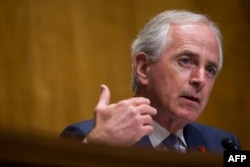
Senator Bob Corker, chairman of the Senate Foreign Relations Committee, told reporters on July 24 that "we still have a little work to do," adding that he expected differences over details in the legislation to be settled quickly.
Corker's comments came just minutes after the White House said President Donald Trump would examine the bill, which also includes new sanctions on Iran and North Korea, to determine if it was the "best deal" for the American people.
"He's going to study that legislation and see what the final product looks like," White House spokeswoman Sarah Huckabee Sanders told reporters on July 24 during a briefing on Air Force One.
The comments by the White House and Corker appear to back off earlier announcements from the administration and Congress over the status of the legislation.
On July 22, Republican and Democratic lawmakers in Washington said they had reached agreement on the legislation that would slap the new sanctions on Moscow and limit the president’s ability to ease or lift them by himself.
A day later, the White House indicated it was ready to accept the legislation, which the administration had originally opposed.
"We support where the legislation is now and will continue working with the House and Senate to put those tough sanctions in place on Russia until the situation in Ukraine is fully resolved," Sanders told ABC television on July 23.
Trump has repeatedly said he wants to improve ties with Moscow, triggering bipartisan concern in Congress that he could lift or ease sanctions punishing Russia for its 2014 seizure of Ukraine's Crimean Peninsula and backing of separatists in eastern Ukraine.
So far, the U.S. administration has shown no indication it intends to lift Ukraine-related sanctions targeting Russia, which denies providing weapons and personnel to separatists in eastern Ukraine despite evidence of such support.
The bill is set to be considered in the House of Representatives as early as July 25.
The Senate will also have to vote on the new bill, which would require Trump to send a report to Congress outlining why the administration wants to suspend or terminate any sanctions. Lawmakers would then have one month to decide whether to allow such a move.
A refusal by Trump to sign the bill would likely trigger political backlash in Washington given the ongoing FBI and congressional investigations into Russia's alleged meddling in the 2016 presidential election and contacts between Trump campaign associates and Russian officials.
Objections to the legislation has come from Russia as well as from Washington’s European Union allies, who have been highlighting the effect it might have on joint energy projects.
Russian President Vladimir Putin's spokesman, Dmitry Peskov, said Russia is "working with our European partners on implementing a number of large-scale projects."
"It goes without saying that we and our European partners attach great importance to finishing these projects and we will work towards this," Peskov said in response to a question about the potential effect on projects such as Nord Stream 2, a pipeline that is to carry Russian gas across the Baltic Sea to Europe.
"That is why discussions about 'sanctions themes' -- which could potentially obstruct these projects -- are a cause of concern for us."
In Brussels, European Commission spokesman Margaritis Schinas said the EU is "activating all diplomatic channels to address these concerns [about] the U.S. measures with our U.S. counterparts."
"For us, G7 unity regarding sanctions is of key importance, as...is respect of the implementation of the Minsk agreement," he said, referring to the Western-backed 2015 agreement on a cease-fire and steps to end the conflict between Russia-backed separatists and government forces in eastern Ukraine.