



Good morning.
Last night we heard what Sergei Lavrov had to say about his meeting with Rex Tillerson in Manila. Now, here's what the U.S. Secretary of State had to say about the encounter:
Tillerson Tells Lavrov Russia's Election Meddling Created 'Serious Mistrust'
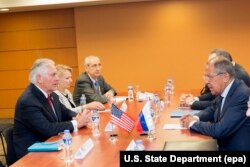
U.S. Secretary of State Rex Tillerson says he has told his Russian counterpart that Moscow's meddling in the 2016 U.S. presidential election created "serious mistrust" between the two countries.
Tillerson, speaking on August 7 on the sidelines of a regional forum in Manila, said he emphasized in a meeting with Russian Foreign Minister Sergei Lavrov that interference in the election was "a serious incident."
He said he tried to help Lavrov "understand just how serious this incident had been and how seriously it had damaged the relationship between the U.S. and the American people and the Russian people, that this had created serious mistrust and that we simply have to find some way to deal with that."
The chief U.S. diplomat also warned Lavrov that Washington was deciding on a response to the Kremlin's decision to order a substantial reduction in the size of the U.S. diplomatic mission in Russia, a move made in retaliation for a new set of sanctions slapped on Russia by the United States.
He asked Lavrov "several clarifying questions" about Moscow's retaliatory moves and warned his Russian counterpart that the U.S. would respond to these actions by September 1.
'Some Willingness'
Nevertheless, Tillerson said the United States still wants to work with Moscow and that it was "not useful" to cut all ties based on one issue.
"We should find places we can work together.... In places we have differences we're going to have to continue to find ways to address those," Tillerson told reporters.
"The fact that we want to work with them on areas that are of serious national security interest to us, and at the same time having this extraordinary issue of mistrust that divides us, that is just what we in the diplomatic part of our relationship are required to do," he said.
Tillerson also told reporters that Moscow had indicated "some willingness" to seek ways to move forward on matters related to Ukraine.
The United States and European Union have imposed sanctions on Russia in response to its seizure of Ukraine's Crimea Peninsula in March 2014 and its support of separatist fighters whose war against Kyiv has killed more than 10,000 people in eastern Ukraine.
Tillerson noted that the United States has a new special representative for negotiations on the conflict, Kurt Volker, who traveled to Ukraine in July to assess the situation.
"We appointed a special envoy to engage with Russia but also coordinating with all parties. This is full visibility to all parties," he said. "We are not trying to cut some kind of deal on the side."
Hours earlier, Lavrov said he believed his U.S. counterpart was ready to continue dialogue with Russia on complex issues despite the bilateral tensions and the imposition of new U.S. sanctions.
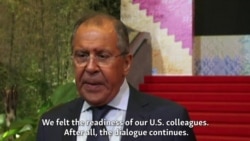
"We felt the readiness of our U.S. colleagues to continue dialogue. I think there's no alternative to that," Lavrov said after what he said was a lengthy meeting with Tillerson.

On August 3, U.S. President Donald Trump said on Twitter that Washington's "relationship with Russia is at an all-time & very dangerous low."
Those comments came a day after Trump signed off on the new sanctions against Moscow, a move Russian Prime Minister Dmitry Medvedev said amounted to a "full-scale trade war" against his country.
The U.S. intelligence community issued an assessment in January saying that Russian President Vladimir Putin ordered an "influence campaign" targeting the U.S. election, with goals that included undermining trust in the U.S. electoral process, denigrating Trump's Democratic rival, Hillary Clinton, and helping Trump.
The U.S. Justice Department and U.S. lawmakers are investigating the alleged Russian interference and examining where there was any collusion between his associates. Russia denies meddling, despite what critics say is strong evidence, and Trump denies there was any collusion.
Strong Signal
At the Association of Southeast Asian Nations (ASEAN) forum, Tillerson also told reporters that the execution and implementation of new UN sanctions imposed on North Korea would be closely monitored and that the resolution sends a strong signal to Pyongyang.
On August 6, the UN Security Council approved a U.S.-written sanctions package against the North that could deprive it of $1 billion a year in export revenue.
He said the support of Russia and China for the sanctions was a strong sign to North Korea that the international community was united in its effort to rein in Pyongyang’s nuclear and ballistic-missile program.
"It's quite clear in terms of there being no daylight between the international community as to the expectation that North Korea will take steps to achieve all of my objectives, which is a denuclearised Korean Peninsula," he said.
Tillerson left open to the North Koreans the possibility of talks with the United States, but he insisted the regime must first end its missile tests, which are banned under previous UN resolutions.
With reporting by Reuters, TASS, AFP, and AP
We are now closing the live blog for today, but we'll be back again tomorrow morning to follow all the latest developments. Until then, you can keep up with all our other Ukraine coverage here.
And here's a video of Sergei Lavrov's remarks following his meeting with Rex Tillerson in Manila:
Lavrov: An Alternative To Dialogue With U.S. 'Does Not Exist'
"We felt the readiness of our U.S. colleagues," Russian Foreign Minister Sergei Lavrov told Russian journalists on August 6 following bilateral talks with U.S. Secretary of State Rex Tillerson on the sidelines of the Association of Southeast Asian Nations (ASEAN) forum in the Philippine capital, Manila. "After all, the dialogue continues. I think an alternative to that simply does not exist," Lavrov said after what he described as "a long meeting with Rex Tillerson." (Reuters, Rossia 24)
Russian Foreign Minister Sergei lavrov met his U.S. counterpart Rex Tillerson in Manila today. here's what he had to say about it (from RFE/RL's news desk):
Lavrov: We Feel U.S. Readiness To Continue Dialogue
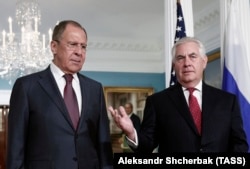
Russian Foreign Minister Sergei Lavrov said on August 6 that he believed his American counterpart was ready to continue dialogue with Russia on complex issues despite bilateral tensions and the imposition of fresh U.S. sanctions against Moscow.
"We felt the readiness of our U.S. colleagues to continue dialogue. I think there's no alternative to that," Lavrov said after what he said was a lengthy meeting with U.S. Secretary of State Rex Tillerson on the sidelines of the Association of Southeast Asian Nations (ASEAN) forum in Manila.
Lavrov told the media that U.S. President Donald Trump's special representative for Ukraine negotiations, Kurt Volker, will soon make his first trip to Moscow.
Lavrov said Volker, who was named in his position last month, will meet with Vladislav Surkov, the Russian envoy for the Ukraine crisis. Volker made his first trip to eastern Ukraine last month.
Lavrov also said that Tillerson agreed to continue a dialogue between U.S. Undersecretary of State Thomas Shannon and Russian Deputy Foreign Minister Sergey Ryabkov. That channel was created to address hot spots, but Russia suspended it after the U.S. tightened sanctions on Russia.
The U.S. side did not immediately comment on Lavrov's statements.
Earlier, Lavrov and Tillerson smiled and exchanged pleasantries but made no substantive remarks as journalists were allowed in briefly for the start of their meeting.
Both Tillerson and Lavrov ignored a shouted question about how the new sanctions might affect their discussions.
Trump on August 3 said on Twitter that Washington's "relationship with Russia is at an all-time & very dangerous low."
Those comments came a day after Trump signed new sanctions against Moscow, a move Russian Prime Minister Dmitry Medvedev said amounted to a "full-scale trade war" against his country.
Trump and Tillerson opposed the sanctions package that Congress passed to make it harder for Trump to ever ease penalties on Russia.
Although Trump ultimately signed the bill, he called it "seriously flawed."