



An update to our top story today:
The new U.S. special envoy for efforts to end the conflict in eastern Ukraine, Kurt Volker, met with a Kremlin aide on August 21 in the Belarusian capital, Minsk.
The Belarusian Foreign Ministry said on Twitter that Volker and Vladislav Surkov, an aide to Russian President Vladimir Putin and the Kremlin's point man for the conflict in eastern Ukraine, were meeting behind closed doors.
The U.S. State Department announced on August 18 that Volker and the Russian representative would discuss "Russian-Ukrainian relations."
Volker's talks with Surkov kick off three days of U.S. diplomacy on the war between Russia-backed separatists and government forces in eastern Ukraine, which has killed more than 10,000 people since April 2014.
U.S. Envoy On Ukraine Conflict To Meet With Russian Counterpart In Minsk
By RFE/RL
The new U.S. special envoy for efforts to end the conflict in eastern Ukraine, Kurt Volker, is expected to meet with a Russian representative on August 21 in the Belarusian capital, Minsk.
The U.S. State Department announced on August 18 that Volker and the Russian representative would discuss "Russian-Ukrainian relations."
Neither side has named the Russian, but Foreign Minister Sergei Lavrov earlier this month said that U.S. Secretary of State Rex Tillerson told him that Volker would meet in the "nearest future" with Vladislav Surkov, the Kremlin's point man for Ukraine.
Volker's planned talks in MInsk are to kick off three days of U.S. diplomacy on the conflict between Russia-backed separatists and government forces in eastern Ukraine, which has killed more than 10,000 people since April 2014.
From Minsk, he will head to the Lithuanian capital, Vilnius, to meet with senior government officials on August 22 to discuss "the way forward in Ukraine," the State Department said.
On August 23, Volker will join U.S. Defense Secretary Jim Mattis in meetings with senior Ukrainian government officials to discuss "the next steps in diplomatic negotiations to restore Ukraine's sovereignty and territorial integrity," the department said.
After Moscow-friendly Ukrainian President Viktor Yanukovych was pushed from power in February 2014 by massive pro-European protests, Russia seized control of Ukraine's Crimea region and fomented separatism in eastern and southern Ukraine.
Russia-backed separatists seized parts of the Donetsk and Luhansk provinces, which border Russia, and the war has persisted despite a pact known as Minsk II, a February 2015 agreement on a cease-fire and steps to resolve the conflict.
Sanctions imposed by the United States, the European Union have not prompted Russia to abandon its support for the separatists or fulfill its commitments under the Minsk agreements.
Tillerson named Volker, a former U.S. ambassador to NATO, as the U.S. special representative for Ukraine negotiations in July.
In an interview with Current Time TV in July, Volker said that ending the fighting will require agreement by all sides on two major principles -- the "territorial integrity of Ukraine, security of all the people" -- and a change in Russia's approach. Current Time TV is the Russian-language network, run by RFE/RL in cooperation with VOA.
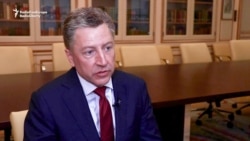

He said that the United States is considering sending Kyiv weapons to help government forces defend themselves against Russia-backed separatists. To date, the United States has provided only nonlethal military aid.
Relations between Moscow and Washington have been driven to a post-Cold War low by disagreements over issues including Russia's aggression in Ukraine, its role in the war in Syria, and its alleged interference in the U.S. presidential election in 2016.
That concludes our live-blogging of the Ukraine crisis for Sunday, August 20, 2017. Check back here tomorrow for more of our continuing coverage.
Moscow Court Refuses To Freeze Siemens Turbines In Crimea, Pending Suit
The Arbitration Court of Moscow has declined to place a freeze on gas turbines manufactured by the German firm Siemens that were transferred to the illegally annexed region of Crimea earlier this year.
The court on August 20 also agreed to begin hearing Siemens' suit on September 18.
Siemens claims the turbines were illegally transferred to Crimea in violation of European Union sanctions imposed against Russia following its illegal annexation of the Ukrainian region in 2014.
Siemens filed the suit on July 11, accusing the firm's Russian partners of shipping four gas turbines for generating electricity to Crimea after claiming they were to be installed at a plant in Taman.
The turbines were manufactured in Russia by a joint project of Siemens and the Russian firm Silovye Mashiny.
After it was revealed that the turbines had been shipped to Crimea, the EU introduced a new packet of sanctions targeting three Russian companies that worked with Siemens and three individuals, including Russian Deputy Energy Minister Andrei Cherezov.
With reporting by Dozhd TV