


U.S. Institutes Visa Restrictions At Its Missions Across Russia
By RFE/RL
The U.S. Embassy in Moscow says that "all nonimmigrant visa operations" at U.S. missions across Russia will be suspended as of August 23 due to a Kremlin-imposed cap on staff at U.S. diplomatic facilities.
In an August 21 statement, the embassy said that visa operations will resume "on a greatly reduced scale" on September 1, with nonimmigrant visa interviews conducted "only in Moscow."
Visa operations at the U.S. consulates in St. Petersburg, the Ural Mountains city of Yekaterinburg, and Vladivostok on the Pacific coast will “remain suspended indefinitely,” it said.
“Russia’s decision to reduce the United States’ diplomatic presence here calls into question Russia’s seriousness about pursuing better relations,” the U.S. Embassy said.
The U.S. step is the latest development in a bitter back-and-forth between Washington and Moscow, whose relations have hit what officials on both sides say is a post-Cold War low.
Already badly strained by tension over Russia's aggression in Ukraine, its role in the war in Syria, and treatment of dissenters at home, ties were frayed further by what U.S. intelligence officials say was a concerted campaign, ordered by President Vladimir Putin and carried out through cyberattacks and propaganda, to influence the U.S. presidential election in 2016.
After Congress passed a bill imposing sanctions on Russia and making it harder for President Donald Trump to ease or lift the punitive measures, the Russian Foreign Ministry said on July 28 that Washington must reduce its diplomatic staff at the U.S. Embassy and consulates to 455 people by September 1. Putin later said that meant the United States must cut 755 of the roughly 1,200 staff members at the missions -- many of whom are Russian.
Russia’s Foreign Minister Sergei Lavrov criticized the U.S. decision shortly after the announcement, claiming the move to curtail visa operations is aimed at stirring up resentment among Russians with Putin's government.
The Kremlin’s deadline for the reduction of personnel is September 1. A 2013 report by the State Department Inspector-General said that the U.S. Embassy in Moscow and the consulates in St. Petersburg, Yekaterinburg, and Vladivostok employed 1,279 staff, including 934 "locally employed" staff and 301 U.S. "direct-hire" staff.
In its August 21 statement, the U.S. Embassy said it will be able to maintain adequate staffing “to carry out essential elements of our mission.”
It said the operations would remain “at reduced capacity for as long as our staffing levels are reduced” in order to comply with the Russian government’s requirement.
The embassy said that all currently scheduled nonimmigrant visa appointments in Russia were being canceled and that applicants will be provided with instructions on how to reschedule their interviews.
The embassy said that in order to comply with "international agreements, diplomatic practice, or customary international law,” first priority for nonimmigrant visas must be given for the travel of UN officials, international organizations with offices in the United States, and bilateral missions.
It said priority would be given to other categories of nonimmigrant visa applications -- such as travel for medical or family emergencies -- depending on staff levels.
“This could include funerals, hospitalizations, or legal proceedings,” the embassy said.
The Kremlin-ordered U.S. diplomatic staff reductions also will affect the scheduling of interviews for some immigrant visa applicants.
The U.S. Embassy said applicants for immigrant visas will be contacted if there is a change to the time and date of their interview.
For Russian university students who study in the United States, the U.S. Embassy said that it plans to offer a block of visa interview appointments in early September.
The U.S. Embassy in Moscow and the U.S. Consulate in St. Petersburg also will no longer accept new visa applications for residents of Belarus.
Instead, the embassy says residents of Belarus are being encouraged to schedule interview appointments at the U.S. embassies in Warsaw, Kyiv, or Vilnius.
Lavrov said that change has clear political undertones.
The U.S. Embassy in Moscow and the three U.S. consulates in Russia say they will continue to provide the full range of American Citizen Services.
Those services include the issuing of passports, reports on births, assistance to victims of crime, emergency loans, and prison visits.
The U.S. Embassy statement said those services will continue because “the safety and security of American citizens overseas is one of our highest priorities.”
An update to our top story today:
The new U.S. special envoy for efforts to end the conflict in eastern Ukraine, Kurt Volker, met with a Kremlin aide on August 21 in the Belarusian capital, Minsk.
The Belarusian Foreign Ministry said on Twitter that Volker and Vladislav Surkov, an aide to Russian President Vladimir Putin and the Kremlin's point man for the conflict in eastern Ukraine, were meeting behind closed doors.
The U.S. State Department announced on August 18 that Volker and the Russian representative would discuss "Russian-Ukrainian relations."
Volker's talks with Surkov kick off three days of U.S. diplomacy on the war between Russia-backed separatists and government forces in eastern Ukraine, which has killed more than 10,000 people since April 2014.
U.S. Envoy On Ukraine Conflict To Meet With Russian Counterpart In Minsk
By RFE/RL
The new U.S. special envoy for efforts to end the conflict in eastern Ukraine, Kurt Volker, is expected to meet with a Russian representative on August 21 in the Belarusian capital, Minsk.
The U.S. State Department announced on August 18 that Volker and the Russian representative would discuss "Russian-Ukrainian relations."
Neither side has named the Russian, but Foreign Minister Sergei Lavrov earlier this month said that U.S. Secretary of State Rex Tillerson told him that Volker would meet in the "nearest future" with Vladislav Surkov, the Kremlin's point man for Ukraine.
Volker's planned talks in MInsk are to kick off three days of U.S. diplomacy on the conflict between Russia-backed separatists and government forces in eastern Ukraine, which has killed more than 10,000 people since April 2014.
From Minsk, he will head to the Lithuanian capital, Vilnius, to meet with senior government officials on August 22 to discuss "the way forward in Ukraine," the State Department said.
On August 23, Volker will join U.S. Defense Secretary Jim Mattis in meetings with senior Ukrainian government officials to discuss "the next steps in diplomatic negotiations to restore Ukraine's sovereignty and territorial integrity," the department said.
After Moscow-friendly Ukrainian President Viktor Yanukovych was pushed from power in February 2014 by massive pro-European protests, Russia seized control of Ukraine's Crimea region and fomented separatism in eastern and southern Ukraine.
Russia-backed separatists seized parts of the Donetsk and Luhansk provinces, which border Russia, and the war has persisted despite a pact known as Minsk II, a February 2015 agreement on a cease-fire and steps to resolve the conflict.
Sanctions imposed by the United States, the European Union have not prompted Russia to abandon its support for the separatists or fulfill its commitments under the Minsk agreements.
Tillerson named Volker, a former U.S. ambassador to NATO, as the U.S. special representative for Ukraine negotiations in July.
In an interview with Current Time TV in July, Volker said that ending the fighting will require agreement by all sides on two major principles -- the "territorial integrity of Ukraine, security of all the people" -- and a change in Russia's approach. Current Time TV is the Russian-language network, run by RFE/RL in cooperation with VOA.
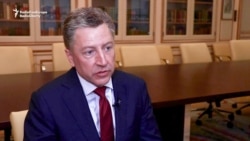

He said that the United States is considering sending Kyiv weapons to help government forces defend themselves against Russia-backed separatists. To date, the United States has provided only nonlethal military aid.
Relations between Moscow and Washington have been driven to a post-Cold War low by disagreements over issues including Russia's aggression in Ukraine, its role in the war in Syria, and its alleged interference in the U.S. presidential election in 2016.