




An item from our news desk:
French President To Hold Talks With Putin, Merkel, Poroshenko On Ukraine Conflict
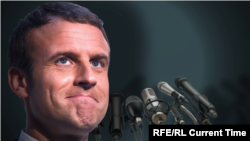
French President Emmanuel Macron has said he will call the leaders of Russia, Germany, and Ukraine on July 24 in a stepped-up international effort to end the fighting in eastern Ukraine.
The holding of the Normandy format talks between Macron and Russian President Vladimir Putin, German Chancellor Angela Merkel, and Ukrainian President Petro Poroshenko is part of a continuous effort by the four countries to resolve the conflict in which Russia-backed separatists are fighting Ukrainian troops.
More than 10,000 people have died in the conflict, which began in early 2014, with hundreds of thousands of others forced to flee their homes.
A cease-fire agreement signed in February 2015 in the Belarusian capital, Minsk, has failed to end the violence, which has recently flared up and led to at least 11 Ukrainian soldiers being killed in recent days.
The French president's announcement comes one day after the United States announced that special envoy to Ukraine Kurt Volker will travel to Kyiv for talks.
The State Department said Volker, a former U.S. ambassador to NATO, will meet in Ukraine with those who "have been affected by Russian aggression."
He will also visit Brussels, France, Austria, and Britain in an effort to find a "path to restoring Ukraine's sovereignty and territorial integrity."
Moscow denies involvement in the conflict despite compelling evidence that Russia has supported the separatists financially and militarily.
Based on reporting by Reuters, AFP, and Interfax
Here's an report from our news desk on U.S: sanctions, which also has ramifications for Ukraine:
U.S. Lawmakers Reportedly Agree On Sanctions For Russia, Iran, North Korea
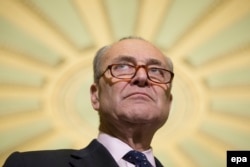
U.S. lawmakers say they have reached a bipartisan agreement on a bill that would bring new sanctions against Russia, Iran, and North Korea.
Steny Hoyer (Democrat-Maryland), the second-ranking Democrat in the House of Representatives, said on July 22 that lawmakers from both parties had resolved several issues that were holding up the bill, a similar version of which was passed by the Senate last month.
Senate minority leader Chuck Schumer (Democrat-New York) said the new sanctions bill is "strong" and he expected it to be passed soon.
"I expect the House and Senate will act on this legislation promptly, on a broad bipartisan basis and send the bill to the president's desk," Schumer said in a statement.
The bill is expected to be voted on as early as July 25 in the House of Representatives.
The Senate will also have to vote on the new bill, which the White House and State Department have voiced reservations about.
The White House had objected to a part of the bill that would require a congressional review if President Donald Trump tried to ease or end the sanctions against Moscow.
Under the new bill, Trump would be required to send a report to Congress outlining why the administration wants to suspend or terminate any sanctions. Lawmakers would then have one month to decide whether to allow such a move.
Trump's optimistic view of future U.S.-Russian relations has led to concerns within Congress that he would reduce or abolish economic sanctions against Russia imposed after Moscow's invasion and illegal annexation of Ukraine's Crimean Peninsula as well as Russian support for the separatists in eastern Ukraine.
'Many Transgressions'
Both Trump and Secretary of State Rex Tillerson have said they have no intention of ending sanctions against Russia until Moscow reverses course on Ukraine.
Moscow has denied supporting the separatists despite evidence to the contrary.
Members of Congress were also keen to impose sanctions against Russia for its meddling in the 2016 presidential election, which U.S. intelligence agencies say is not in doubt despite Moscow's denials. Trump has also seemed less than convinced about Russian interference.
"Given the many transgressions of Russia, and President Trump's seeming inability to deal with them, a strong sanctions bill such as the one Democrats and Republicans have just agreed to is essential," said Schumer.
House Democratic leader Nancy Pelosi said she was concerned that adding North Korea in the legislation could lead to delays.
"It is essential that the addition of North Korea to this package does not prevent Congress from immediately enacting Russia sanctions legislation and sending it to the president's desk before the August recess," she said in a statement.
Intense Negotiations
Many lawmakers hope the bill would send a message to President Donald Trump to keep a strong line against Russia.
Senator Ben Cardin (Democrat-Maryland), a ranking Democrat on the Senate Foreign Relations Committee, said the deal was agreed to only after "intense negotiations."
He said in a statement that Congress "is poised to send President Putin a clear message on behalf of the American people and our allies, and we need President Trump to help us deliver that message."
The new sanctions package in the agreed-to legislation would impose mandatory penalties on people involved in Iran's ballistic-missile program and any person or entity that does business with them.
The measure would also apply "terrorism sanctions" to Iran's Islamic Revolutionary Guards Corps and put in force an arms embargo.
The European Union said in a statement after reports of the agreement in Congress that sanctions against Russia and Iran should be coordinated with Brussels and that "unilateral measures" undermine the effect of the sanctions.