



An item on power being cut in Donetsk, courtesy of RFE/RL's news desk:
Kyiv Cuts Electricity Supply To Separatist-Held Parts Of Donetsk Region
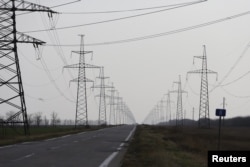
Ukraine's state power company says it has terminated electricity supplies to the parts of the Donetsk region that are controlled by Russia-backed separatists.
Vsevolod Kovalchuk, acting head of the power distributor Ukrenergo, said on Facebook on July 26 that "the power supply to the districts in the Donetsk region that are temporarily not controlled [by the government] was cut" overnight.
According to Kovalchuk, the districts controlled by pro-Russia separatists in the region stopped receiving energy produced by power stations located in Kyiv-controlled regions of Ukraine.
Earlier in April, Ukraine cut electricity supplies to the districts controlled by Moscow-backed separatists in another eastern region, Luhansk.
The war between Ukrainian government forces and the separatists, who hold parts of the Luhansk and Donetsk regions, has killed more than 10,000 people since April 2014.
Here's an item from our news desk on reports that Mikheil Saakashvili has been stripped of his Ukrainian citizenship:
Ex-Georgian President Saakashvili Reportedly Loses Ukrainian Citizenship

KYIV -- Ukraine's migration agency says Mikheil Saakashvili, the former Georgian president who later served as governor of Ukraine's Odesa region, has been stripped of his Ukrainian citizenship.
In a statement posted on July 26 on its website, the State Migration Service said the decision to revoke a person's citizenship could be made only by Ukraine's president.
It also explicitly mentioned Saakashvili, and suggested that paperwork received from Georgian officials had been included in the decision.
Ukraine's TSN news agency quoted unnamed officials in the migration agency as saying that Saakashvili gave false information when he filled out application forms to obtain citizenship in 2015.
There was no comment or announcement by President Petro Poroshenko about the migration statement, or Saakashvili in particular.
Saakashvili also did not immediately offer any public comment about the development.
But officials with the Ukrainian political party he headed, called the "Movement of New Forces," said in a post to Facebook that "Poroshenko, in the spirit of his predecessor, has irrevocably gone down the path of unconstitutional action for usurpation and holding onto power at all costs.”
Davit Sakvarelidze, a former deputy prosecutor-general and a representative of the Movement of New Forces, said Poroshenko's decision to revoke Saakashvili's citizenship would not impede the activities of the party.
"Ukraine is on the brink of survival and preserving itself as a state," Sakvarelidze said in a Facebook post on July 26. "The man who had spoken about that louder than anyone else was left without Ukrainian citizenship and the right to enter Ukraine today. But it will by no means stop us... We will coordinate with the established headquarters in terms of further joint actions and go forward, taking all necessary measures."
Sakvarelidze also said Poroshenko's decision would "bring the end of the regime under his leadership closer."
Georgian Criminal Charges
Poroshenko's order is the latest setback to Saakashvili, a U.S.-educated lawyer who helped lead Georgia's 2003 Rose Revolution -- promising to reform the ex-Soviet republic and draw it closer to the West.
His policies angered Russia, however, and the growing acrimony paved the way for a brief, disastrous war in 2008 when Russia’s army invaded Georgia, humiliated Georgia’s U.S.-trained forces, and seized control of two of Georgia's breakaway regions -- South Ossetia and Abkhazia.
Saakashvili was widely unpopular when he left the Georgian presidency.
Georgian officials stripped him of his Georgian citizenship in December 2015 after he received a Ukrainian passport.
Saakashvili is now wanted in Tbilisi on criminal charges related to his activities when he was Georgia's president, charges he has called politically motivated.
In Ukraine, Saakashvili had been seen as an ally of Poroshenko when he was appointed governor of Ukraine's largest and most important port, Odesa, in May 2015.
He resigned from that post in November 2016, openly accusing Poroshenko of dishonesty and charging that the central government in Kyiv was sabotaging crucial reforms.