

EU's Juncker calls for better ties with Russia, but not at any cost:
By RFE/RL
BRUSSELS -- European Commission President Jean-Claude Juncker has said that the EU should seek better relations with Moscow, but without giving up its values.
"There is no European security for the future centuries without Russia," Juncker told the bloc's ambassadors in Brussels on August 29.
"The European Union is 5.5 million square kilometers, Russia alone has 17.5. Any more questions?" he added.
He also said that the EU should "find with Russia a discourse that is more suitable for the future ahead of us."
But he insisted that this should be done "without renouncing our values and principles [such as] the annexation of Crimea and the rest."
Juncker has repeatedly called for improved relations with Moscow, which have been strained by animus over Russia's illegal annexation of Ukraine's Crimea region in March 2014 and its continued support for separatists in the country's east.
More than 10,000 people have been killed since April 2014 in fighting between Ukrainian government forces and the Russia-backed separatists, who hold parts of two Ukrainian eastern provinces.
In response to Russia's aggression in Ukraine, the EU adopted economic sanctions against Moscow that were prolonged by six months in June.
The bloc also has also imposed asset freezes and visa bans on 153 people and 40 entities that it claims are responsible for the destabilization of Ukrainian sovereignty. This list is, according to EU diplomats, expected to be rolled-over by six months in September.
Holding a traditional summer news conference in Berlin on August 29, German Chancellor Angela Merkel acknowledged that lifting the sanctions would benefit both Russia and Germany.
But she stressed that the restrictions must remain in place until Moscow fulfills the conditions for their removal.
Merkel called for continued dialogue between all sides in the conflict in eastern Ukraine so that eventually there could be a solution that would lead to the lifting of the sanctions.
"If the [February 2015 Minsk peace] agreement is kept, then the requirement will be met for lifting the sanctions on Russia," she said.
"That would be good for the Russian economy as well as good for the German economy," the chancellor added.
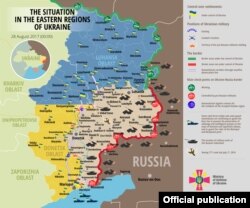
Here is today's map of the latest situation in the Donbas conflict zone, according to the Ukrainian Defense Ministry:
This is a pretty cool project (not unlike this study of Ukrainian memory and identity by RFE/RL's Daisy Sindelar):
Ukraine is among those countries that will be warily watching developments in Belarus next month:
Russia Says Western Concerns About Zapad War Games Unfounded
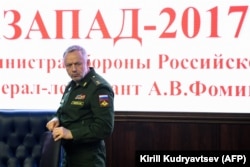
Russia says that upcoming Zapad 2017 military exercises with Belarus will be "purely defensive" and pose no threat to Russia's neighbors, NATO, or the West.
Deputy Defense Minister Aleksandr Fomin charged on August 29 that Western concerns about the war games, which are set to be held in Belarus and parts of western Russia on September 14-20, are unfounded.
Fomin asserted that Western politicians and media outlets have been "spreading myths about a Russian threat" in connection with the exercises, but that "none of these paradoxical theories has anything in common with reality."
He appeared to be referring to concerns about the intent of drills, questions about the number of troops involved, and speculation that Russia could use the exercises as a cover for an occupation of Belarus or an offensive against NATO states or Ukraine.
Fomin repeated the numbers that have been previously announced, saying that "about 12,700" troops will participate -- about 7,200 from Belarus and 5,500 from Russia. He said that about 3,000 will be in Belarus during the drills.
But Western military officials and experts say that the true numbers could be far higher, with as many as 100,000 military personnel involved.
Russia holds the Zapad (West) exercises every four years, rotating them with drills in three other parts of the country.
Under Organization for Security and Cooperation in Europe (OSCE) rules known as the Vienna Document, states conducting maneuvers involving more than 13,000 troops must notify other nations in advance and be open to observers.
Belarus has invited observers from seven countries to the drills.
NATO 'Watching Closely'
NATO Secretary-General Jens Stoltenberg said on August 24 that the alliance will send two experts, but added that this is not enough and urged Russia not to "use loopholes" to pump up the numbers while keeping observers out.
NATO routinely invites Russia to watch its war games as a confidence-building measure, Stoltenberg told the Associated Press, but "Russia has never, since the end of the Cold War, invited any NATO ally to observe any of their exercises."
In Poland on August 25, Stoltenberg said that NATO would "be watching very closely the course of these exercises" and that Russia and Belarus should "respect the obligation to be transparent."
Belarus borders NATO members Poland, Lithuania, and Latvia, as well as Ukraine. The area the exercises are due to take place also includes the Russian exclave of Kaliningrad, which lies between Poland and Lithuania on the Baltic Sea.
Russia's military actions in Ukraine have increased concerns about Moscow's intentions regarding NATO nations, particularly former Soviet republics or Warsaw Pact satellites of the Soviet Union.
Russia occupied and seized Ukraine's Crimean Peninsula in 2014 and backs separatists whose war against Kyiv's forces has killed more than 10,000 people in eastern Ukraine since April of that year.
Those actions have prompted NATO to step up its defenses in the east.
On August 29, the United States sent additional jet fighters to patrol the skies over the Baltic states, Lithuania's Defense Ministry said.
Seven US F-15 fighter jets landed at the country's northern Siauliai military air base, where NATO member Poland ran patrols using four jets over a four-month rotation.