
Putin: Russia ready to prolong gas deal if needed:
By RFE/RL
Russian President Vladimir Putin has indicated he is ready to offer Ukraine a temporary contract for the transit of natural gas if talks fail before the current one with Moscow expires on January 1.
Speaking at the sidelines of an energy forum in Moscow on October 2, Putin said he was prepared to sign a transit agreement under European law if Kyiv succeeds in implementing the European energy package by the end of the year.
The Russian president was referring to Ukraine's commitments to abide by EU energy regulations, which include having companies independent of one another produce and transmit gas, known as "unbundling."
Putin noted that it was "quite likely" that Ukraine won't fulfill its EU obligations by the end of the year, which will also require Kyiv to pass additional legislation, he suggested.
If Ukraine didn't succeed, Putin said Russia would consider extending the contract for up to a year.
Kyiv usually makes about $3 billion annually for transmitting gas to EU countries based on the current 10-year contract with Moscow.
Ukraine stopped importing gas directly from Russia in 2015 after Moscow sent troops into Crimea the previous year, eventually taking it over while backing separatists in two eastern Ukrainian regions.
Instead, Kyiv gets Russian gas indirectly through reverse flows from neighboring EU countries, namely Slovakia, Poland, and Hungary.
An additional reverse-flow point is expected to open with Romania on January 1.
As winter approaches, a third round of EU-mediated energy talks between Moscow and Kyiv in September were inconclusive.
After the talks in Brussels, the energy ministers of Russia and Ukraine, Aleksandr Novak and Oleksiy Orzhel, said the sides had agreed to meet again by the end of this month.
Currently, Ukraine is an important gas-transit country for the EU, but its role could be diminished as Moscow pursues the Nord Stream 2 project to build a pipeline under the Baltic Sea, bypassing Ukraine, that could go online as soon as spring 2020.
However, at the same Russia Energy Week conference, the board chairman of Russian state-run Gazprom, Viktor Zubkov, said that if the company wanted to, it could complete Nord Stream 2 by November.
So far, 2,042 kilometers of Nord Stream 2, or 83 percent of its total length, has been laid.
On October 1, German Chancellor Angela Merkel, whose country will benefit the most from Nord Stream 2, appointed Count Bernard Waldersee as commissioner for ensuring gas transit through Ukraine, Ukrainian Ambassador to Germany Andriy Melnyk said on social media.
Germany and other EU countries have pressed for gas to still flow through Ukraine after the Russian energy project is completed.
Russia meets about a third of Europe's gas needs, much of which currently flows through Ukraine's state-run 38,000-kilometer gas-pipeline network. (w/dpa, Reuters, and RIA Novosti)
We are now closing the live blog for today, but we'll be back again tomorrow morning to follow all the latest developments. Until then, you can keep up with all our other Ukraine coverage here.
Here's more on the story mentioned in the previous tweet, from the Crimea Desk of RFE/RL's Ukrainian Service:
Russia Jails Crimean Tatar Activist On 'Bogus' Terrorism Charges
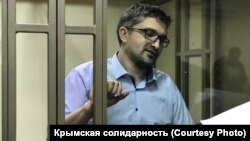
ROSTOV -ON-DON -- A military court in Russia’s southern city of Rostov-on-Don has handed a 2 ½-year prison sentence to Crimean Tatar activist and blogger Nariman Memedeminov for allegedly "making public calls for terrorism."
Calling the charge "bogus," Human Rights Watch (HRW) said in a statement on October 2 that Memedeminov's prosecution was "just the latest in the government’s relentless persecution of Crimean Tatar activists."
Rights groups and Western governments have denounced what they call a campaign of oppression targeting members of the Turkic-speaking Crimean Tatar minority and others who opposed Moscow's seizure of the Ukrainian peninsula in March 2014.
The majority of Crimean Tatars were against the Russian takeover of their historical homeland.
Memedeminov was arrested and charged in March 2018, and has remained in custody ever since.
His YouTube channel covered topics including politically-motivated court hearings of Crimean Tatar activists and unlawful searches of their homes, according to HRW.
The activist has rejected the charge against him.
The accusation stemmed from a video he posted in 2013 of an Hizb ut-Tahrir meeting and two other videos he reposted about the Islamic group's activities.
Hizb ut-Tahrir is banned in Russia as a terrorist organization, but operates legally in Ukraine.
However, Moscow imposed its own laws on the Crimean Peninsula after it annexed the territory.
Since 2015, Russian authorities have prosecuted at least 63 Crimean Tatars on "fabricated" terrorism charges, HRW researcher Yulia Gorbunova said.
"Russian authorities have been harassing journalists, intimidating human rights lawyers, and seeking to portray politically active Crimean Tatars as 'terrorists' and 'extremists'," Gorbunova added.
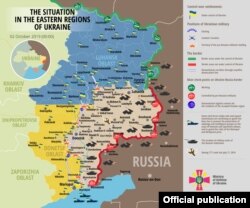
Here is today's map of the latest situation in the Donbas conflict zone according to the Ukrainian Defense Ministry. (CLICK TO ENLARGE)