


Another news item, this time from RFE/RL's Ukrainian Service:
Ukraine Detains Suspected Islamic State Group Leader
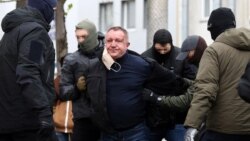
An elite Ukrainian police unit has apprehended a suspected 30-year-old member of the Islamic State (IS) extremist group in Zhytomyr region west of Kyiv.
The Russian citizen was detained based on an Interpol notice related to murder and was hiding in Ukraine to evade arrest, the National Police said in a statement on November 21.
The unnamed suspect was born in the easternmost Ukrainian region of Luhansk but had lived in Russia for an extended period.
"According to reports, the detainee is a member of the terrorist radical organization Islamic State and even the leader of one of its groups," the police said.
"By ethnicity, he is Daghestani, but was born in the Luhansk region of Ukraine. He lived in Russia for a long time. He was hiding in the territory of our country in order to avoid responsibility for murder."
Last week, Ukrainian authorities, in coordination with the U.S. Central Intelligence Agency and Georgia’s Interior Ministry, detained Al-Bara Shishani, a top IS commander.
The Georgian national had served as a deputy to Abu Omar al-Shishani, the man the Pentagon has described as the militant group's "minister of war."
After the latter was killed in 2016, Al-Bara Shishani fled to Turkey and in 2018 used a fake passport to enter Ukraine, where he continued to coordinate IS activities, Ukraine’s State Security Service (SBU) said.
He was detained in the Kyiv region near a private home where he resided, the SBU said.
He certainly doesn't mince his words:
And here's another video bite from today's impeachment hearings in the U.S. capital:
Former U.S. Official Warns Against Russian-Backed 'Fiction' On Ukraine
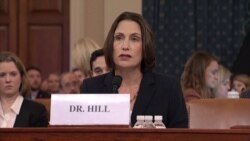
At the impeachment inquiry inquiry into U.S. President Donald Trump, a former National Security Council official said Russia is backing a "fictional narrative" of Ukrainian interference in U.S. affairs. Fiona Hill, who served as Trump's top Russia adviser, warned representatives "not to promote politically driven falsehoods," and called Ukraine "a valued partner of the United States." (Reuters)

From our news desk in Washington:
Trump Impeachment Testimony Shows Concerns Over Role, Aims Of Giuliani
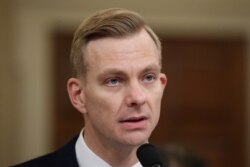
WASHINGTON -- Two U.S. officials, one current and one former, say they became increasingly alarmed by the role President Donald Trump's personal lawyer Rudy Giuliani played in Ukraine, as a congressional impeachment panel entered its fifth day of testimony.
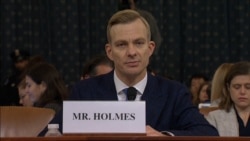
In his opening statement on November 21, David Holmes, a senior staff member from the U.S. embassy in Ukraine, told the hearing that Giuliani made it clear that a White House visit by Ukrainian President Volodymyr was contingent on the newly elected leader publicly announcing investigations into former Vice President Joe Biden, a Democrat who is seeking to challenge Trump in next year's presidential election, and his son Hunter, who sat on the board of Ukrainian natural-gas company Burisma.
This, Holmes said, was part of a narrative that led him to believe that Trump cared only about personal gain and not on agreed-upon interagency foreign policy priorities.
Holmes added that he was "shocked" on July 18 when he found out security assistance to Ukraine, which is engaged in a war with Russia-backed separatists in its eastern region, was being withheld.
The testimony is part of a congressional inquiry into whether Trump committed impeachable offenses and is based on events related to a July 25 phone call between the U.S. president and Zelenskiy.
Holmes told lawmakers that, beginning in March, the embassy’s work became overshadowed by Trump's personal attorney, Rudy Giuliani, and a "cadre of officials" with a direct line of contact to the U.S. president and his chief of staff Mick Mulvaney.
Instead of pursuing policy goals that focus on "peace and security, economic growth and reform, and rule of law," Giuliani pursued a political agenda of smearing then-U.S. Ambassador to Ukraine Marie Yovanovitch and calling on Kyiv to investigate the Bidens.
After Zelenskiy’s inauguration in May, according to Holmes, three officials said they would take the lead on coordinating foreign policy on Ukraine: then-special envoy to Ukraine Kurt Volker, Energy Secretary Rick Perry, and Sondland.
Over time, Holmes said he learned that a White House visit by Zelenskiy and up to $400 million of U.S. security assistance was tied to Trump's wish for Kyiv to pursue investigations into the Bidens, particularly Joe Biden.
Until a public announcement was made, Trump would continue withholding $390 million in military aid to Ukraine, Holmes said.
During lunch in Kyiv on July 26 with Gordon Sondland, the U.S. ambassador to the European Union, Holmes said Sondland told him that the U.S. president “doesn’t give a s**t about Ukraine, he only cares about “big stuff.”
When asked what constituted “big stuff,” Sondland told Holmes that “big stuff” meant that which benefits the president like "‘the Biden investigation that Giuliani was pushing."
By late August he said, "my clear impression was that the security assistance was likely intended by the president either as an expression of dissatisfaction that the Ukrainians had not agreed to the Burisma/Biden investigation or as an effort to increase the pressure on them to do so."
Holmes also was told in Kyiv by a visiting lawmaker, Senator Ron Johnson (Republican-Wisconsin) that Trump had "a negative view of Ukraine and that President Zelenskiy would have a difficult time overcoming it.”