


.
.
.
Poroshenko: Zelenskiy crossed "no red lines" in Paris talks with Putin:
By RFE/RL's Russian Service
KYIV -- Former Ukrainian President Petro Poroshenko has said his successor, Volodymyr Zelenskiy, did not cross any "red lines" in his recent talks with Russian President Vladimir Putin on resolving the conflict in eastern Ukraine.
In an interview with RFE/RL's Russian Service in Kyiv on December 11, Poroshenko said the December 9 meeting in Paris was neither "a step forward, nor two back."
The talks in the French capital, sponsored by France and Germany, lasted eight hours but did not produce a breakthrough.
In their first face-to-face meeting, Putin and Zelenskiy agreed to exchange prisoners and pledged to ensure a lasting cease-fire between Ukrainian troops and Russia-backed separatists in a conflict that has killed more than 13,000 people and devastated eastern Ukraine.
They made no progress, however, on thorny issues including a timeline for local elections in separatist-controlled areas in the east and control of the border in rebel-held regions.
Poroshenko said Zelenskiy had not compromised Ukraine's national interests and argued this was due in large part to actions by Ukraine's political opposition.
"I can state that it's already positive that no red lines were crossed. At the same time, I can confirm that the firm government position of our political forces and parliamentary partners in the opposition were delivered and heeded."
Poroshenko, leader of the European Solidarity party, told a Kyiv rally on December 8 that "we cannot make any concessions until the last sliver of Ukrainian land is free."
In his interview with RFE/RL, Poroshenko said time would tell whether the Paris summit between Zelenskiy and Putin had been a success. "A more objective assessment of the summit can be made in four months: We'll see first if the next summit takes place and when, and also what kind of work is done over the next four months."
Poroshenko, who lost in a landslide to Zelenskiy in the presidential election in April, said future summits should be held only to resolve thorny, substantive issues.
"If we need to hold summits just to exchange groups of prisoners, then, first, we already did that without a summit, and in sufficiently large numbers, and, secondly, Putin can unfortunately take new hostages any time," he said.
The Paris talks focused on the implementation of a 2015 peace agreement for eastern Ukraine that was signed in Minsk and brokered by France and Germany.
The Minsk agreement puts forth that Ukraine can regain control over the border with Russia in the separatist-held regions only after they are granted broad self-rule and hold local elections.
Ukraine's State Bureau of Investigations confirmed on December 10 that investigators had opened a probe into whether Poroshenko had committed treason by agreeing to the deal.
Poroshenko said the Minsk agreement was "justified," and blamed Russia's "absolutely unconstructive" position for the failure of its implementation.
"And that is precisely why we proposed that additionally peacekeepers be introduced, which should be fully agreed with the permanent members of the UN Security Council, besides Russia," Poroshenko said.
Poroshenko said in any future negotiations Ukraine's European, Euro-Atlantic orientation could not be questioned, nor its territorial integrity, including Crimea, which Russia forcibly annexed in March 2014.
The 54-year-old former Ukrainian president also ruled out any form of federalization for Ukraine, as Russia has been pushing.
"Ukraine is a united, single state and we will not allow it to be divided," he said.
.
.
.
.
.
Interior minister: police detain "suspects" over 2016 killing of journalist Sheremet:
By RFE/RL
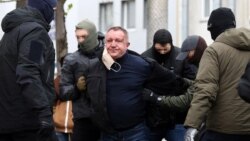
Ukrainian police have detained several suspects in connection with the 2016 killing of investigative journalist Pavel Sheremet.
"This is the result of very complex and persistent work of real professionals and an important step toward fully solving the case!" Interior Minister Arsen Avakov wrote on Facebook on December 12.
Avakov did not give any further details other than saying "suspects" had been detained.
Sheremet, a Belarusian-born Russian citizen who had made the Ukrainian capital of Kyiv his permanent home, was leaving his apartment to head to the studio where he hosted a morning radio program when an improvised explosive device planted under the vehicle he was in exploded on July 20, 2016.
The 44-year-old, who was honored by the Committee to Protect Journalists with the International Press Freedom Award in 1998, was well known as a hard-hitting reporter and commentator who had worked at prominent media outlets in Belarus, Russia, and Ukraine during his decades-long career.
Often critical of political leaders, he had received threats and been harassed on several occasions. His Belarusian cameraman, Dzmitry Zavadski, was abducted and killed in 2000 after the two returned from a reporting trip in Russia's Chechnya region.
Sheremet was stripped of his Belarusian citizenship in 2010 while he was living in Russia, where he had moved in 1997 to avoid persecution following his reports criticizing Belarusian President Alyaksandr Lukashenka's government.