




News from overnight:
-- Ukrainian state-owned PrivatBank on December 18 filed a $600 million lawsuit in Israel as part of its worldwide effort to recover assets it says the lender’s two previous majority shareholders had allegedly embezzled.
-- Ukraine’s national legislature, the Verkhovna Rada, on December 19 passed a law in its second and final reading that makes it a criminal offense for a member of parliament to vote for one or more lawmakers.
Good morning!
From our news desk:
Ukraine's Ex-Envoy To UN Appointed Ambassador To Washington
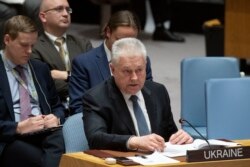
Ukraine's former two-term permanent representative to the UN, Volodymyr Yelchenko, has been named Kyiv’s new envoy to the United States.
President Volodymyr Zelenskiy issued the relevant decree late on December 18.
Yelchenko, 60, is a seasoned diplomat with nearly four decades of experience.
He was Ukraine's permanent UN envoy in 1997-2000 and again from December 2015. He replaces Valeriy Chaliy in Washington whose tenure had expired.
He gave his last speech at the United Nations on December 18 -- when the General Assembly adopted an updated resolution on Russian-occupied Crimea that seeks to protect human rights on the Ukrainian peninsula.
"Crimea is an integral part of Ukraine," Yelnichenko reiterated in his address.
He also was the ambassador to Austria in 2005-2006, and to Russia between 2010 and 2015.
Then-President Viktor Yushchenko dismissed Yelchenko from his post in Vienna on December 28, 2006 for violating instructions when issuing visas to members of the political opposition in Turkmenistan.
When his predecessor, Chaliy, was the deputy head of the presidential secretariat in 2007, he described Yelchenko as one of Ukraine’s best diplomats.
Here's another news item from this morning:
Ukraine Lifts Prosecutorial Immunity For Members Of Parliament
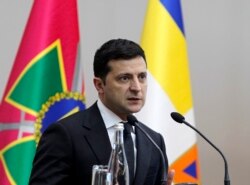
Ukraine's national legislature, the Verkhovna Rada, on December 18 passed a bill in its final reading that cancels prosecutorial immunity for lawmakers.
A solid majority of 291 national deputies voted for the bill, which was a key feature among President Volodymyr Zelenskiy’s campaign promises.
It essentially simplifies the procedure for prosecuting corrupt lawmakers, allowing law enforcement to bypass parliament when requesting permission to detain or arrest them. It also contains a disputed rule that gives the prosecutor-general the sole power to initiate criminal proceedings against members of parliament.
If the president signs the bill, it will go into effect on January 1.
Thirty-two partial or full changes were made between the first and second readings of the draft law.
Two of them strike wording from the constitution.
One removes the clause that says members of parliament are “guaranteed parliamentary immunity.” Also taken out was language that lawmakers “cannot be prosecuted, detained, or arrested without the consent of the Verkhovna Rada of Ukraine.”
The bill stipulates that the prosecutor-general is the only person who can open a criminal case and has the right to enter data on offenses committed by deputies into the Unified Register of Pretrial Investigations (ERDR). The chief prosecutor also files motions to detain lawmakers.
This particular rule was the most controversial. Two graft-fighting agencies have asked Zelenskiy to veto the bill because of it.
The Special Anti-Corruption Prosecutor’s Office (SAP) and National Anti-Corruption Bureau (NABU) in separate statements said the rule infringes on their respective agencies’ independence.
In a statement, NABU said the rule compels it to convince the prosecutor-general to register a criminal case each time they want to initiate an investigation into a lawmaker.
“In addition, the draft law doesn’t specify how investigators should transmit information to the prosecutor-general to initiate an investigation,” NABU said.
According to the Anti-Corruption Action Center in Kyiv, the bill strengthens selective immunity for certain lawmakers because the power to open a criminal case lies with one person.
“According to this draft law, the prosecutor-general receives a monopoly to initiate criminal proceedings against members of parliament,” the corruption watchdog said on its website. “That means that only one person in the country can submit information to the ERDR, which means the initiation of an investigation against members of parliament depends on the integrity or availability of the prosecutor-general.”
Lawmaker Denys Monastyrskiy of the pro-presidential Servant of the People party said the rule makes the chief prosecutor more accountable.
“A vote of no confidence can be personally taken regarding the prosecutor-general,” he told Current Time, the Russian-language network led by RFE/RL in cooperation with Voice of America. “So, in order for him not to transfer responsibility to his subordinates and other participants in criminal proceedings, the Verkhovna Rada decided to concentrate these powers with this person.”
Parliament in September removed a constitutional article that repeals immunity for lawmakers and in December passed the requisite bill in its first reading.
In the 28 years of Ukraine’s post-Soviet independence, 19 lawmakers have had their immunity stripped.