



The London Telegraph has been looking at how hard Ukraine-related sanctions have been hitting Russia. Much harder than people realised, it concludes:
Sanctions linked to the Ukraine crisis could end up costing Russia 9pc of its gross domestic product, the International Monetary Fund has said.
Russia's economy is showing signs of stabilisation after slumping under pressure from Western financial sanctions and Russian counter-measures. Low international prices for its oil exports have added to pressure on the rouble and government finances.
"The effects of sanctions in terms of external access to financial markets and new investment technology will linger," the fund said, summing up the findings of a mission in May.
Last year Western countries imposed restrictions that limit international financing for major Russian banks and energy companies, and also hi-tech exports to the energy sector. Russia retaliated by banning imports of most Western food products.
The fund estimated the immediate effect of sanctions and counter-sanctions had been to wipe between 1pc and 1.5pc off GDP, rising to 9pc over the next few years. These model-driven results were subject to significant uncertainty, it cautioned.
The IMF also forecast "weak" economic growth of around 1.5pc annually in the medium term. Russia's economy was growing around 7pc a year before the 2008 global financial crisis.
Read the entire article here
Good morning. We'll start the live blog today with an update from the latest peace talks in Minsk:
Peace talks between the warring sides in the conflict in eastern Ukraine broke up after six hours on August 3 amid reports that they failed to secure progress on a planned buffer zone.
The talks in the Belarusian capital Minsk are seeking to salvage a sweeping but largely ineffective cease-fire signed by the Ukrainian government and Russian-backed rebels six months ago.
The latest meetings were meant to agree to the withdrawal of smaller weapons from a proposed 30-kilometer-wide buffer zone, which splits rebel-run districts from the rest of Ukraine.
Donetsk separatist negotiator Denis Pushilin said the discussions were "aborted by the Ukrainian side" because of Kyiv's refusal to move back its forces from four strategic locations.
Pushilin said that some talks would continue into August 4.
"But most likely, nothing will get done," he said. Envoys from K pacyiv and Moscow did not speak to reporters.
Ukraine has been under pressure from European allies to back the extended buffer zone. Yet several hundred residents of the Kyiv-controlled frontline port of Mariupol rallied against the pullback on August 2 out of fear that it would only provoke a new rebel advance.
Barring any major developments that ends the live blogging for today.
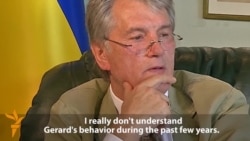
Former Ukrainian President Viktor Yushchenko had harsh words for the French actor, Gerard Depardieu. Once considered a family friend, Yushchenko tells RFE/RL's Belarus Service that Depardieu's pro-Russian attitudes have "debased his nation."

Opposition party office attacked in Kharkiv:
At least 50 young men, many in balaclavas, have attacked the former office of the Party of Regions in Ukraine's eastern city of Kharkiv.
The office is currently used by Ukrainian lawmaker Mykhaylo Dobkin, who represents the Opposition Bloc in parliament.
The attackers destroyed a minibus parked near the office and smashed the building's windows with stones on August 3.
The attackers said they were representing the Ukrainian right-wing nationalist group Right Sector and an organization called Public Guard.
They said they gathered at the site to protest against the Opposition Bloc's participation in local elections in October and attacked the building after Dobkin's people started shooting at them with firearms, wounding one activist.
Kharkiv, Ukraine's second-largest city, is only about 20 kilometers from the Russian border. (UNIAN, Pravda.ua, Interfax)
More on ex-PM Azarov's 'salvation committee':
Former Ukrainian Prime Minister Mykola Azarov has announced the formation of what he calls the Ukraine Salvation Committee.
Azarov told reporters in Moscow on August 3 that the newly established committee's goal was to "restore order in our home."
Azarov added that he could not name all the members of the newly established group, as many are in Ukraine and it is dangerous to disclose their names.
Azarov called the popular pro-European protests in Ukraine last year that toppled President Viktor Yanukovych a "coup."
According to Azarov, who along with Yanukovych and other top officials fled Ukraine and is currently residing in Russia, "it is impossible to restore accord in Ukraine without changing the country's current political leadership."
Azarov, 67, served as prime minister under Yanukovych from 2010 to 2014.
Both he and Yanukovych are wanted by the current Ukrainian authorities for crimes, among others, related to embezzlement and abuse of power.
An international warrant for Azarov's arrest has been issued by Interpol.
"I am sure, we will return [to Ukraine].... We are ready to assume responsibility for restoring Ukraine's development," Azarov added.
Within minutes of reports about the formation of the Ukraine Salvation Committee, Kremlin spokesman Dmitry Peskov said the Russian government "has nothing to do with this initiative." (Interfax, TASS)