




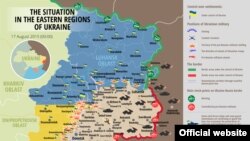
As this latest map of the military situation from Ukraine's Defense Ministry shows, things do seem to be hotting up in the Donbas:
The Ukrainian crisis keeps throwing up surprising ramifications...
Much has been written about how Russia and China have been cozying up to each other recently. Not so much has been written about China's investment in Ukraine:
Ukraine’s KSG Agro released a statement today, Sept. 24, denying reports that it had reached an agreement to sell 3 million hectares to a Chinese firm. Hong Kong’s South China Morning Post had reported a deal between KSG Agro and China’s Xinjiang Production and Construction Corps, (XPCC) in which China would be able to farm the area for up to 50 years. The paper cited a statement from XPCC as the source of its report. Quartz and other media also reported on the story.
In its statement, the Warsaw-listed agricultural firm said that it is only working with its Chinese partners on a project to install drip-irrigation systems over an area of 3,000 hectares in Ukraine next year. “KSG Agro does not intend or have any right to sell land to foreigners, including the Chinese,” the statement posted on their website said. China’s XPCC could not be immediately reached for comment.
Read the entire story here
Our news desk has issued this item on U.S. plans to expand its drone program, which could also be peripherally significant for Ukraine:
The Wall Street Journal reports that the U.S. military is planning to drastically increase the number of drone flights it carries out in foreign airspace during the next four years.
The Pentagon plan aims to boost intelligence and air strike capabilities across a growing number of conflict zones, raising the number of daily flights from the current level of 61 to as many as 90 by 2019.
The move would provide extra surveillance in Ukraine, Iraq, Syria, the South China Sea, and North Africa.
It also would expand the Pentagon's capacity to carry out deadly air strikes.
The U.S. Air Force currently carries out most drone missions.
The new plan would lead to more drone flights carried out by the U.S. Army, Special Operations Command, and government contractors.
The move represents the first significant expansion of the U.S. drone program since 2011.
(The Wall Street Journal, AFP)