



Could this give some more impetus to diplomatic efforts to end the crisis? Or would it just be good PR for the Kremlin?
Russian Foreign Minister Sergei Lavrov said on August 19 that Putin would "positively" consider a request from Washington to meet.
Relations between Russia and the West are at a post-Cold War low because of Moscow's forcible seizure of Ukraine's Crimean Peninsula and Russia's involvement in the fighting in eastern Ukraine.
Moscow denies arming separatists fighting against Ukrainian troops or having any Russian troops in Ukraine, despite mounting evidence to the contrary.
More than 6,400 people have been killed in eastern Ukraine since fighting began 16 months ago.
Obama thanked Putin via phone for Moscow's part in agreeing to a nuclear deal with Iran in July.
The two last met face-to-face in November, and Putin has not made any official visits to the United States since returning as president for a third term in mid-2012.
(Reuters, AFP)
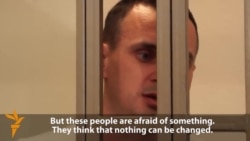
RFE/RL's Russian Service has issued a video of Oleh Sentsov in court today:
Russian prosecutors are seeking a 23-year prison sentence for Ukrainian filmmaker Oleg Sentsov, a vocal opponent of Russia's annexation of Crimea, on charges of conspiracy to commit terrorist attacks. Speaking during his trial in the Russian city of Rostov-on-Don, Sentsov described the Russian government as "a criminal regime."

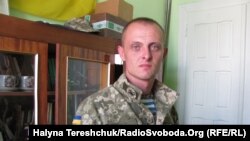
Ukrainian paratrooper Oleksandr Mashonkin (pictured) was captured after the hellish fighting at the Donetsk airport in January -- and thrust into another nightmare. The "cyborg," who was released in a prisoner exchange after 197 days in captivity in Donetsk, says he and fellow prisoners were beaten with “pipes, stools, table legs” and even a cross wielded by a priest.
RFE/RL's Halyna Tereshchuk and Robert Coalson recount Mashonkin's story here
This is a useful timeline of the Ukraine crisis:
Anna Nemtsova has been writing for The Daily Beast on where Russia is hiding the bodies of its soldiers who are dying in Ukraine. Here's an excerpt:
Hundreds of soldiers are dying on both sides in the war that started in April last year and never seems close to ending. Kiev reported around 1,800 military were killed in Donbas; the Russian non-governmental organization Union of Committees of Soldiers’ Mothers believed that at least half of the rebel losses, 900 militants, were Russian professional military. And there is a dramatic difference between how Russian and Ukrainian families treated their lost sons in the conflict.
If Ukraine buries its military as heroes with crowds saying goodbye to each dead soldier, and the media covering the funerals, Russia stays quiet about its sons dying in Ukraine.
“It’s as if my people had been swapped with some strangers,” the head of Soldiers’ Mother’s Valentina Melnikova told The Daily Beast on Tuesday. “I am amazed to see how scared military families are to protest against their sons being sent to Ukraine. Parents of killed soldiers, 40- and 50-year old people, are scared to death to protest. Of what? If it’s to lose their jobs, this is ridiculous, they have lost their children.”
Last May President Putin officially declared military deaths in peacetime a state secret. His decision was seen as an attempt to cover up the Kremlin’s role in the Ukraine war. Russian human rights groups protested Putin’s decree.Russia stayed quiet about its sons dying in Ukraine.
Last week, the Supreme Court upheld Putin’s decree, ruling against the complaint by a Russian civil society group claiming that the decree was illegal, that it was hiding the true information about Russia’s military involvement in eastern Ukraine.
That did not surprise Soldiers’ Mothers. They had seen the same story since the year they founded their organization 1989.
“Nobody was supposed to know the names of Soviet soldiers killed in Afghanistan or in Baku, their names appeared on the gravestones years later, sometimes a decade later,” Melnikova said.
Today the organization receives calls from unhappy wives of soldiers and officers moved together with their children to the Rostov region near the Ukraine frontier.
“The insanity we see is against Russia, against our state, our society—all these military families with at least 500 little children are at the new military base, closer to the Ukrainian border. Even in 1941 families were not brought close to the front lines,” Melnikova told The Daily Beast.
Read the entire article here