

Merkel: Everything must be done to respect Minsk deal:
German Chancellor Angela Merkel says everything must be done to fully implement a cease-fire agreement in eastern Ukraine.
She was speaking in Berlin on August 24 at a joint news conference in Berlin with French President Francois Hollande and Ukrainian President Petro Poroshenko.
She said the peace deal reached in Minsk in February "hasn't been fully implemented and that's meant that there have been more and more victims."
Poroshenko reiterated that "there is no alternative to the Minsk process."
Earlier in Kyiv, Poroshenko marked Ukraine's Independence Day, warning of the need to act carefully in the next year in the face of "Russian aggression."
More than 6,400 people have been killed in fighting between Ukrainian government forces and Russian-backed separatists in Ukraine's east since April 2014. (Reuters, TASS)
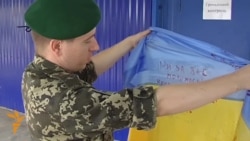
Ukrainian border guards greeted hundreds of people crossing from Crimea who were unwilling to celebrate Ukraine's Independence Day on the peninsula, which was annexed by Russia last year.

Manneken Pis, “Little Man Pee,” a landmark small bronze statue in Brussels, was dressed as a Ukrainian Cossack to mark the country’s Independence Day.
Poll: Support for independence rose in year of conflict:
By RFE/RL's Ukrainian Service
A new opinion poll from Ukraine shows that after 16 months of war against Russian-backed separatists in the country's east, more Ukrainians now support independence than at any time in the last 15 years.
The findings by the Kyiv-based Razumkov Center come from a survey conducted ahead of Ukraine's August 24 Independence Day celebrations, which commemorate its 1991 declaration of independence from the Soviet Union.
Andriy Bychenko, the director of sociological research at the Razumkov Center, told RFE/RL the survey reflected a surge of patriotic feelings since the ouster of President Viktor Yanukovych in February 2014 and the outbreak of war with separatists about two months later.
Bychenko said that "the fact that Ukraine did not give up" and allow eastern Ukraine to break away from the rest of the country with Russia's military support was "a manifestation, not a cause, of a high level of support for independence."
Not all analysts see the survey as a promising sign for Ukraine, which is struggling with severe economic troubles and an armed conflict that persists despite a cease-fire deal signed in February 2015.
It was impossible for the researchers to conduct their opinion survey in parts of eastern Ukraine now under the control of separatists or on the Crimean Peninsula, which Russia annexed in March 2014 after sending in troops and staging a referendum deemed illegal by about 100 countries.
Kyiv-based commentator Oksana Zabuzhko told RFE/RL the poll's indication that only 72 percent of Ukrainians in government-controlled territory support independence was "a most alarming signal for the Ukrainian state."
Still, a similar study conducted in 2014 by the Razumkov Center -- which also did not include residents in Crimea or the conflict zone in eastern Ukraine -- found that only 61 percent of respondents supported Ukraine's independence.
The new poll's results do not mean that a large minority of Ukrainians oppose independence: The survey found that 8 percent of respondents would now vote against independence, while the remaining 20 percent did not offer an opinion.
Ukraine's population, including Crimea and the parts of the eastern regions of Donetsk and Luhansk that are controlled by separatists, is about 46 million.
There are about 2.5 million people living in Crimea and about 1.3 million in separatist-controlled parts of the eastern provinces of Donetsk and Luhansk, from which many have fled since the conflict erupted.
The shifting population and poll numbers indicate that support for independence has risen substantially since 2005 -- a year after the Orange Revolution ushered a pro-Western president to power -- when a poll by Razumkov found that 53 percent of all Ukrainians supported it.
But still, the August 2015 survey results stand in stark contrast to 24 years ago, when 90 percent of Ukrainians supported the parliament's August 24, 1991 declaration of independence from the Soviet Union in a popular referendum that December. (Written by Ron Synovitz)