



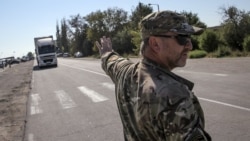
Estonian journalist Andrei Babin, one of the individuals Ukraine sanctioned yesterday, was surprised to learn he was on the list.
"I was disappointed. I am not an enemy of Ukraine as a state, of Ukrainian people. I have been to Ukraine multiple times, my relatives live there. I love Ukraine very much. I associate it with the warmest feeling, with blue skies, yellow fields, hospitality of the people," he told RFE/RL's Ukrainian Service.
When asked why he thinks he was sanctioned, Babin said that in July last year he wrote an article titled I Keep My Fingers Crossed For You, Novorossia.
"I understand that the title is provocative. The article itself is very emotional, which is unusual for me, a calm, peace-loving person as everybody knows me. There, I admit, I overstepped some boundary," he added.
The Ukrainian Security Council has "pardoned" six journalists from its new list of sanctioned individuals. The three BBC journalists mentioned there before, are no longer listed.
All in all, 41 journalists and bloggers were on Ukraine’s new sanctions list.
Names of British, German and Spanish journalists were taken off the sanctions list, tweeted Ukrainian President’s spokesman Svyatoslav Tsegolko.
Earlier this month the head of Russia's Investigative Committee, Aleksandr Bastrykin, claimed that the Ukrainian prime minister fought alongside Chechen rebels in the first of two devastating post-Soviet separatist wars in the region.
The claim was ridiculed on the Internet.
Poroshenko Orders Removal Of BBC Journalists From Sanctions List
Ukrainian President Petro Poroshenko has ordered the country's Security Council to remove three BBC journalists from a new sanctions list.
The announcement was made on September 17 in a post on Twitter by presidential spokesman Svyatoslav Tseholko.
"Freedom of the press is of absolute value to me," Tseholko quoted Poroshenko as saying in the post.
The three were among about a dozen journalists included on a sanctions list signed by Poroshenko late on September 16 after separatist rebels in the east set a date for what Kyiv sees as “illegal elections.”
The fate of the other journalists is unclear.
The decision to include journalists was criticized by the New York-based Committee to Protect Journalists among others.
"While the government may not like or agree with the coverage, labeling journalists a potential threat to national security is not an appropriate response," said the committee's Europe and Central Asia program coordinator, Nina Ognianova.
The Organization for Security and Cooperation in Europe said such action is "not the way to ensure security."
Kremlin spokesman Dmitry Peskov condemned the move as “totally unacceptable.”
The Russian news agency TASS described the decision to blacklist three of its reporters, one based in Washington, one in South Africa and one in Moscow, as "odd" since two of the three journalists do not cover Ukraine.