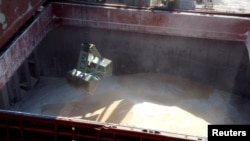
Grain from Ukraine is unloaded in the port of Ravenna, Italy, on August 13.
Russia's announcement that it is suspending its participation in a Black Sea grain export deal requires a strong international response from the United Nations and the Group of 20 (G20) major economies, Ukrainian President Volodymyr Zelenskiy said on October 29.
"This is a completely transparent attempt by Russia to return to the threat of large-scale famine for Africa, for Asia," Zelenskiy saidin a video address, adding that Russia should be kicked out of the G20.
"Why can a handful of people somewhere in the Kremlin decide whether there will be food on the tables of people in Egypt or Bangladesh?" Zelenskiy asked. "Russian terror and blackmail must lose. Humanity must win."
Russia told UN Secretary-General Antonio Guterres in a letter that it was suspending the deal for an "indefinite term" because it could not "guarantee safety of civilian ships" traveling under the pact, Reuters reported.
U.S. President Joe Biden denounced the move as "purely outrageous" and said it would increase starvation.
"There's no merit to what they're doing. The UN negotiated that deal and that should be the end of it," Biden told reporters.
The United Nations urged Russia not to withdraw from the deal, and deputy UN spokesman Farhan Haq said negotiations with Russia were ongoing.
"It is vitally important that all parties refrain from any actions that could jeopardize the Black Sea Grain Initiative," Haq said, using the formal name for the deal.
The European Union said it supported UN-led efforts to keep the Ukraine grain deal alive.
Nabila Massrali, spokesperson for foreign affairs and security policy at the European Commission, said the EU stressed that "all parties must refrain from any unilateral action that would imperil the Black Sea Grain Initiative, which is a critical humanitarian effort that is clearly having a positive impact on access to food for millions of people around the world."
Russia also asked the UN Security Council to meet on October 31 to discuss an alleged attack on its Black Sea Fleet, Russian Deputy UN Ambassador Dmitry Polyansky said.
It said some of the ships attacked in Sevastopol in the early hours of October 29 were civilian vessels involved in ensuring the security of the grain exports from three Ukrainian Black Sea ports.
The Russian Defense Ministry said in a statement that in light of the attack, which it said Ukraine carried out "with the participation of British experts," Russia "suspends participation in the implementation of agreements on the export of agricultural products from Ukrainian ports."
The ministry said earlier that drones were used in the attack and that they were all destroyed. Only one Russian ship, a minesweeper, sustained minor damage, it said.
Ukrainian Foreign Minister Dmytro Kuleba said earlier on Twitter that Ukraine had previously warned that Russia planned to "ruin" the grain-export deal.
Kuleba called on "all states to demand Russia to stop its hunger games and recommit to its obligations."
The grain export deal between Ukraine, Russia, Turkey, and the United Nations allowed a resumption of grain exports. Under the July 22 agreement, Ukraine was able to restart its Black Sea grain and fertilizer exports, and some Russian fertilizer exports also resumed.
The agreement was set to last 120 days with the option for renewal on November 19 "if no party objects," a UN spokesman said on October 28.
Russia had threatened to pull out of the agreement on grounds that the grain was not being sent to poorer countries, which at the time the deal was signed desperately needed the grain to ensure their populations did not starve.
Analysts have pointed out that Moscow’s withdrawal from the deal would deprive Ukraine of a major part of its hard-currency revenues and at the same time would drive up global food prices and inflation in Europe.
Ukrainian Farmers Risk Their Lives As Global Food Crisis Looms
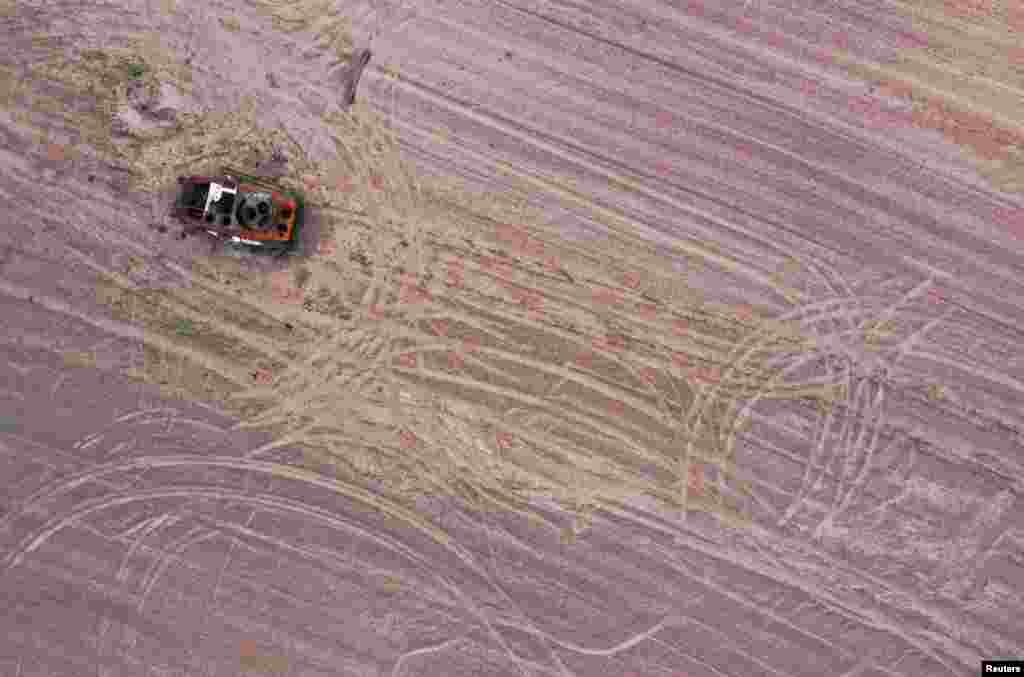
1/9A destroyed military vehicle in a previously mined grain field in Chernihiv, northern Ukraine, in late May.
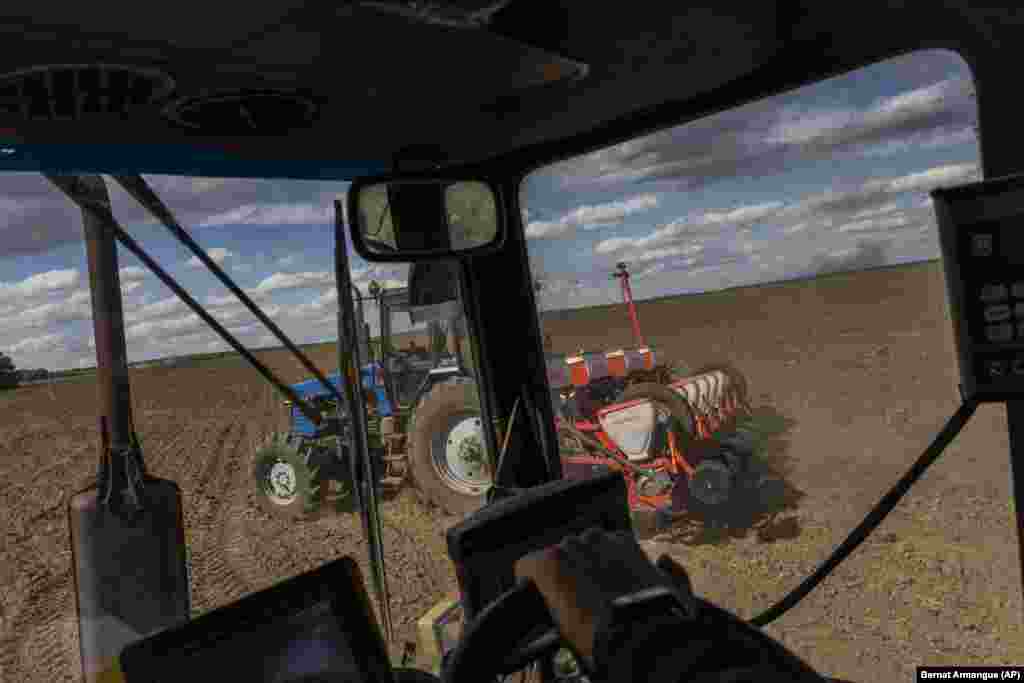
In a normal farming season, Ukraine's farmers would work according to strict schedules depending on the crops. Now, farmers must wait for it to be safe to plant -- often at night under the cover of darkness. The hardships faced by farmers are many: severe diesel shortages, indiscriminate artillery strikes, mines, the charred remains of armored vehicles in their fields, and personnel shortages.
The inability of Ukraine to transport millions of tons of grain and other agricultural products amid Russia's invasion has aggravated a global food crisis. The country is a major exporter of seed oils, corn, and wheat, but the war and Russia's blockade of Ukraine's ports have effectively stopped a significant amount of that flow. While Ukraine's leaders seek ways to export the country's agricultural output, its farmers face perilous conditions as a result of the ongoing conflict.
Show moreShow less
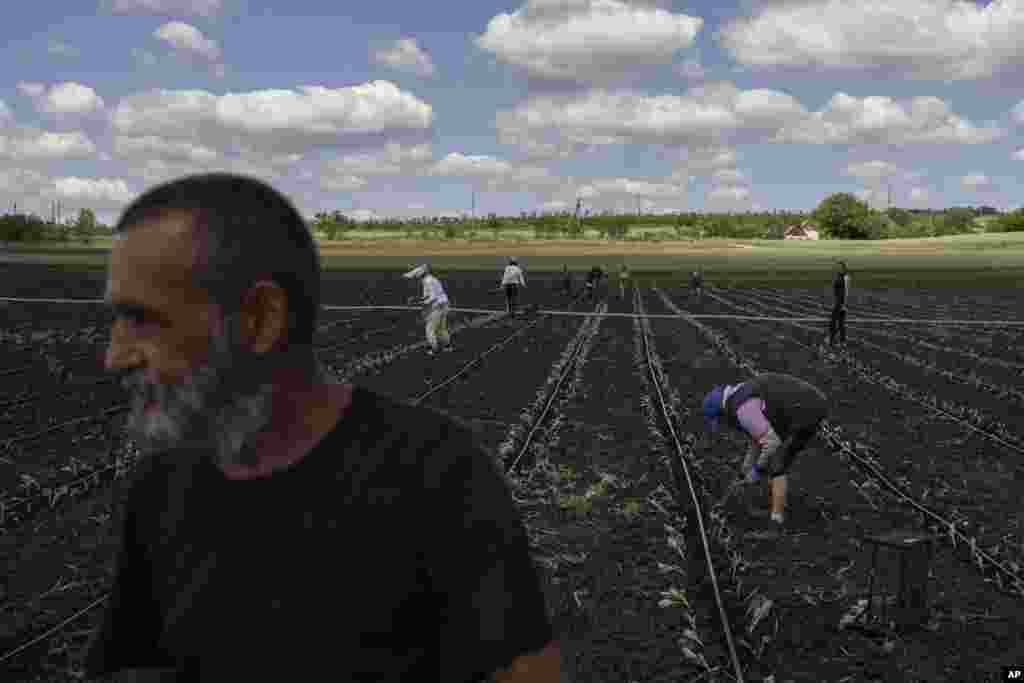
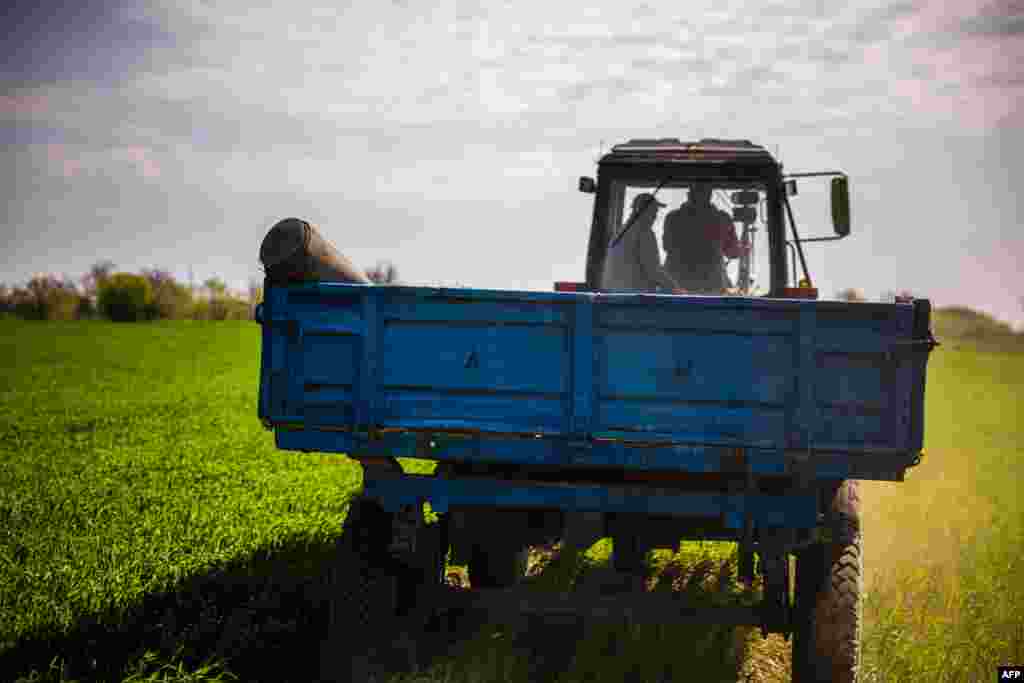
2/9Farmers work in a field near Soledar in eastern Ukraine on June 6.
Prior to the war, Ukraine exported more than 5 million metric tons of grain per month, the vast majority of which passed through its Black Sea ports. Russian warships have blocked those ports, making such shipments impossible and putting global food supplies and Ukraine's agricultural sector at risk.
The inability of Ukraine to transport millions of tons of grain and other agricultural products amid Russia's invasion has aggravated a global food crisis. The country is a major exporter of seed oils, corn, and wheat, but the war and Russia's blockade of Ukraine's ports have effectively stopped a significant amount of that flow. While Ukraine's leaders seek ways to export the country's agricultural output, its farmers face perilous conditions as a result of the ongoing conflict.
Show moreShow less
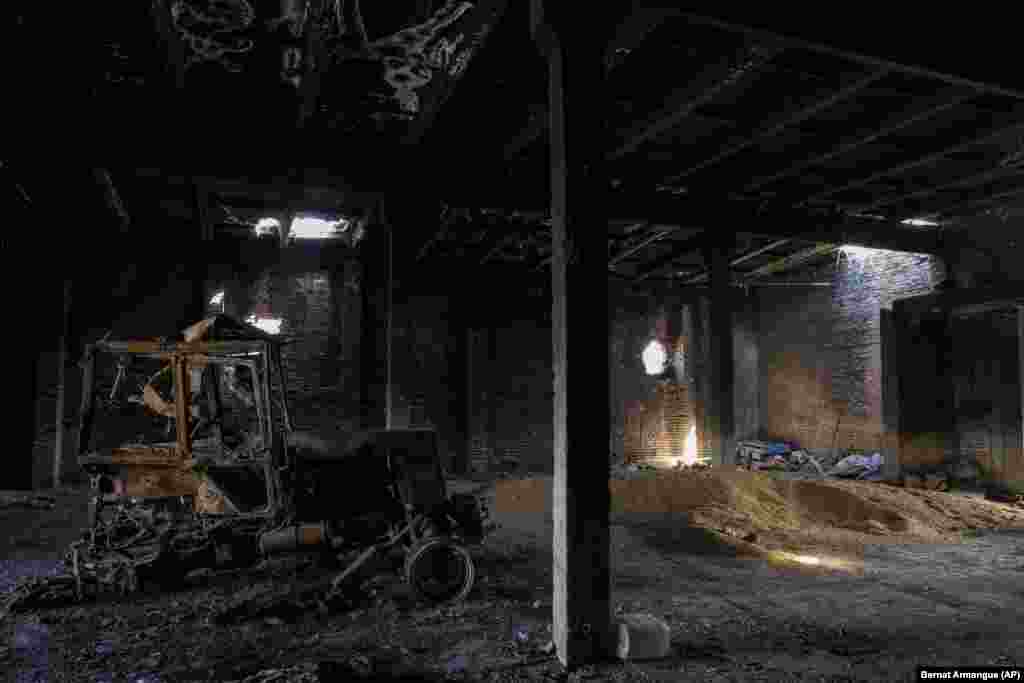
3/9A tractor charred by a Russian attack lies inside a warehouse at a grain farm in Cherkaska Lozova, near Kharkiv, on May 28.
"It's an almost grotesque situation we see at the moment in Ukraine, with nearly 25 million metric tons of grain that could be exported but that cannot leave the country simply because of lack of infrastructure, the blockade of the ports," said Josef Schmidhuber, a deputy director at the UN's Food And Agriculture Organization.
Ukraine, its neighbors, and the EU, are now scrambling to find other routes to get Ukrainian grain to markets, with rail emerging as a viable option despite many logistical challenges.
The inability of Ukraine to transport millions of tons of grain and other agricultural products amid Russia's invasion has aggravated a global food crisis. The country is a major exporter of seed oils, corn, and wheat, but the war and Russia's blockade of Ukraine's ports have effectively stopped a significant amount of that flow. While Ukraine's leaders seek ways to export the country's agricultural output, its farmers face perilous conditions as a result of the ongoing conflict.
Show moreShow less
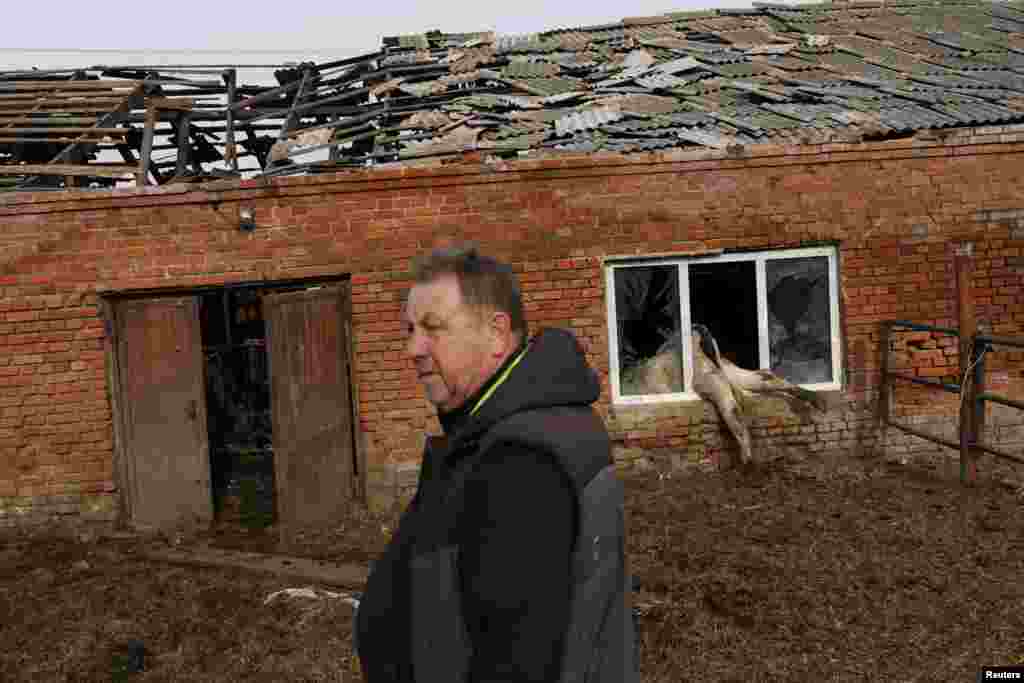
4/9Farmer Oleksandr Novikov, 58, surveys the damage to his farm in Vilhivka, near Kharkiv, on May 11.
Russian forces have been accused of looting grains and selling them to other countries, destroying fields, and killing livestock in an intentional effort to harm Ukrainian farmers during their invasion of Ukraine.
The inability of Ukraine to transport millions of tons of grain and other agricultural products amid Russia's invasion has aggravated a global food crisis. The country is a major exporter of seed oils, corn, and wheat, but the war and Russia's blockade of Ukraine's ports have effectively stopped a significant amount of that flow. While Ukraine's leaders seek ways to export the country's agricultural output, its farmers face perilous conditions as a result of the ongoing conflict.
Show moreShow less
5/9Smoke from shelling rises on the horizon while farmers seed sunflowers in a field in Cherkaska Lozova, near Kharkiv, in late May.
According to FAO estimates, in addition to the 720 to 811 million people who were facing chronic hunger in 2020, Russia's war in Ukraine risks raising -- by 7.6 million to 13.1 million -- the number of undernourished people in 2022 and 2023. Jordan, Yemen, Israel, and Lebanon are among the countries most at risk, as they rely heavily on basic commodities imports, with significant shares from Russia and Ukraine.
The inability of Ukraine to transport millions of tons of grain and other agricultural products amid Russia's invasion has aggravated a global food crisis. The country is a major exporter of seed oils, corn, and wheat, but the war and Russia's blockade of Ukraine's ports have effectively stopped a significant amount of that flow. While Ukraine's leaders seek ways to export the country's agricultural output, its farmers face perilous conditions as a result of the ongoing conflict.
Show moreShow less
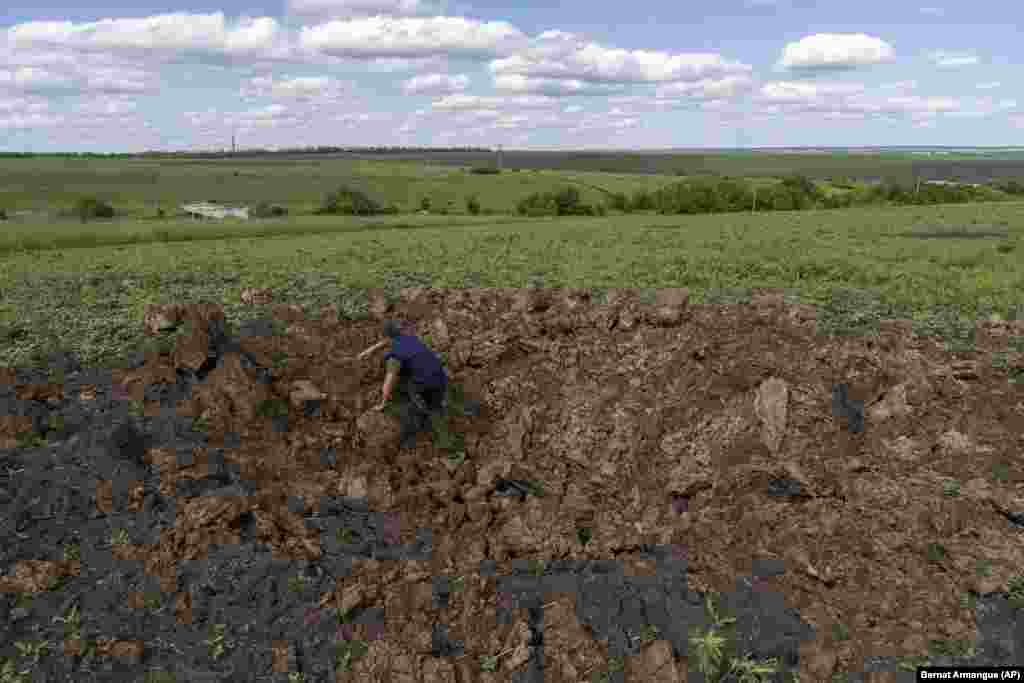
6/9A farm worker climbs out of a crater caused by shelling in Cherkaska Lozova.
The European Parliamentary Research Service reports that Russia and Ukraine supply more than half of cereal imports in northern Africa and the Middle East, while countries in eastern Africa import 72 percent of their cereals from Russia and 18 percent from Ukraine.
The inability of Ukraine to transport millions of tons of grain and other agricultural products amid Russia's invasion has aggravated a global food crisis. The country is a major exporter of seed oils, corn, and wheat, but the war and Russia's blockade of Ukraine's ports have effectively stopped a significant amount of that flow. While Ukraine's leaders seek ways to export the country's agricultural output, its farmers face perilous conditions as a result of the ongoing conflict.
Show moreShow less
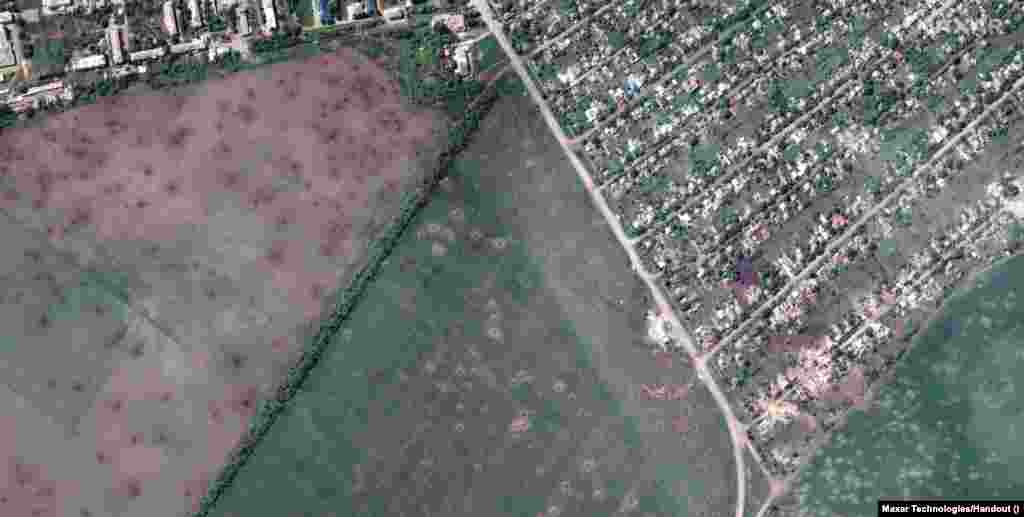
7/9A satellite image of Lyman, Ukraine, shows artillery craters in fields and destroyed buildings in late May.
According to the FAO, 50 countries rely on Russia and Ukraine for at least 30 percent of their wheat imports. In the Middle East and North Africa, these countries include Lebanon, Egypt, Libya, Oman, Saudi Arabia, Yemen, Tunisia, Iran, Jordan, and Morocco.
The inability of Ukraine to transport millions of tons of grain and other agricultural products amid Russia's invasion has aggravated a global food crisis. The country is a major exporter of seed oils, corn, and wheat, but the war and Russia's blockade of Ukraine's ports have effectively stopped a significant amount of that flow. While Ukraine's leaders seek ways to export the country's agricultural output, its farmers face perilous conditions as a result of the ongoing conflict.
Show moreShow less
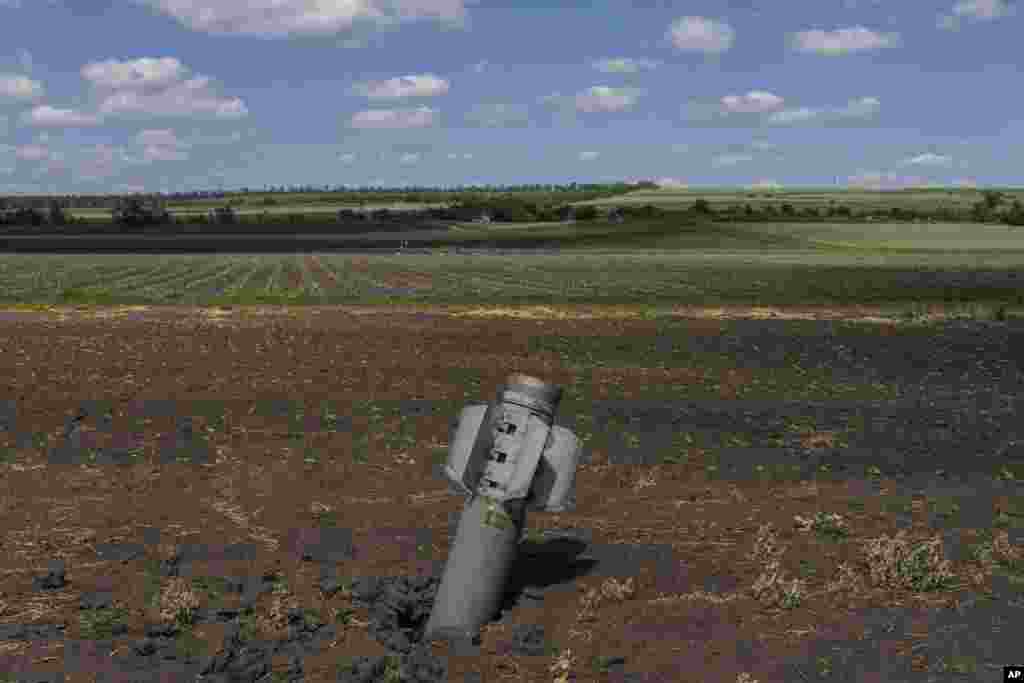
8/9A Russian projectile lies in a field near Soledar in eastern Ukraine on June 6.
On April 29, Ukraine's Agriculture Ministry reported that nearly 30 percent of the country's farmland is now occupied, unsafe, or unable to be farmed. Bread prices have increased in some of the world's poorest and most vulnerable countries as a result of Russia's invasion.
The inability of Ukraine to transport millions of tons of grain and other agricultural products amid Russia's invasion has aggravated a global food crisis. The country is a major exporter of seed oils, corn, and wheat, but the war and Russia's blockade of Ukraine's ports have effectively stopped a significant amount of that flow. While Ukraine's leaders seek ways to export the country's agricultural output, its farmers face perilous conditions as a result of the ongoing conflict.
Show moreShow less
9/9Farmers remove an unexploded shell from their fields near the village of Hryhorivka, Zaporizhzhya, eastern Ukraine, in early May.
World Food Program Executive Director David Beasley has warned: "When a nation that is the breadbasket of the world becomes a nation with the longest bread line of the world, we know we have a problem." He adds that the failure to open Ukraine's port in Odesa is a declaration of war on global food security, resulting in famines, destabilization, and mass migration around the world.
Russia has said it will lift the blockade if Western sanctions are lifted, a demand Ukrainian Foreign Minister Dmytro Kuleba has characterized as an attempt at "blackmail."
The inability of Ukraine to transport millions of tons of grain and other agricultural products amid Russia's invasion has aggravated a global food crisis. The country is a major exporter of seed oils, corn, and wheat, but the war and Russia's blockade of Ukraine's ports have effectively stopped a significant amount of that flow. While Ukraine's leaders seek ways to export the country's agricultural output, its farmers face perilous conditions as a result of the ongoing conflict.
Show moreShow less
Previous slide
Next slide
The United Nations on October 28 had urged parties to the Black Sea Grain Initiative to renew it.
"We underline the urgency of doing so to contribute to food security across the world, and to cushion the suffering that this global cost-of-living crisis is inflicting on billions of people," UN spokesman Stephane Dujarric said in a statement.
The agreement freed up exports from three of Ukraine's ports -- Odesa, Chornomorsk, and Yuzhne -- which had been blockaded since Russia launched its invasion of Ukraine in February.
The deal set up a corridor that is exclusively humanitarian, the Ukrainian Ministry of Infrastructure said.
The ministry says that since the first ship left the port in Odesa on August 1, Ukraine has exported more than 9 million tons of food, of which more than 5 million tons went to countries in Africa and Asia.
At the same time, 190,000 tons of wheat were sent to countries on the brink of famine within the framework of the UN World Food Program, the ministry said.
"Ukraine remains a reliable partner for the civilized world and is ready to continue promptly collecting and shipping agricultural products to ensure global food security," the ministry added.
RFE/RL's Ukrainian Service has seen its audience grow significantly since Russia's full-scale invasion in February 2022 and is among the most cited media outlets in the country. Its bold, in-depth reporting from the front lines has won many accolades and awards. Its comprehensive coverage also includes award-winning reporting by the Donbas.Realities and Crimea.Realities projects and the Schemes investigative unit.